KCCI Releases "New Year Retail Market Consumer Trends" Report
Emphasizing Circulation, Omni-hub, New Market, and Customer Value
On January 21, the Korea Chamber of Commerce and Industry (KCCI) released its report titled "2026 Retail Market Consumer Trends," presenting "connection" as this year's key concept for the retail sector. The report forecasts that the competitiveness of retailers will depend on how precisely they connect customers and stores, as well as artificial intelligence (AI) and experiences.
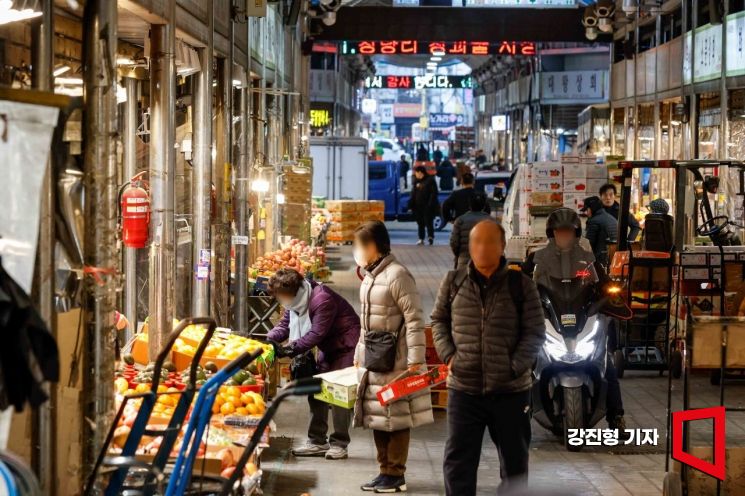 Customers visiting Cheongnyangni Fruit and Vegetable Market in Dongdaemun-gu, Seoul, are looking at fruits. Photo by Kang Jin-hyung
In the report, the KCCI stated, "In an era of rapidly changing consumer trends and limitless competition where industry boundaries are disappearing, retail has moved beyond simply scaling up for growth." The report summarized retail trends using the keyword "C.O.N.N.E.C.T." Seo Yonggu, a professor at Sookmyung Women’s University who participated in selecting the keywords, analyzed, "Retail has evolved past just selling products; it is now a 'competition of connection' that organically links dispersed technologies and spaces to deliver new value."
Each letter stands for: Circulation, Omni-hub, New market, New value, Experience, Customer value, and Technology.
"Circulation (C)" reflects the concept of a sustainable consumption flow. The KCCI pointed out, "The competitiveness of retail is shifting from the ability to sell more to being environmentally friendly, such as enabling longer use of products." "Omni-hub (O)" refers to the redefinition of offline stores. Large supermarkets are building small logistics centers inside their stores, and convenience stores and neighborhood supermarkets are partnering with delivery platforms to transform into urban delivery hubs. "New market (N)" emphasizes global expansion based on K-culture. The KCCI evaluated, "Korea is now exporting not only products but also its unique shopping platforms and culture."
"New value (N)" reflects the increasingly polarized nature of consumer preferences. The analysis suggests that retailers must respond precisely to consumers who seek ultra-low prices for daily necessities but are willing to spend boldly on hobbies and experiences. "Experience (E)" is linked to the changing role of offline stores. The KCCI explained, "Offline stores are now places that sell time, not just products," and "the length of time customers spend in stores is now a key measure of retail competitiveness."
Regarding "Customer value (C)," the importance of securing loyal customers was emphasized. The KCCI stated, "Relationship management, which involves managing the lifetime value of each customer, is a core strategy." Finally, in terms of "Technology (T)," the role of AI was highlighted. Global companies such as Amazon are running highly sophisticated personalization engines, with over 30% of their total sales generated through AI recommendations. Naver has also introduced a system that suggests products perfectly tailored to individual preferences without requiring a search.
Lee Heewon, Director of the KCCI Distribution and Logistics Promotion Center, emphasized, "Successful cases at home and abroad show that the future of retail is already shifting toward a connected model," adding, "How quickly and realistically companies implement the 'CONNECT strategy' will determine the survival of the future retail industry."
© The Asia Business Daily(www.asiae.co.kr). All rights reserved.

















