200 Autonomous Vehicles to Be Deployed Citywide in the Second Half of the Year
Utilizing the National AI Data Center for Simultaneous Training, Validation, and Operation
First Nationwide Case of a Citywide Pilot Zone and Mega-Sandbox for Autonomous Vehicles
The entire city of Gwangju will be transformed into a testing ground for autonomous vehicles. With Gwangju designated as South Korea's first "Autonomous Driving Demonstration City," 200 autonomous vehicles will be gradually deployed across the city starting in the second half of this year.
The Gwangju Metropolitan Government announced that, according to the "Autonomous Driving Demonstration City Promotion Plan" released by the Ministry of Land, Infrastructure and Transport on January 21, Gwangju has been designated as the nation's first autonomous driving demonstration city and will conduct large-scale autonomous vehicle demonstrations throughout the city.
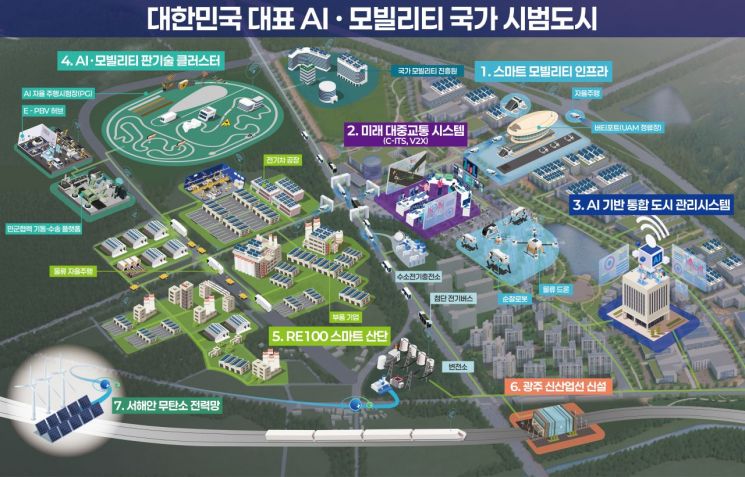
An autonomous driving demonstration city is a project in which the entire city is designated both as a pilot operation zone for autonomous vehicles and as a mega-sandbox. With a government budget of 61 billion won, 200 autonomous vehicles will be gradually deployed starting in the second half of this year.
The demonstration routes will cover the entire city of Gwangju. Initially, operations will begin in suburban areas with relatively low traffic volumes and will gradually expand into the city center. Once safety is ensured, free rides will also be offered so that citizens can experience them firsthand.
Once the entire city of Gwangju is designated as a pilot operation zone in April, demonstrations will begin in parts of Gwangsan-gu, Buk-gu, and Seo-gu. Next year, the scope will expand to include Seo-gu, Nam-gu, and Dong-gu, as well as major hubs such as Chosun University Hospital, broadening the demonstration to a city-wide scale.
While there have been previous cases where fewer than 10 autonomous vehicles were operated along specific routes by some local governments, this is the first time that 200 autonomous vehicles will be operated across an entire city and the whole city will be designated as a mega-sandbox.
The core of this project is the establishment of a "data pipeline." Two hundred software-defined vehicles (SDVs), optimized for autonomous driving, will collect driving data while operating on real roads. This data will then be processed and trained using the high-performance GPU resources of the Gwangju National AI Data Center. Various driving scenarios will also be validated in virtual environments in parallel.
The Gwangju Metropolitan Government expects that, through the autonomous driving demonstration city, companies developing autonomous driving technologies, components, and services, as well as early-stage startups, will cluster in Gwangju, forming an ecosystem for the autonomous vehicle industry.
The demonstration city will be operated around the following pillars: a city-scale regulatory-free testing environment, provision of vehicles dedicated to technology development, securing large-scale AI training data, support for control and insurance, and fostering collaboration and cooperation.
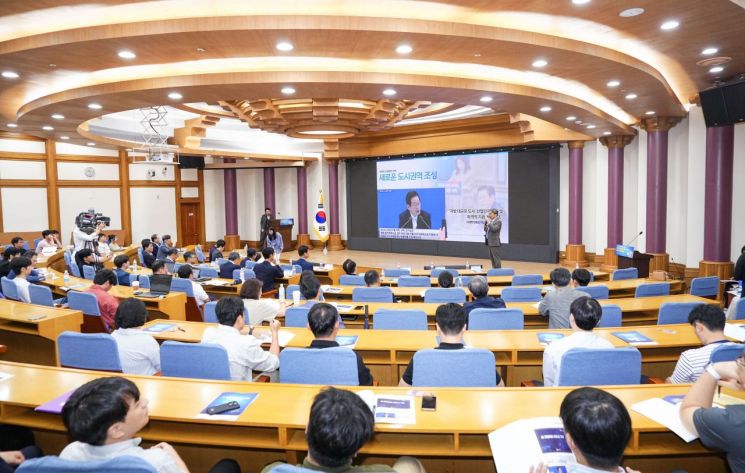 Kang Gijeong, Mayor of Gwangju Metropolitan City, attended the "AI Mobility New Town Concept National Assembly Policy Forum" held on the morning of September 17 last year at the First Conference Room of the National Assembly Members' Office Building in Yeouido, Seoul, and gave a presentation on the topic of "Creating a Future Mobility Specialized City in Gwangju." Provided by Gwangju City
Around March, Gwangju plans to establish a collaborative council involving the five district offices, taxi industry, businesses, universities, research institutes, and the local police agency. A "K-Autonomous Driving Cooperation Model" will also be established, with participation from automakers, autonomous driving companies, platform companies, and insurance firms.
This project is linked to the AI Mobility National Pilot City and the Physical AI-Based Future Vehicle Industry Innovation Cluster initiatives. The goal is to build an ecosystem for the future vehicle industry that encompasses development, demonstration, production, and certification.
Kang Gijeong, Mayor of Gwangju, stated, "The autonomous vehicle industry is a key sector that will drive future growth for both Gwangju and South Korea. The selection of Gwangju as the first city-scale demonstration city reflects the government's commitment to fostering the city as a future AI mobility industry hub." He added, "We will ensure that autonomous driving technology becomes part of citizens' daily lives and make 2026 the inaugural year of a 'prosperous Gwangju' leap forward."
© The Asia Business Daily(www.asiae.co.kr). All rights reserved.
![Clutching a Stolen Dior Bag, Saying "I Hate Being Poor but Real"... The Grotesque Con of a "Human Knockoff" [Slate]](https://cwcontent.asiae.co.kr/asiaresize/183/2026021902243444107_1771435474.jpg)

















