Inscriptions Invisible to the Naked Eye Revealed Through Digital Technology
79 Out of 300 Graffiti Newly Identified on the Wall
Seventy-nine new examples of graffiti and sketches, left behind just before the eruption of Mount Vesuvius, have been newly identified in the ancient southern Italian city of Pompeii.
On January 20, Yonhap News, citing foreign news outlets such as Reuters and an announcement from the Pompeii Archaeological Park, reported that additional inscriptions reflecting the daily lives and emotions of ancient Roman citizens have been discovered.
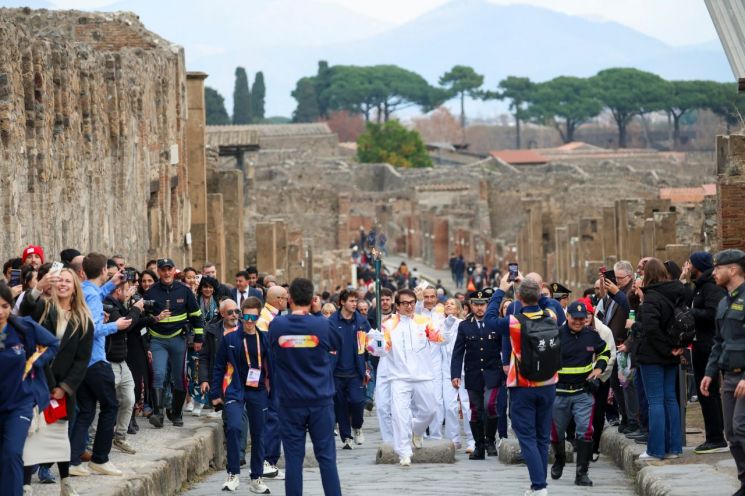 Actor Jackie Chan participating in the Olympic torch relay passing through the Pompeii Archaeological Park in Italy on December 22 last year. Photo by AP Yonhap News
Pompeii flourished as a center of commerce and culture during the Roman Empire, but in 79 AD, a massive eruption of Mount Vesuvius buried the entire city under several meters of volcanic ash, bringing life to an abrupt halt. As a result, the city's streets, houses, murals, and inscriptions have been preserved in a remarkably intact state, earning Pompeii the nickname "the city where time stood still."
The newly identified graffiti and sketches were found on a long corridor wall that connects the district where city theaters were concentrated to the lively main street known as Stabia Street. Although this wall has been frequented by countless visitors for over 230 years since its initial excavation in the late 18th century, many of the traces left on its surface were difficult to discern with the naked eye and had not been properly interpreted.
The research team focused on the concentration of ancient graffiti on this wall and employed advanced digital technology. By dividing the wall into a virtual grid to precisely record the locations of the markings, and applying Reflectance Transformation Imaging (RTI)-a technique that photographs the surface under light from multiple directions-they were able to restore fine scratches and engravings. As a result, 79 previously unreleased examples of graffiti were identified.
The newly revealed inscriptions include a sketch depicting two gladiators facing off, as well as love confessions such as "Erato loves..." with the object omitted. The researchers explained that such graffiti vividly illustrates the emotions, preferences, and entertainment culture of ordinary citizens that do not appear in official records.
This research project, titled "Whispers of the Corridor," was a joint effort by scholars from Sorbonne University in France, Universit? du Qu?bec in Canada, and the Pompeii authorities. Gabriel Zuchtriegel, director of the Pompeii Archaeological Park, stated, "This technology is the key to opening new rooms of the ancient world," adding, "The more than 10,000 inscriptions remaining in Pompeii will continue to be important assets for research."
According to the authorities, a total of 300 pieces of graffiti and inscriptions were identified through this project, of which 79 are newly discovered. The research team plans to expand the use of this digital analysis method to other areas in the future, with the goal of systematically restoring the "silent records" remaining in Pompeii.
© The Asia Business Daily(www.asiae.co.kr). All rights reserved.

















