"Meeting the Sun" Exhibition
Featuring 19 Works Including Paintings and Tapestries
At White Cube Seoul Until March 7
One artist left her homeland during the Korean War, while the other departed amidst civil war and exile. Although Lee Seongja, who was active in Paris, and Etel Adnan, who also worked in France, lived through different times and backgrounds, they are alike in that they contemplated the universe through the language of abstraction. The two-person exhibition "Meeting the Sun," which places the works of these two female artists side by side, invites viewers to compare and interpret two worlds along these intersecting points.
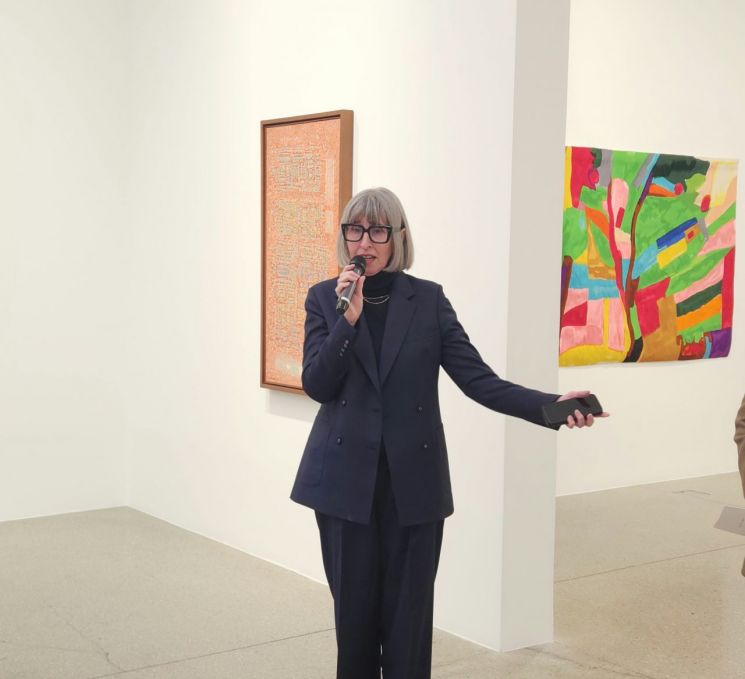 Susan May, Global Art Director of White Cube, is giving a greeting at the press conference for the two-person exhibition "Meeting the Sun" by artists Etel Adnan and Lee Seongja, held on the 20th at White Cube in Gangnam-gu, Seoul. Photo by Seo Mideum
Lee Seongja was born in Korea in 1918 and moved to France in 1951, at the height of the Korean War. Her emigration, chosen in the midst of a life upended by war, was both an act of survival and a new beginning. In Paris, she enrolled at the Acad?mie de la Grande Chaumi?re and was introduced to Western modernist art in earnest. She expanded her artistic world by interacting with artists active in the Parisian art scene at the time. In a male-dominated abstract art world, Lee established her own unique visual language by combining Eastern philosophy and cosmic order within her paintings, and she was active on the international stage.
Etel Adnan was born in Beirut, Lebanon, in 1925. Born to a Greek mother and a Syrian father, she grew up in an environment where multiple languages and cultures coexisted. After studying philosophy at the Sorbonne in Paris, she moved to the United States to teach philosophy at a university, and engaged in activities spanning poetry, fiction, and journalism. In 1977, she published the novel "Sitt Marie Rose," which dealt with the Lebanese Civil War and brought her international attention. However, due to this work, she could no longer return to her homeland and went into exile in France. Since then, she continued to explore themes of politics, violence, nature, and the universe through both writing and painting.
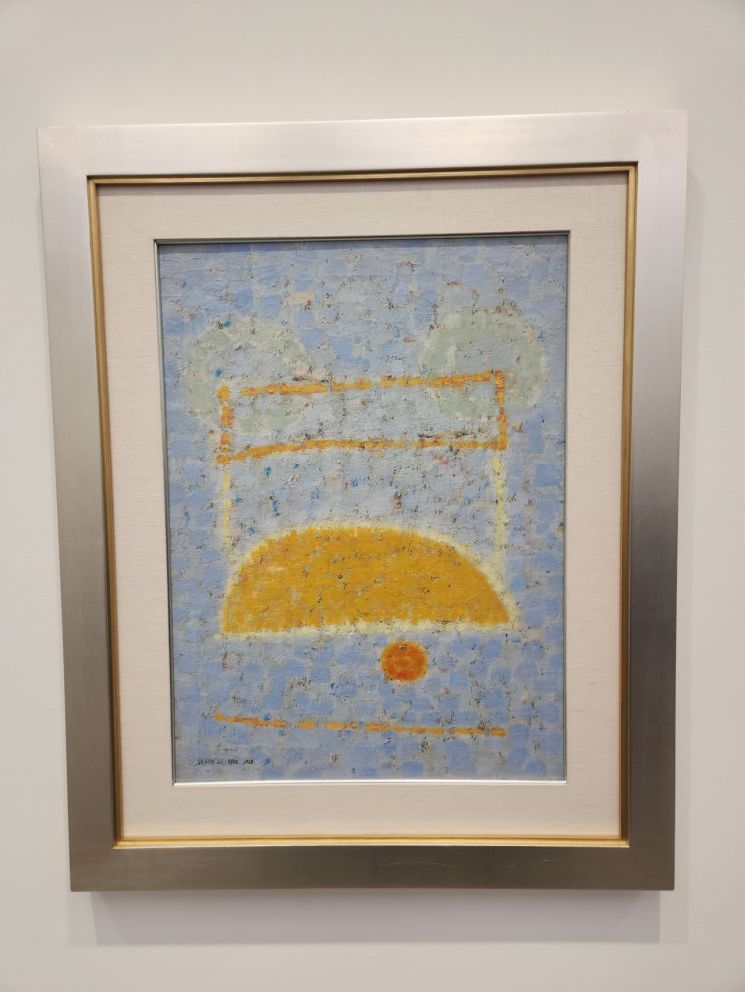
The lives of these two artists are connected by the shared experience of "departure." However, this departure was not merely a physical relocation; it became an opportunity to reconstruct their identities and worldviews. After their migrations, the universe became for both artists a space for contemplation that replaced their homelands, as well as a site of imagination that transcended boundaries.
Lee Seongja's abstraction is structural and condensed. The lines, squares, and circles arranged on her canvases hint at the human body and landscapes, yet bind the entire surface together in a single order. The color fields, built up through repetitive brushwork, create a density reminiscent of weaving, and the canvas is maintained in a state of tension and balance. Her paintings reveal a cosmic order that emphasizes contemplation and composition over the immediate expression of emotion.
In contrast, Adnan's paintings begin with color and light. The intense color fields laid over simple geometric forms evoke the sun, energy, and the primal forces of nature. In her 2018 work "Untitled," the color that begins with a red square gradually expands into a variety of hues, conjuring images of the universe expanding after the Big Bang. Especially in her tapestry works, circular and irregular color fragments reminiscent of the sun and moon are arranged to create a sense of expanded space in a way distinct from her paintings.
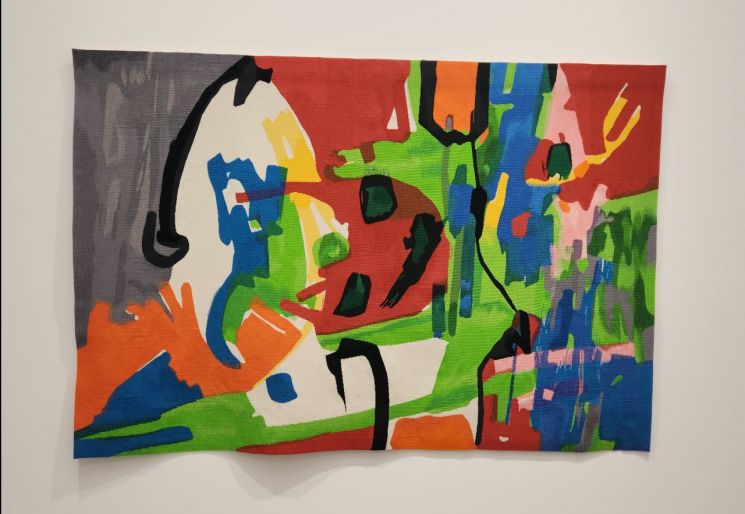
The works of the two artists also differ in terms of their periods of production. The pieces by Lee Seongja featured in this exhibition are mainly from the 1960s, whereas Adnan's works were created after the 2010s. However, this temporal gap actually becomes a point of connection between the two. The imagination of the 1960s, when humanity began to see Earth as a single planet with the advent of space exploration, permeates Lee's orderly compositions, while the perspectives that emerged after the expansion of science and cosmology are reflected in Adnan's color field paintings and tapestries.
"Meeting the Sun" places side by side two abstract worlds shaped by the experiences of migration, exile, and being women artists, demonstrating that abstraction can be more than a formal experiment-it can serve as a language for contemplating the era and existence itself. The exhibition runs at White Cube Seoul until March 7.
© The Asia Business Daily(www.asiae.co.kr). All rights reserved.



















