Yoon Hyunjun, CEO of JobKorea: "In the AI Era, Open Recruitment and Job Postings Will Disappear"
AI Is Currently Used as a Tool to Improve Efficiency in Recruitment
AI Identifies Gaps in Companies and Proactively Recommends Needed Talent
"Resumes will disappear."
Yoon Hyunjun, CEO of JobKorea, made this prediction about the future of recruitment as shaped by artificial intelligence (AI) technology. CEO Yoon stated, "We are living in an era where digital technology and AI are intertwined," and predicted, "We are now entering a fully-fledged AI era." He added, "I believe the overall HR (human resources) process could be completely transformed," and anticipated, "The first thing to disappear will be the resume." He also remarked, "The concept of open recruitment and securing applicants through job postings will largely diminish and eventually vanish."
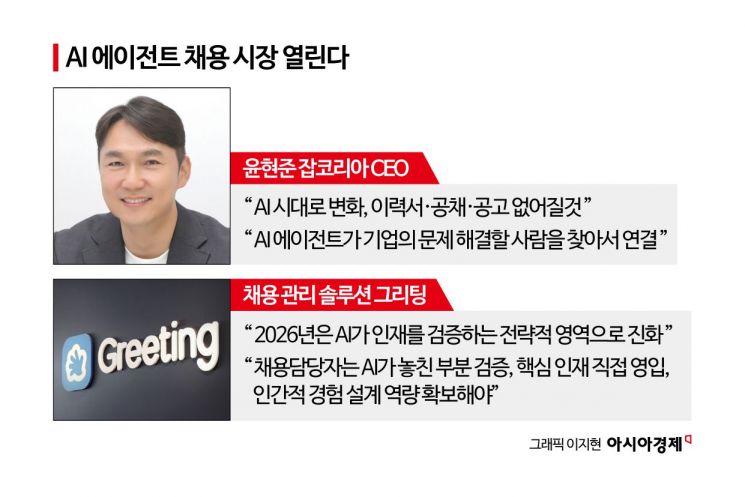
CEO Yoon explained that, rather than companies posting job openings to find applicants as they do now, companies will instead share the problems they are facing or their future direction, and AI agents will identify and connect them with people who can solve those problems or help shape that direction. In fact, as large corporations increasingly reduce new hires and prefer ongoing recruitment of experienced professionals, the likelihood of this prediction becoming reality is growing.
Recruiters Also Use AI... Evolution in Talent Verification
HR managers at companies are introducing AI technology into recruitment work to reduce time and costs and increase productivity. The recruitment management solution "Greeting" recently reported in its "AI Recruitment Strategy Report," based on a survey of 200 recruiters, that the average recruitment lead time was shortened by 30% after adopting AI.
The report stated, "Last year, recruiters actively used AI for tasks such as drafting job postings and communicating with applicants, experiencing increased efficiency and reduced work hours," and predicted, "This year, AI will go beyond its current supporting role to evolve into a strategic area that understands context and verifies talent."

Greeting also projected, in line with JobKorea's predictions, that AI agents will be used at every stage of recruitment, and that data-driven talent prediction will ultimately increase recruitment success rates. Greeting is currently used by over 7,000 large and small companies in Korea, including LG Display, Kia, KB Securities, and Socar.
AI Recruitment Bias Issues Persist... "Human Intervention Is Essential"
While AI can make recruitment faster and more efficient, it can also introduce bias, making human intervention necessary. This is because AI can inherit human biases present in historical data. Overseas, AI recruitment tools have caused issues such as filtering candidates based on gender, race, age, accent, or disability. In particular, since recruitment involves decisions that affect individuals' rights and obligations, it is included in the scope of "high-impact AI" under the world's first AI Basic Act, which will take effect on January 22.
Greeting suggested that, to prevent such side effects, recruiters should secure three core competencies: verifying areas AI may overlook, directly recruiting key talent, and designing human-centric experiences. Kim Deokjoong, adjunct professor at Sookmyung Women's University and director of the Pub AI Research Institute, advised, "In areas requiring high-risk work or ethical judgment, human intervention must be institutionalized as an essential, not just a supplementary, measure." He added, "If organizations blindly accept AI decisions without clear accountability, they may gain speed in execution but risk losing a trust-based collaborative culture."
© The Asia Business Daily(www.asiae.co.kr). All rights reserved.


















