Global Rights Secured for Liver Cancer CAR-T Therapy 'C-CAR031'
Up to 75% Response Rate Achieved in Phase 1 Clinical Trials
Multinational pharmaceutical company AstraZeneca (AZ) has strengthened the potential of CAR-T (Chimeric Antigen Receptor T-cell) therapies targeting solid tumors by acquiring the rights to a candidate CAR-T therapy for liver cancer in China. Previously, while CAR-T therapies had demonstrated innovative treatment effects for blood cancers, the prevailing view was that they were unlikely to succeed in treating solid tumors. However, with recent clinical trials yielding meaningful results, analysts say the company has embarked on a strategic move based on growing confidence in the technology.
According to the domestic and international pharmaceutical and biotech industries on January 20, AZ secured the rights for 'C-CAR031,' a candidate CAR-T therapy for liver cancer jointly developed with its Chinese partner, biotech company Abecell Therapeutics, for up to $630 million (approximately 930.6 billion won) in China. AZ already held the rights for countries outside China, and with this agreement, the company has now secured global rights to C-CAR031.
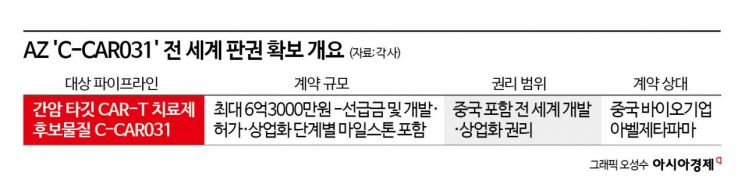
Although CAR-T therapies have attracted attention as a solution for intractable cancers, skepticism has grown as CAR-T therapies developed and invested in by major pharmaceutical companies have failed to show clear results in clinical trials for solid tumors. AZ also discontinued the development of its own solid tumor-targeting CAR-T candidate 'AZD5851' in August last year during Phase 1 clinical trials.
In a situation where industry expectations had cooled, AZ's renewed push to secure rights to solid tumor-targeting CAR-T therapies is interpreted as a sign of increased confidence in the technology, following positive clinical trial results. According to research presented by a team from Zhejiang University Hospital at the 2024 American Society of Clinical Oncology (ASCO), C-CAR031 achieved an objective response rate (ORR) of 56.5% in clinical trials for liver cancer patients, and an ORR of 75.0% in the highest dose group with sufficient drug administration. This means that 5 to 7 out of 10 patients experienced a reduction in tumor size. The response rate for Kymriah, the first CAR-T therapy approved by the U.S. Food and Drug Administration (FDA) for lymphoma, a type of blood cancer, is 52.0%. Achieving a similar response rate in solid tumors as in blood cancers is considered an encouraging result.
Some experts believe that AZ's acquisition of these rights is more focused on the potential of the underlying platform technology than on the individual candidate C-CAR031 itself. Conventional CAR-T therapies have limitations, as immune cells are weakened by inhibitory signals released by cancer cells when entering solid tumors. C-CAR031 features an additional mechanism on top of the existing CAR-T structure that allows immune cells to resist exhaustion even in the tumor microenvironment. The so-called 'armored' technology blocks inhibitory signals from cancer cells, enabling T-cells to maintain their attack capabilities within tumors. Analysts suggest that AZ sees the possibility of applying this technology broadly to solid tumor cell therapies.
Korean biotech companies are also actively developing CAR-T therapies targeting solid tumors. Curecell, which developed Rimcato (ingredient: Anvalcel), the first domestically produced CAR-T therapy, is working on solid tumor-targeting CAR-T therapies using its 'Hyperkine' technology that dramatically increases immune cell counts. Verismo Therapeutics, a subsidiary of HLB Innovation, is conducting Phase 1 clinical trials for its CAR-T candidate 'SynKIR-110.' According to the market research firm Global Information (GII), the global solid tumor therapy market is projected to grow from $207 billion (approximately 306 trillion won) in 2025 to $307 billion (approximately 454 trillion won) by 2030.
© The Asia Business Daily(www.asiae.co.kr). All rights reserved.

















