Up to 35% Drop Thanks to Stabilized Oil Prices and Exchange Rates
Travel Demand Expected to Recover Ahead of Summer Peak Season
The fuel surcharge, which has a significant impact on international airfare prices, will be reduced for the first time in half a year. With the decline in international oil prices and the stabilization of exchange rates, the actual cost of airline tickets is expected to drop further.
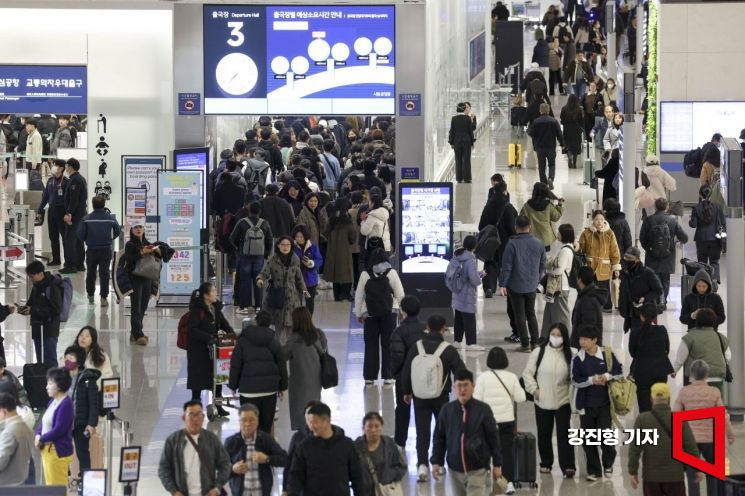 On December 31, ahead of the New Year's bridge holiday, Incheon International Airport Terminal 1 is bustling with travelers. Photo by The Asia Business Daily
According to the airline industry on January 19, Korean Air will adjust its international fuel surcharge next month from the previous range of 15,000 won to 115,500 won to a new range of 10,500 won to 76,500 won. The reduction rate by route ranges from a minimum of 24.2% to a maximum of 34.9%. Asiana Airlines will also lower the fuel surcharge for all international routes next month by approximately 26.4% to 35.6%.
This adjustment brings a halt, for now, to the upward trend in international fuel surcharges that had continued since last summer. For Korean Air, the fuel surcharge for short-haul routes increased from 7,000 won in July last year to 15,000 won last month, while the longest North American routes more than doubled from 57,400 won to 115,500 won during the same period, significantly raising the perceived price of tickets.

This reduction is attributed to the combined effect of falling international oil prices and stabilized exchange rates during the fuel surcharge calculation period. International fuel surcharges are imposed in stages based on the price of Singapore jet fuel (MOPS), and the average price for next month is 194.68 cents per gallon, an 11.4% decrease from the previous month (216.85 cents). Accordingly, the applicable stage has been lowered from stage 7 to stage 5.
The reduction in fuel surcharges is expected to ease the financial burden of overseas travel for consumers. Since the fuel surcharge accounts for around 20% of the airfare, a larger reduction has a greater impact on the actual cost. In particular, for long-haul routes, the difference in round-trip costs can amount to several hundred thousand won. As the burden of airfare is alleviated ahead of the summer peak season, consumers are likely to have more travel options.
Meanwhile, according to air traffic statistics from the Ministry of Land, Infrastructure and Transport and the Korea Civil Aviation Association released on January 9, the total number of domestic and international air passengers last year was 124,793,082, a 3.9% increase from the previous year's 120,058,371. This figure is 1.2% higher than the pre-COVID-19 level in 2019, which was 123,360,000 (32,980,000 domestic and 90,380,000 international), indicating that air passenger demand has recovered to pre-pandemic levels.
© The Asia Business Daily(www.asiae.co.kr). All rights reserved.


















