Pixhawk-Based PX4 Drone Achieves Real-World Takeoff and Flight
with NIST Standard PQC Applied
The National Institute for Mathematical Sciences (NIMS) has successfully applied cryptographic technology that is secure even against quantum computer attacks to the actual flight control communications of drones. This marks the first time in Korea that control commands exchanged while a drone is flying have been protected using the National Institute of Standards and Technology (NIST) standard post-quantum cryptography (PQC), while also achieving real-world takeoff and flight.
On January 20, the NIMS Cryptography Research Team announced that it had demonstrated the normal operation of open-source flight control software PX4, after directly applying NIST standard PQC digital signature and key establishment algorithms, along with AES symmetric encryption, to the MAVLink flight control communication layer of a Pixhawk-based drone. A key achievement is that this was accomplished without altering the existing structure of MAVLink and PX4, and that real-time flight control was proven possible in an actual hardware environment.
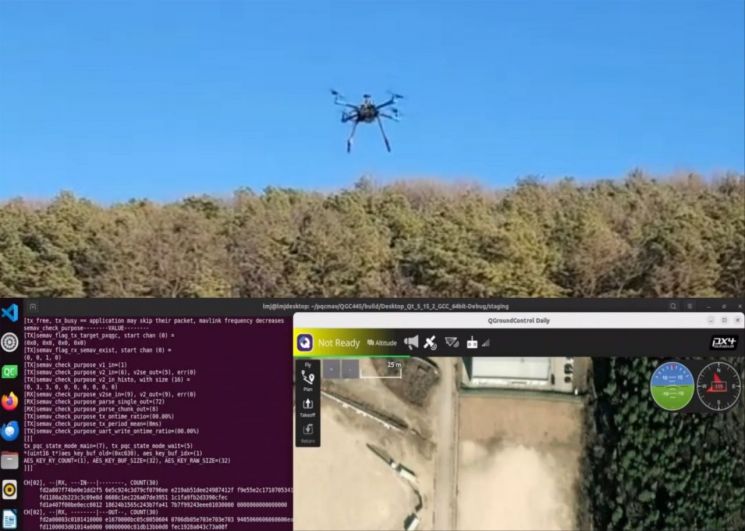 PQC Applied PX4-Based Drone Flight Demonstration Scene (Flight Video, Control Screen, Filming Video). Provided by NIMS
What Is a 'Pixhawk-Based Drone'?
Pixhawk is a flight control computer that serves as the brain of a drone. It receives sensor data such as from gyroscopes, accelerometers, and GPS to calculate the aircraft's attitude, and it controls the motors and control surfaces. As a standard open hardware platform widely used in drone research and industry worldwide, it is combined with open-source flight control software like PX4 and applied to various types of drones. In other words, a 'Pixhawk-based drone' refers to a drone that uses the most commonly adopted control board in both commercial and research settings.
The distinguishing feature of this demonstration is that PQC was applied directly to the MAVLink control and telemetry communications actually used by drones. The drone cryptographically verifies flight commands sent from the ground station and maintains the confidentiality, integrity, and authentication of subsequent communications, thereby ensuring the reliability of the entire flight control loop. Unlike previous PQC applications, which were limited to external cryptographic modules or protecting communication channels, this achievement is recognized for implementing a security architecture compatible with the real-time, resource-constrained environment of drone control.

Lead researcher Shim Kyunga explained, "Rather than simply replacing classical cryptography with PQC, we designed and validated a lightweight PQC architecture tailored to the characteristics of drone environments, where it is difficult to use existing security protocols like TLS. While this is currently a proof-of-concept at the basic flight stage, further optimization will be needed to expand to long-distance flights or multi-drone environments."
Going forward, the research team plans to expand lightweight PQC architecture research to a wide range of constrained environments, including unmanned systems (UxV), Internet of Things (IoT), industrial control systems, and healthcare devices, as well as to pursue step-by-step technology transfer and joint demonstrations with industry partners.
© The Asia Business Daily(www.asiae.co.kr). All rights reserved.


















