Highest Proton Surge Since 1991
Potential Impact on Satellites, GPS, and Aviation
The third most powerful geostationary solar particle event in recorded history has occurred. As a result of a powerful solar sunspot explosion accompanied by a coronal mass ejection (CME) reaching Earth, the highest level of high-energy protons since March 1991 has been observed.
The Korea Aerospace Administration announced that a strong CME that occurred on January 19 reached Earth in the early hours of January 20, prompting the issuance of level 4 solar particle event and geomagnetic disturbance alerts in succession. Accordingly, the space weather disaster crisis alert was raised to the 'Yellow' (Caution) level, and the situation was communicated to relevant agencies.
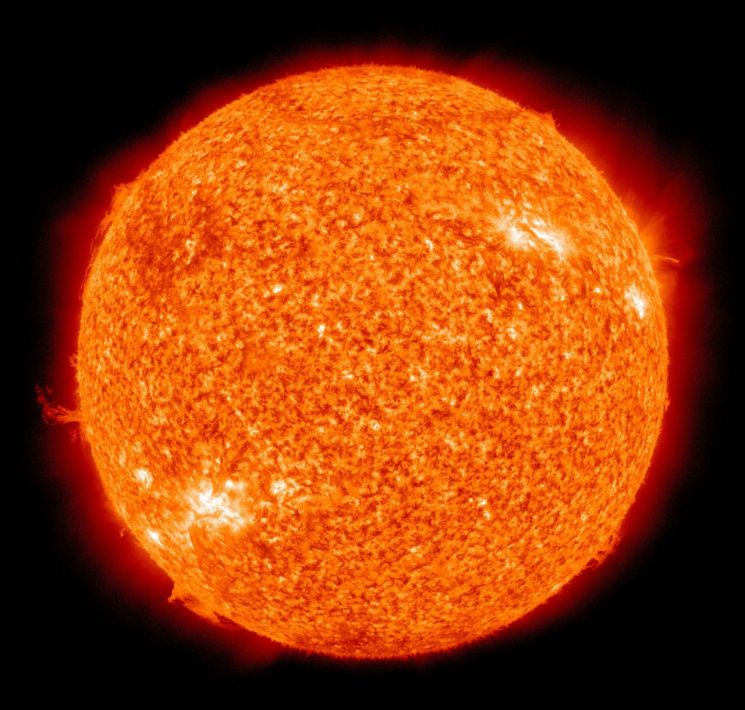
According to the Space Environment Center of the Korea Aerospace Administration, a sunspot explosion that occurred at 2:56 a.m. on January 19 led to the issuance of a level 4 solar particle event alert at 3:17 a.m. on January 20. The observed proton influx reached 37,000 pfu, marking the third highest level ever recorded, following 43,500 pfu in March 1991 and 42,200 pfu in October 1989. Pfu is a unit that indicates the amount of high-energy particles entering a unit area per second.
In response to the level 4 solar particle event alert, the Korea Aerospace Administration issued a 'Blue' (Attention) space weather disaster crisis alert at 4:20 a.m. on January 20. When an additional level 4 geomagnetic disturbance alert was issued, the agency raised the alert to 'Yellow' (Caution) at 5:30 a.m. in accordance with standard procedures. This action was taken due to the occurrence of two or more level 4 or higher space environment events within the past 24 hours.
Currently, the Korea Aerospace Administration is operating a 24-hour space weather disaster response system, centered on the Space Hazard Response Division with the participation of relevant agencies. Preventive measures are being implemented across sectors such as satellites, aviation, telecommunications, and power. There is a possibility of temporary disruptions to radio-based services, including satellite communications, GPS location information, aircraft navigation equipment, and shortwave radio communications as a result of this event. However, the Korea Aerospace Administration reported that no actual damage to major sectors has been reported so far.
Yoon Youngbin, Administrator of the Korea Aerospace Administration, stated, "In space weather disaster situations, satellite communications and location information services may be affected," and advised, "The public should check flight information in advance when using air travel and be aware of possible GPS location errors."
The Korea Aerospace Administration plans to continue strengthening space environment monitoring and cooperating with relevant agencies to minimize damage to the public and industry as a whole, in preparation for the possibility of future space weather disasters caused by solar activity.
© The Asia Business Daily(www.asiae.co.kr). All rights reserved.

















