Public Forum at the National Assembly Highlights Divided Opinions
Key Issues: Three-Tier Prosecution Office Structure, Investigative Judicial Officers
Further Discussions Scheduled at Lawmakers' General Assembly on the 22nd
On January 20, the Democratic Party of Korea held an internal public hearing to gather expert opinions regarding prosecution reform. The party plans to hold a general assembly of lawmakers on January 22 to further collect opinions on the Prosecution Office Act and the Serious Crimes Investigation Office Act, among others.
The Democratic Party held the public hearing on prosecution reform at the National Assembly, concurrently with a policy assembly of lawmakers. In his opening remarks, Democratic Party leader Jung Cheongrae stated, "The establishment of the Prosecution Office and the Serious Crimes Investigation Office must be discussed and implemented as part of the broader progress of democracy. Under the fundamental principle of separating investigation and indictment, the Democratic Party must advance prosecution reform that meets public expectations, together with the people, with history, and in line with the spirit of the times."
During the forum, a general overview of the Prosecution Office Act and the Serious Crimes Investigation Office Act, which have been pre-announced for legislation by the government's Prosecution Reform Task Force, was provided. This was followed by a debate between supporters and opponents of the government’s proposals.
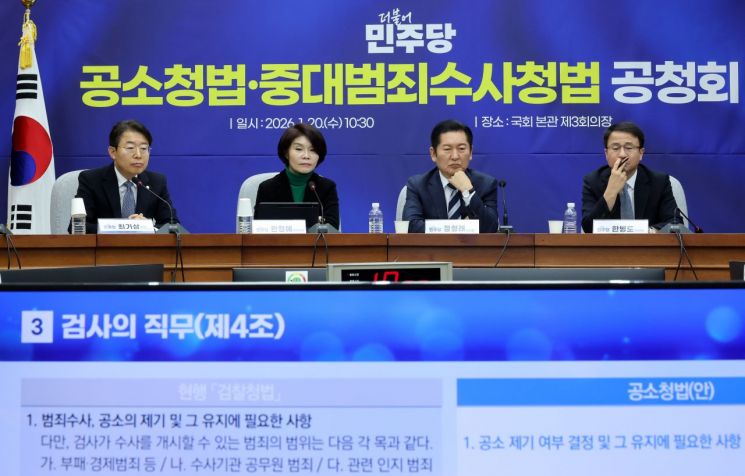
Did the Government’s Prosecution Reform Plan Adhere to the Principle of Separating Investigation and Indictment?
Panelists on both sides held sharply differing views on whether the government’s proposed reforms, which have been pre-announced for legislation, align with the principle of separating investigation and indictment.
Choi Hojin, a professor at Dankook University, noted regarding the reform proposal, "The scope of prosecutors’ duties under the Prosecution Office Act no longer includes criminal investigation," adding, "The most notable feature is that prosecutors at the Prosecution Office cannot initiate investigations."
In contrast, Hwang Moonkyu, a professor at Joongbu University, pointed out, "Separation can only be achieved if the Criminal Procedure Act is also amended," expressing concern about whether the Democratic Party will be able to amend the Criminal Procedure Act. He argued that, since the Criminal Procedure Act is a procedural law, there remains a basis for investigation authority under the Prosecution Office Act.
Consensus on Issues with the Dual Structure of Investigative Judicial Officers and Specialized Investigators
There was also debate over the plan to have both investigative judicial officers and specialized investigators within the Serious Crimes Investigation Office. This measure was designed as an incentive for current prosecutors to transfer to the new office, but concerns were raised that it could lead to a resurgence of prosecutorial command over investigations.
Professor Choi argued, "It is a practical measure to secure legal expertise and on-site investigative know-how," adding, "It allows for an equal and cooperative relationship rather than a hierarchical one." He explained that, depending on the case, a specialized investigator could serve as team leader, making the structure complementary.
On the other hand, Professor Hwang cautioned, "The incentive of appointing investigative judicial officers, essentially prosecutors, could undermine the fundamental premise of prosecution reform," and questioned, "Would investigations be impossible if the titles were the same?" However, even among those supporting the government’s proposal, there was consensus that the term "investigative judicial officer" in the plan should be reconsidered.
Three-Tier Structure for the Prosecution Office: Necessary or Unnecessary?
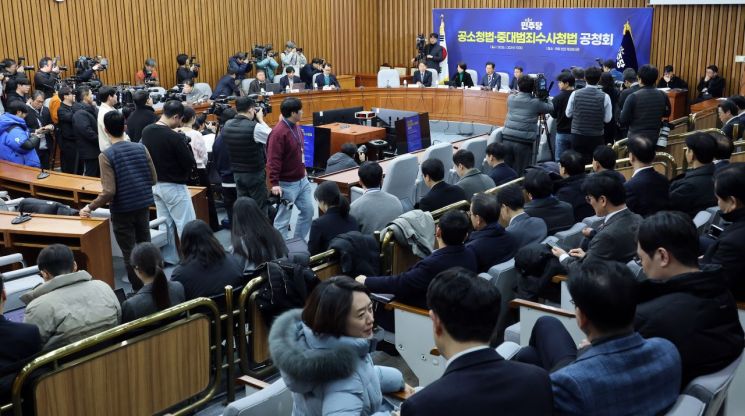
There was also debate over whether the Prosecution Office Act should establish a three-tier structure-comprising the National Prosecution Office, High Prosecution Offices, and Local Prosecution Offices-similar to the current prosecution system. Professor Choi argued, "To maintain the functions of appeals and re-appeals, a dedicated body is necessary," adding, "High Prosecutors’ Offices have handled state litigation, and without them, there would be no agency to take over these responsibilities, making replacement difficult." In contrast, Professor Hwang noted, "There have been claims that High Prosecutors’ Offices have little actual work even under the current system," and argued, "It would be more appropriate for Local Prosecution Offices to handle appeals."
Other opinions were also exchanged regarding checks and balances on the roles of police and prosecutors.
Attorney Shin Inkyu pointed out issues with non-indictment decisions by prosecutors, stating, "There is a need for oversight mechanisms such as a Citizens’ Indictment Committee to control non-indictment decisions, and to increase impeachment for fabricated indictments." Attorney Kim Pilseong suggested, "A National Investigation Committee or similar third-party body should be established to oversee the appropriateness of investigations and review their outcomes."
Democratic Party to Hold Another General Assembly on January 22 to Discuss Prosecution Reform
Meanwhile, the Democratic Party decided to hold another general assembly of lawmakers on January 22 for further in-depth discussion. Democratic Party spokesperson Baek Seunga told reporters after a party strategy meeting, "Today’s public hearing was held in the format of an expert panel discussion," adding, "Since it is difficult to gather all lawmakers’ opinions today, we plan to convene another general assembly on the 22nd." She continued, "We aim to find answers that reflect the diverse views of lawmakers," and clarified, "(The January 22 assembly) will not be for formal approval, but rather to continue deliberations."
The party also decided not to be constrained by the government’s legislative pre-announcement deadline of January 26. Democratic Party spokesperson Moon Geumjoo stated, "Party leader Jung has made it clear that there will be ample deliberation without being bound by the pre-announcement deadline, and we will develop a comprehensive proposal through the collection of opinions."
© The Asia Business Daily(www.asiae.co.kr). All rights reserved.


















