On January 20, the People's Bank of China kept the Loan Prime Rate (LPR), which serves as the de facto benchmark interest rate, unchanged for the eighth consecutive month.
The central bank announced that the five-year LPR, which serves as the benchmark for mortgage loans, will remain at 3.5%, and the one-year LPR, which serves as the benchmark for general loans, will remain at 3.0%.
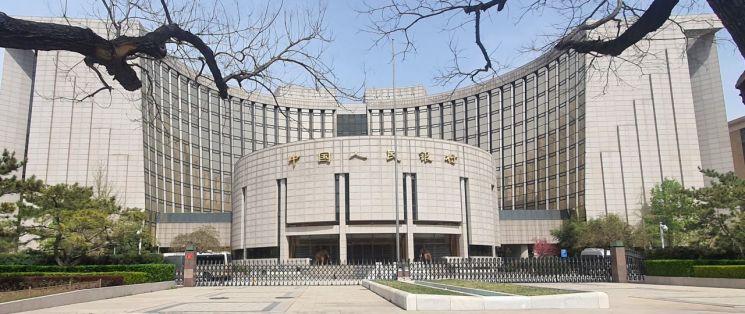
The market had widely anticipated another hold this month. A recent Reuters survey of 22 experts also projected that the rates would remain unchanged.
Last May, amid growing pressure for economic stimulus due to tariff disputes with the Donald Trump administration in the United States, the People's Bank of China cut both the five-year and one-year LPR by 0.1 percentage points each for the first time in seven months. Since then, the rates have been kept steady for eight consecutive months, including this month.
The previous day, the National Bureau of Statistics of China announced that last year's annual gross domestic product (GDP) grew by 5%. However, growth in the fourth quarter was limited to 4.5%.
The International Monetary Fund (IMF) projected in its World Economic Outlook report that China's economic growth rate this year will be 4.5%. According to a Reuters survey of 73 economists, China's economic growth rate is expected to slow to 4.5% next year and remain at this level in 2027.
With investment and consumer sentiment weakening, the market expects Chinese authorities to implement additional monetary easing this year to support economic growth.
Each month, China calculates the LPR by aggregating the interest rates set by 20 major commercial banks, taking into account their own funding costs and risk premiums. Although a separate benchmark interest rate exists, it has not been adjusted by the authorities for a long time, so the LPR effectively functions as the benchmark rate.
© The Asia Business Daily(www.asiae.co.kr). All rights reserved.
![User Who Sold Erroneously Deposited Bitcoins to Repay Debt and Fund Entertainment... What Did the Supreme Court Decide in 2021? [Legal Issue Check]](https://cwcontent.asiae.co.kr/asiaresize/183/2026020910431234020_1770601391.png)















