2023 National Cancer Registration Statistics: 288,600 New Cases
One in Two Cancer Patients Is Aged 65 or Older
Five-Year Survival Rate Rises to 74%
It has been revealed that one out of every 19 people in South Korea is either currently undergoing cancer treatment or has experienced cancer in the past. The five-year survival rate for cancer patients has steadily increased, reaching 74%. Due to the impact of an aging population, prostate cancer has, for the first time, become the most common cancer among men.
On January 20, the Ministry of Health and Welfare and the National Cancer Registry released the "2023 National Cancer Registration Statistics," which contains these findings. This data serves as a key indicator used as a foundational resource for establishing national cancer control policies.
According to the report, the number of newly diagnosed cancer patients in 2023 was 288,613 (151,126 men and 137,487 women), representing a 2.5% increase (7,296 people) compared to the previous year. This figure is 2.8 times higher than the 101,854 cases recorded in 1999, when cancer statistics were first compiled.
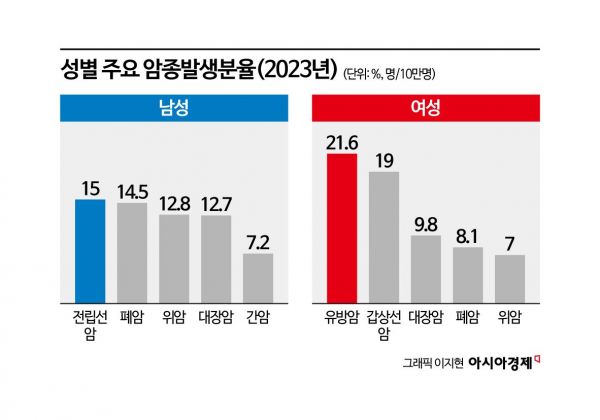
By cancer type, thyroid cancer remained the most common, followed by lung cancer, colorectal cancer, breast cancer, stomach cancer, and prostate cancer.
Notably, among men, prostate cancer surpassed lung cancer to become the most common cancer for the first time since statistics have been recorded. This is related to the aging population structure. Among newly diagnosed cancer patients, those aged 65 and older accounted for 50.4% (145,452 people), surpassing half for the first time.
There was a clear difference in survival rates depending on the stage (progression) of the cancer. When cancer was detected at an early stage, confined to the organ of origin, the survival rate was very high at 92.7%. However, when the cancer had metastasized to distant organs, the survival rate dropped sharply to 27.8%.
Due to the influence of the National Cancer Screening Program and similar initiatives, the rate of early diagnosis is on the rise. For stomach cancer, the proportion diagnosed at an early stage has increased to 70.5%. The early detection rates for other major cancers, such as breast cancer (64.8%) and cervical cancer (55.0%), are also being steadily managed. In contrast, pancreatic cancer (17.0%), liver cancer (40.4%), and lung cancer (42.5%) continue to record relatively low survival rates.
As of 2023, the total number of cancer survivors in South Korea was calculated at 2,732,906. This represents 5.3% of the total population, meaning that one in every 19 people has experienced cancer.
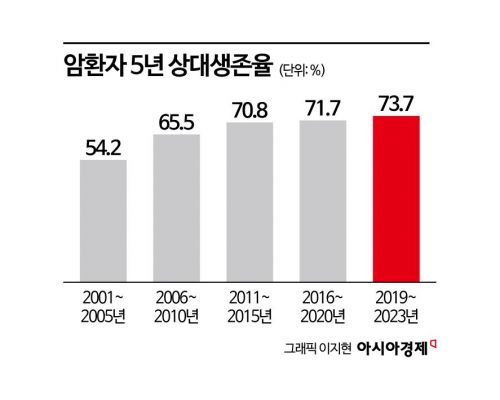
The five-year relative survival rate (the probability of a cancer patient surviving for five years compared to the general population) for those diagnosed in the past five years (2019-2023) was 73.7%. This means that more than seven out of ten cancer patients survived for more than five years after diagnosis. This rate is 19.5 percentage points higher than the 54.2% survival rate recorded about 20 years ago (2001-2005). Notably, among all cancer survivors, 62.1% (about 1.7 million people) have survived for more than five years after diagnosis.
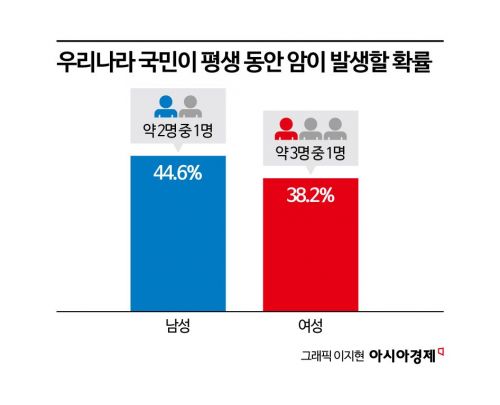
Additionally, assuming the current cancer incidence rate remains unchanged, it is estimated that the lifetime probability of developing cancer in South Korea is approximately one in two for men (44.6%) and one in three for women (38.2%).
Meanwhile, when adjusted for the world standard population, South Korea's cancer incidence rate stands at 288.6 cases per 100,000 people, which is similar to or slightly higher than major countries. However, the cancer mortality rate is 64.3 per 100,000 people, which is significantly lower than Japan (78.6) and the United States (82.3). Despite the high incidence rate, the low mortality rate indicates that cancer is being detected early and treated effectively. The Ministry of Health and Welfare explained that this demonstrates South Korea's world-class cancer management capabilities.
Lee Jungkyu, Director of Public Health Policy at the Ministry of Health and Welfare, stated, "Objective data shows that cancer survival rates are steadily improving thanks to early screening and treatment outcomes," adding, "We will strive to develop cancer control policies focused on prevention and early diagnosis to address the increasing cancer burden in an aging society."
Yang Hankwang, President of the National Cancer Center, emphasized, "With the number of cancer survivors in South Korea reaching 2.73 million and an increase in elderly cancer patients, the importance of cancer management is growing. Through the National Cancer Control Program, we will systematically promote not only cancer prevention and treatment but also support for cancer survivors."
© The Asia Business Daily(www.asiae.co.kr). All rights reserved.
![Clutching a Stolen Dior Bag, Saying "I Hate Being Poor but Real"... The Grotesque Con of a "Human Knockoff" [Slate]](https://cwcontent.asiae.co.kr/asiaresize/183/2026021902243444107_1771435474.jpg)













