German Think Tank: "America's Own Goal... Exporters Absorbed Only 4%"
A new study has found that 96% of the additional costs resulting from tariffs imposed by President Donald Trump of the United States on the rest of the world last year were borne by American businesses and consumers.
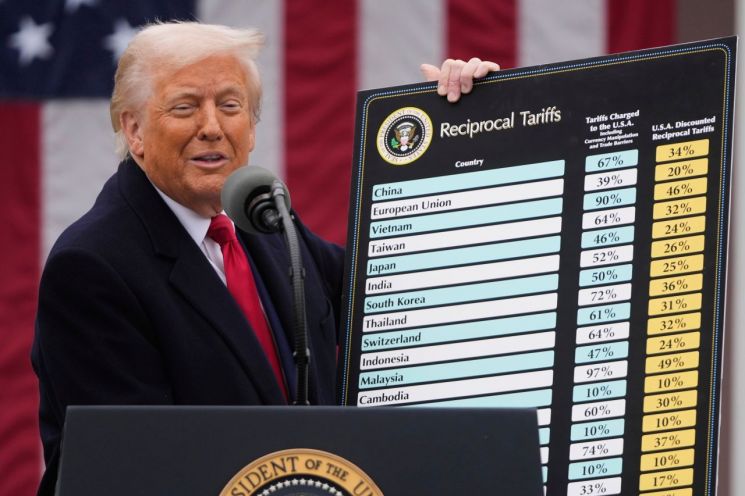
On the 19th (local time), the German think tank Kiel Institute for the World Economy (IFW) released a report titled "America's Own Goal: Who Pays the Tariffs?" The report analyzed 25 million trade records, amounting to a total of 4 trillion dollars (5,895 trillion won), and found that only 4% of the tariff costs were absorbed by exporters, while the remaining 96% were passed on to American buyers.
The report also noted, "Although trade volumes plummeted, export prices did not decrease." In fact, in August of last year, U.S. exports to Brazil and India, which were subject to a high tariff rate of 50% due to trade with Russia, dropped by as much as 24%, but export prices remained unchanged.
Since April of last year, President Trump has imposed reciprocal tariffs and other duties on countries worldwide, asserting that foreign companies would bear the tariff costs and that there would be no inflation in the United States. However, the report pointed out that tariffs function as a kind of "consumption tax" on imports, stating, "In the long run, companies will see their margins decrease, and consumers will face higher prices."
Julian Hinz, a researcher at IFW, said, "The claim that foreigners bear the tariffs lacks evidence, and there is no transfer of added value to the United States through tariffs. The data show the exact opposite of President Trump's claim: Americans are paying the price." He added, "Countries exporting to the United States will be pressured by reduced sales and the need to find new export markets. In the end, tariffs are detrimental to everyone."
German Chancellor Friedrich Merz also stated on the same day, "Tariffs are usually borne by the people of the importing country-in this case, American consumers," adding, "But of course, they also harm the European economy, especially Germany."
The U.S. daily The Wall Street Journal (WSJ) commented on the IFW study, saying, "It contradicts President Trump's core argument," and noted, "As a trade war with Europe threatens to resume, it shows that he could find himself in a disadvantageous position." Previously, on the 17th, President Trump announced that he would impose an additional 10% tariff starting next month on eight European countries that opposed the U.S. annexation of Greenland, a Danish territory. If this policy is implemented, in addition to the previously agreed reciprocal tariffs, exports from European Union (EU) member states such as France, Germany, and the Netherlands will face a 25% tariff, while goods from the United Kingdom will be subject to a 20% tariff.
© The Asia Business Daily(www.asiae.co.kr). All rights reserved.

















