Paju City Holds 2nd Renewable Energy Conflict Mediation Committee
Discussing Inclusive Strategies for Expanding Renewable Energy
Paju City has once again rolled up its sleeves to resolve local conflicts surrounding the expansion of renewable energy. The city has opened a second forum for discussion aimed at improving public acceptance and institutional reforms.
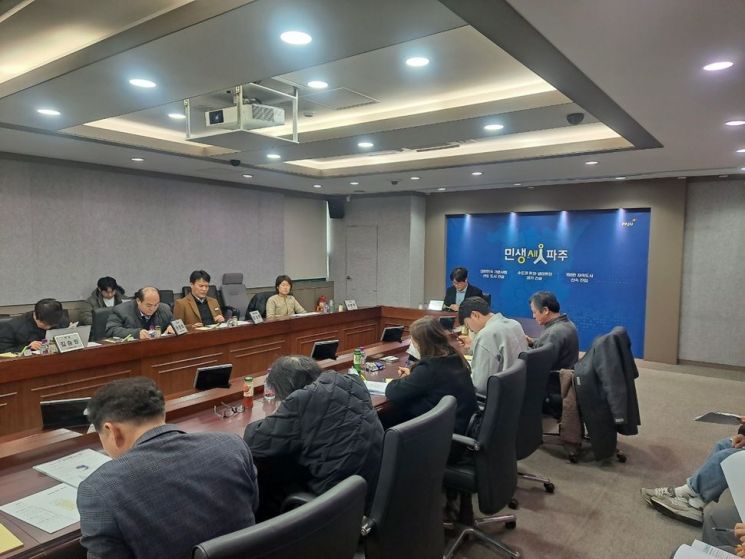 Paju City held the "2nd Paju City Renewable Energy Conflict Mediation Steering Committee" on the 15th at the Paju City Hall Video Conference Room. Photo by Paju City
Paju City in Gyeonggi Province held the "2nd Paju City Renewable Energy Conflict Mediation Steering Committee" on the 15th at the Paju City Hall video conference room. This meeting was part of follow-up discussions to preemptively prevent local conflicts that may arise during the expansion of renewable energy and to enhance public acceptance through institutional and administrative alternatives.
The steering committee was co-hosted by Paju City and the ICLEI Korea Office, with participation from partner organizations such as the Gyeonggi Research Institute, Gyeonggi Environment & Energy Agency, and Pulssi Action Research Institute. A total of 22 participants attended, including civic groups, experts, city council members, and officials from relevant departments.
The meeting began with a sharing of opinions on the recommendations presented at the first committee session. The committee previously analyzed that conflicts related to the siting of renewable energy generation facilities stem from a lack of communication to improve public acceptance, uniform setback distance standards, and concerns about environmental and landscape damage. This meeting was convened to develop practical response measures to address these issues.
During the meeting, Paju City shared its actions regarding the three recommendations raised at the first session: clearly defining the committee’s roles and authority; re-examining Paju City’s role with a focus on conflict cases; and establishing institutional measures for prior public communication. Participants exchanged views on these topics and agreed on the need to clarify the committee’s role and respond institutionally.
Subsequent presentations proposed various alternatives for conflict resolution. Kim Seungwon, Team Leader at the Gyeonggi Environment & Energy Agency, introduced exemplary cases of education and communication centered on resident participation and benefit sharing, emphasizing the need to enhance public acceptance. Jeon Seulji, Senior Officer at the ICLEI Korea Office, presented administrative and procedural improvement measures for expanding renewable energy in Paju City and proposed a revision of setback distance regulations, highlighting the importance of establishing region-specific standards.
The meeting also included discussions on an expert academic forum scheduled for March and a citizen debate planned for April. Through these events, the city aims to incorporate expert opinions and broaden consensus with residents, thereby further developing Paju City’s unique renewable energy policies.
Kim Haewon, Head of the Energy Division, stated, "Through this second steering committee, we were able to derive more concrete alternatives to the issues raised so far and take a step closer to establishing an institutional foundation for conflict prevention. We will continue to reflect citizens’ voices through various channels and develop energy transition models tailored to the local context."
© The Asia Business Daily(www.asiae.co.kr). All rights reserved.

















