Unprecedented Move Amid Criminal Investigation
Focus on Powell's Statement as Fed Independence Faces Threats
Jerome Powell, Chair of the U.S. Federal Reserve (Fed), will personally attend oral arguments at the U.S. Supreme Court regarding the lawsuit over President Donald Trump’s authority to dismiss a Fed governor. As U.S. prosecutors have launched a criminal investigation into Powell over alleged excessive spending on Fed headquarters construction, attention is focused on whether Powell’s rare appearance in court will signal concerns about threats to central bank independence.
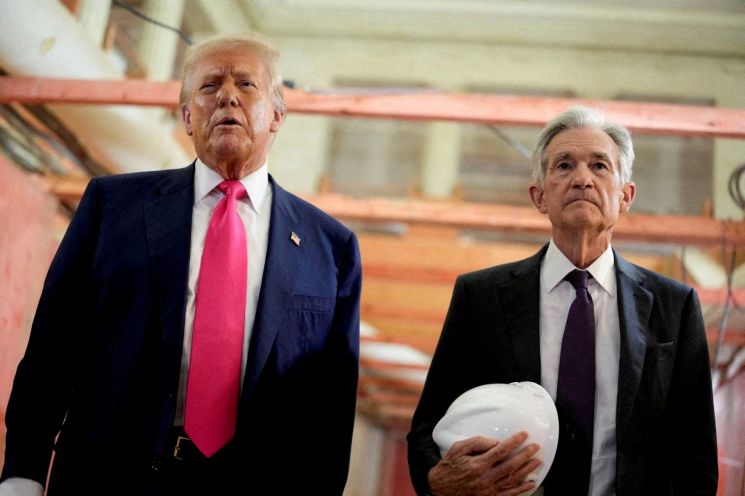 Donald Trump, President of the United States (left), and Jerome Powell, Governor of the U.S. Federal Reserve (Fed). Photo by Reuters
According to reports from the Associated Press and CNBC on January 19 (local time), Chair Powell is scheduled to attend oral arguments at the U.S. Supreme Court in Washington, D.C. on January 21. The hearing is related to the lawsuit filed by Fed Governor Lisa Cook challenging her dismissal.
The central issue in the case is whether the President has the authority to dismiss a Fed governor, given that the independence of the central bank is legally protected. In August of last year, President Trump attempted to dismiss Governor Cook, citing allegations of mortgage fraud involving a property she owns. Cook has categorically denied the accusations and filed a lawsuit, and while a lower court has suspended the dismissal, the Supreme Court is now set to make a final ruling.
Within and outside the Fed, there is growing concern that attempts by the President to dismiss a Fed governor, along with various forms of political pressure, could pose a serious threat not only to the independence of the central bank’s monetary policy but also to its very existence.
Local media have noted that it is extremely rare for the Fed Chair to personally attend Supreme Court oral arguments on such matters. Analysts say this is not unrelated to the fact that, even before taking office in January of last year, President Trump had strongly pressured Powell to cut interest rates, and when Powell did not comply, Trump escalated the pressure by raising the possibility of dismissal. More recently, U.S. prosecutors have launched an investigation into Powell over the Fed headquarters construction costs, and both political and financial circles view this as a continuation of political pressure on the central bank.
Given these circumstances, there is widespread speculation that Powell may use his appearance at the oral arguments in the lawsuit involving Governor Cook-who is facing a similar predicament-to deliver a message defending the Fed’s independence as the head of the central bank.
Having previously avoided open confrontation with President Trump, Chair Powell took the unusual step of issuing a public statement on January 11 to respond directly. He stated that the threat of criminal charges against him was “a result of the Fed making interest rate decisions based on what best serves the public interest, rather than following the President’s preferences,” and criticized, “This issue is about whether the Fed can continue to set interest rates based on evidence and economic conditions, or whether monetary policy will be dictated by political pressure or intimidation.”
Depending on the Supreme Court’s decision, the boundaries between presidential authority and the Fed’s independence could be redefined. As such, this hearing is expected to be a critical turning point for the political independence of the U.S. central bank and the future direction of monetary policy.
© The Asia Business Daily(www.asiae.co.kr). All rights reserved.

















