Governor Kim Youngrok Attends Second Administrative Integration Meeting with Provincial Council
Calls for Inclusion of Balanced Development Fund and Rural Measures in Special Bill
Discussion on Fiscal Incentives, Gwangju-Centric Concerns, and Use of Government Buildings
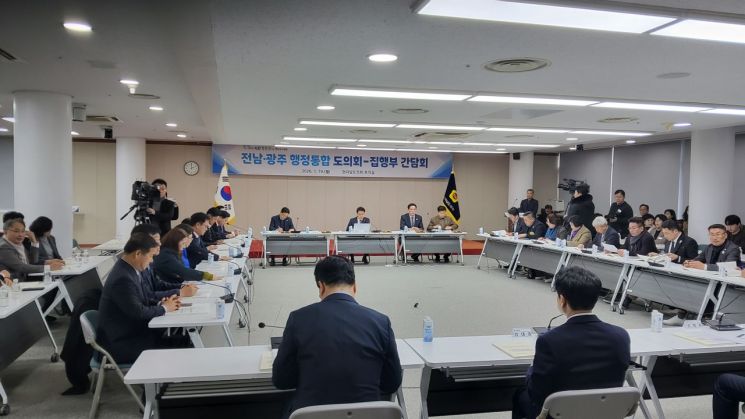 On the 19th, a meeting between the Jeonnam Provincial Council and the executive branch regarding the 'Gwangju-Jeonnam Administrative Integration' was held at the Choui Room of the Jeonnam Provincial Council. Photo by Shim Jinseok
On January 19, Jeollanam-do held the second meeting between the provincial government and the provincial council regarding the Gwangju-Jeonnam Administrative Integration at the Choui Room of the Jeonnam Provincial Council, where they discussed key elements of the special bill, including government incentives and special provisions.
More than 100 participants attended the meeting, including Kim Youngrok, Governor of Jeollanam-do; Kim Taekyun, Chairman of the Jeonnam Provincial Council; Kim Daejung, Superintendent of Jeonnam Office of Education; Kang Wiwon, Vice Governor for Economic Affairs and head of the Gwangju-Jeonnam Administrative Integration Planning Team; as well as directors of Jeonnam Province and provincial council members.
This meeting marked the third communication event with the provincial council, following a briefing for all council members on January 8 and the first meeting on January 13. The session provided a detailed explanation of the progress of the administrative integration and the special bill, and gathered opinions from provincial council members.
The council members raised questions on several topics, including: how to incorporate measures such as the Regional Balanced Development Fund into the special bill; establishing institutional safeguards to prevent the marginalization of rural and fishing communities; and the direction for the use and operation of government office buildings.
Lee Gwangil, Vice Chairman of the Jeonnam Provincial Council from the Democratic Party, emphasized, "It is essential to clarify how fiscal incentives such as local allocation tax and consumption tax will be distributed and for how many years they will be guaranteed. Provisions to prevent the marginalization of Jeonnam, such as the Regional Balanced Development Fund, must be properly reflected in the special bill. There also needs to be a concrete plan for the use of government buildings and the allocation of institutions after the integration."
Shin Minho, a Jeonnam provincial council member (Suncheon 6) from the Democratic Party, stated, "The main purpose of administrative integration is to ensure prosperity for all, but there are significant concerns about the concentration of benefits in Gwangju. We need to create a virtuous cycle where young people can receive education and settle in the region, rather than moving to large cities or the capital area. If a national medical school is established through the integration of Suncheon National University and Mokpo National University, they can fully serve as regional hub universities. The government's policy to create 10 Seoul National University-level institutions should be reflected and included as a special provision in the special bill."
Kim Moonsu, a Jeonnam provincial council member (Shinan 1) from the Democratic Party, pointed out, "When I reviewed the special bill submitted during the first meeting, there was not a single provision related to agriculture, livestock, or fisheries. Although a few items have been added today, they seem hastily put together. There are also no provisions addressing future climate change response. Now is the time to consider how to include these aspects in the special bill."
In response, Governor Kim highlighted that, given the regional characteristics of Gwangju and Jeonnam-being far from the capital area, having low fiscal independence, and facing a high risk of regional extinction-support from the balanced development fund is absolutely necessary. He also pledged to ensure that various special provisions, including permitting authority for 50MW solar power and 100MW offshore wind projects, as well as for advanced strategic industries, petrochemical and steel industries, and agriculture and fisheries, are included in the special bill.
Governor Kim further emphasized, "The provincial council is a strong partner in administrative integration, representing the voices of all 22 cities and counties. I will work closely with the council to responsibly advance the administrative integration."
Chairman Kim Taekyun also remarked, "This was a meaningful time to broadly share issues between the executive branch and the council regarding the significant matter of administrative integration. We will do our utmost to move forward in a direction that benefits the lives of our residents."
Meanwhile, as meetings and public hearings continue, deliberation and public discussion on the Gwangju-Jeonnam administrative integration are deepening. Jeollanam-do plans to gather residents' opinions through all possible means and aims to complete the process by submitting the special bill at the end of this month and securing approval from the National Assembly in February.
© The Asia Business Daily(www.asiae.co.kr). All rights reserved.

















