Bank of Korea Releases Financial Institution Lending Attitude Survey Results
Non-bank Institutions Maintain Tightened Lending Standards
In the first quarter of this year, it is expected that households will find it somewhat easier to obtain loans from banks.
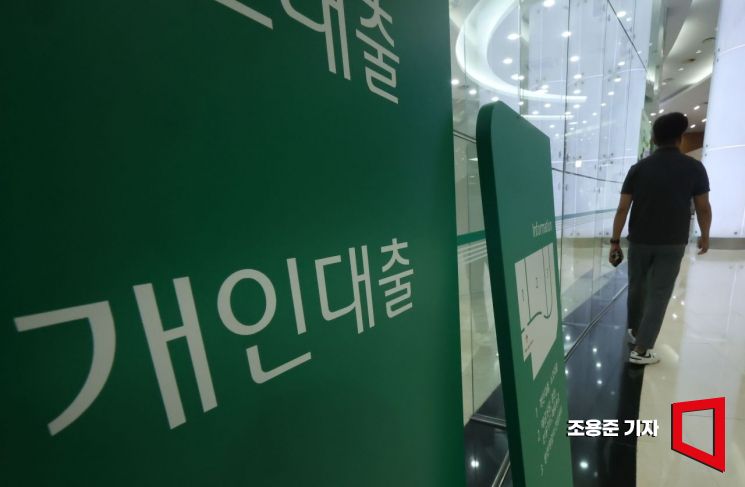 On the 3rd, a loan-related information board was posted at a commercial bank branch in Euljiro, Jung-gu, Seoul. Photo by Jo Yongjun jun21@
According to the results of the "Financial Institution Lending Attitude Survey" conducted by the Bank of Korea on loan officers at financial institutions, the overall lending attitude index for banks in the first quarter turned positive at 8, marking a reversal after four quarters. A positive index indicates that more financial institutions responded they would ease lending standards than those who said they would tighten them.
The lending attitude of banks had dropped from 7 in the first quarter of last year to -13 in the second quarter, and continued to tighten, recording -28 in the third quarter and -21 in the fourth quarter.
By borrower type, more banks responded that they would ease household loan requirements compared to the previous quarter, shifting the balance toward "easing." The index for household mortgage loans shifted from -44 in the fourth quarter of last year to 6 in the first quarter of this year, while general household loans moved from -25 to 0. This suggests that the tightening trend for household loans, which has continued since the second quarter of last year, is expected to ease somewhat.
A Bank of Korea official stated, "Household loans have maintained a tightening stance due to the June 27 measures and subsequent policies last year, but with the resumption of lending in the new year, lending standards are expected to be somewhat eased, especially for housing-related loans, compared to the previous quarter."
Corporate loans also showed a relaxation in lending attitudes for both large corporations and small and medium-sized enterprises (SMEs). The index for large corporate loans rose from 3 in the fourth quarter of last year to 6, and for SMEs, it shifted from -3 to 11, indicating a predominance of easing.
Loan demand in the first quarter is also expected to increase, mainly for SME and household mortgage loans. The overall loan demand index for domestic banks was 12, maintaining an upward outlook following the previous quarter's 6. This is due to expectations that SME loan demand will rise from 0 to 17, and household mortgage loan demand will increase from 0 to 11.
Demand for large corporate loans and general household loans is also expected to continue increasing, but the pace of growth is expected to slow, with large corporate loans rising from 8 to 6 and general household loans from 17 to 8.
A Bank of Korea official explained, "Corporate loan demand is expected to increase mainly among SMEs due to demand for facility investment, working capital, and expanded liquidity at the beginning of the year. For households, housing-related loans are also expected to rise somewhat due to demand for home purchases and jeonse (long-term rental deposit) funds."
Domestic banks expect the credit risk for both corporations and households in the first quarter to remain at the same level as the previous quarter. The overall credit risk index stood at 20, unchanged from the previous quarter. Specifically, the credit risk index for SMEs is expected to decrease to 28 from 31 in the previous quarter, while the index for large corporations (8 to 14) and households (11 to 14) is expected to rise somewhat. However, concerns about SME credit risk remain relatively high.
For non-bank financial institutions, all sectors except credit card companies are expected to maintain a tightening stance on lending. However, the degree of tightening is expected to be somewhat less than before. Credit risk is also expected to remain a concern in all sectors due to continued sluggish business conditions and concerns about borrowers' repayment capacity.
Meanwhile, this survey was conducted from November 25 to December 16 of last year, targeting a total of 203 financial institutions, and examined trends over the past three months as well as outlooks for the next three months.
© The Asia Business Daily(www.asiae.co.kr). All rights reserved.

















