Longer Job Search Periods for Young People Lead to Weaker Lifetime Employment Stability
One Year of Unemployment: 66.1% Chance of Regular Employment After Five Years
Three Years Without Employment: Probability Drops to 56.2%
If the job search period for young people aged 15 to 29, who are in the early stages of career development, becomes prolonged, it can lead to weaker employment stability and lower income throughout their entire lives.
According to the "BOK Issue Note: Assessing the Lifetime Impact of Delayed Labor Market Entry and Housing Cost Burdens for the Young Generation" published by the Bank of Korea on January 19, the probability of working in a regular position five years later was 66.1% if the period of unemployment lasted one year, but this dropped to 56.2% if the period extended to three years. The report also found that for each additional year of past unemployment, current real wages decreased by 6.7%. Lee Jaeho, Deputy Head of the Macroeconomic Analysis Team at the Bank of Korea's Research Department, who authored the report, stated, "The young generation, by nature of entering economic activity for the first time, inevitably lacks accumulated assets and experience, making their economic foundation more vulnerable compared to other age groups. Recently, difficulties in the initial job search process and in securing housing have become even more pronounced than in the past."
The First Job Barrier Is High: Widening Gap Between Large Corporations and SMEs, Shift from 'Any Job First' to 'Delayed Employment'
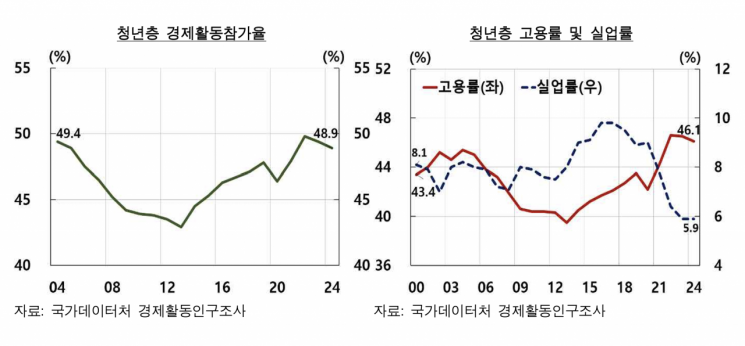
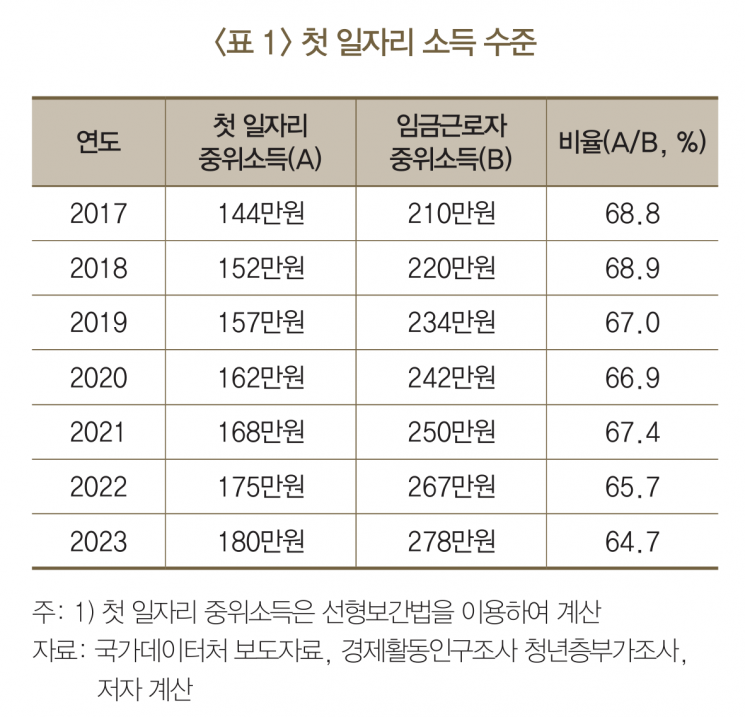
From a macroeconomic perspective, such as labor force participation rates and unemployment rates, the employment conditions for the current young generation have generally improved since the early to mid-2010s. However, underneath these statistics, there are underlying difficulties, including a prolonged job search period at the initial stage of entering the labor market. Lee pointed out, "The deepening dual structure of the labor market is due to factors such as the weakening of corporate growth ladders and employment rigidity." He explained, "Because small and medium-sized enterprises, which make up the secondary labor market, have not been able to create enough quality jobs, young people are delaying employment as they seek jobs in large corporations, which make up the primary labor market. At the same time, companies are increasingly favoring experienced hires and expanding rolling recruitment."
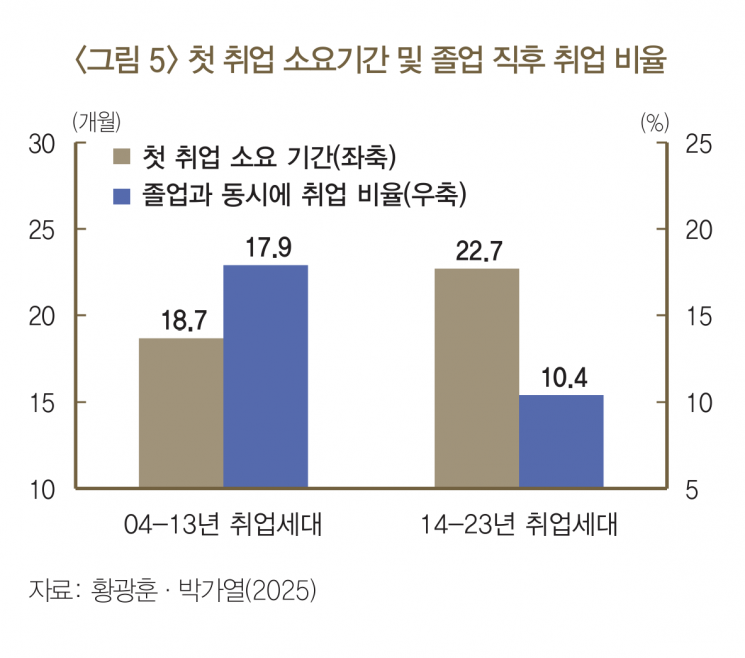
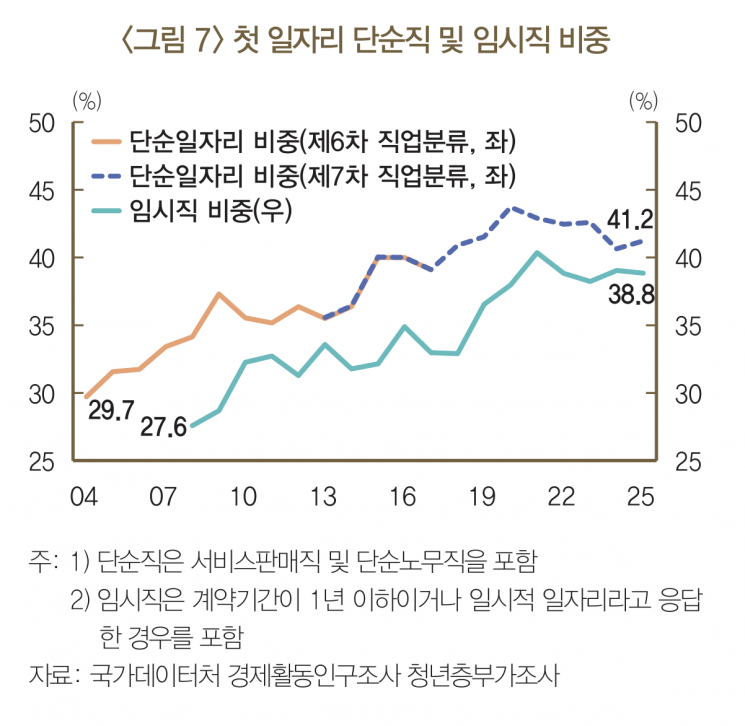
In addition to these structural factors, the recent economic slowdown and the resulting decrease in quality jobs have also negatively affected youth employment. Lee noted, "During prolonged job searches, young people are easily drawn into excessive competition for credentials and may be forced to take temporary or daily jobs." He added, "Ultimately, there is a risk that they will fall into a state of being 'out of the labor force,' potentially leading to long-term detachment from the labor market."
The so-called 'scarring effect'-where prolonged job search periods for young people result in weakened employment stability and reduced income over their lifetimes-was also observed in the case of Japan's 'employment ice age generation' or 'lost generation,' who faced difficulties entering the labor market from the early 1990s to the 2000s. These individuals, suffering from the triple burden of high unemployment, low wages, and job insecurity, frequently changed jobs and missed out on opportunities to build skills through in-house training. According to Lee Geuntae and Lee Jisun (2017), the employment rate for Japanese university graduates plummeted from 81.3% in 1991 to 55% in 2003, while the proportion of non-regular workers aged 15 to 24 rose from 20.5% in 1990 to 47.7% in 2005. Now middle-aged, this cohort continues to struggle with low wages, job instability, and a high proportion of non-regular employment, indicating the lasting aftereffects of employment shocks experienced during their entry into society.
Heavy Housing Cost Burden: More Single-Person Households Living on Monthly Rent, Hindering Human Capital Accumulation
The current young generation faces a much heavier housing cost burden than in the past. As more young people become independent for study or work, the number of single-person households, particularly in the Seoul metropolitan area, has increased rapidly, with most living in monthly rental accommodations. However, unlike the spread of smaller households due to this household diversification, the supply of small, non-apartment housing-where young people predominantly reside-has not increased sufficiently, due to declining profitability and rising costs after COVID-19. Lee emphasized, "This supply-demand mismatch has led to a sharp rise in monthly rents, significantly increasing the housing cost burden for young people." On the other hand, the share of young people living in vulnerable accommodations such as gosiwon rose from 5.6% in 2010 to 11.5% in 2023, and the proportion living in spaces below the minimum housing standard (14 square meters) has also started to rise, indicating that the quality of housing has fallen far short of expectations.
Excessive housing costs for young people can have negative ripple effects on asset formation, human capital accumulation, and financial soundness throughout their lives. Lee explained, "The analysis showed that for every 1% increase in housing costs, total assets decreased by 0.04%," and "when the share of housing expenses rose by 1 percentage point, the share of education expenses fell by 0.18 percentage points. This suggests that rising housing costs can hinder the accumulation of human capital." The housing cost burden has also been a major factor in the sharp increase in youth debt. The proportion of youth debt relative to all age groups jumped from 23.5% in 2012 to 49.6% in 2024. Lee pointed out, "This increase in debt not only reduces their consumption capacity but is also likely to constrain future investments in education or careers."
Ultimately, the fundamental solutions are to ease labor market rigidity and improve the dual structure in terms of employment, and to address supply-demand imbalances in housing by expanding the supply of small housing units. Lee concluded, "In the short term, it is necessary to expand programs supporting work experience for young people to prevent them from leaving the labor market, while also considering enhanced short-term financial support to ensure at least a minimum level of housing stability for the youth."
© The Asia Business Daily(www.asiae.co.kr). All rights reserved.



















