Resumption of Talks on Access to Regulated Service Markets
Accelerating Discussions on Market Opening and Institutional Coordination
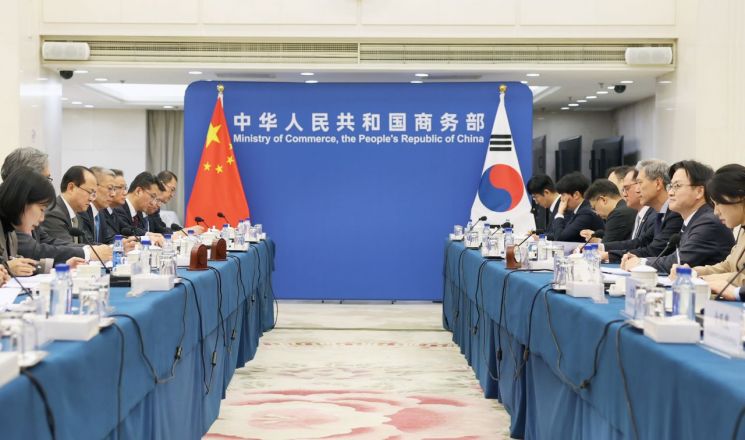
As South Korea and China resume follow-up negotiations on the Free Trade Agreement (FTA) in the areas of services and investment, the restoration of economic cooperation channels between the two countries is gaining momentum. With the resumption of high-level talks that had been suspended after the summit, discussions to expand the trade structure from a focus on goods to the domains of services and investment are once again on the table.
The Ministry of Trade, Industry and Energy announced that it will hold the 13th round of follow-up negotiations in Beijing from January 19 to 23, focusing on market opening and institutional improvements in the fields of services, investment, and finance. The South Korean delegation is led by Kwon Hyejin, Deputy Minister for Trade Negotiations, while the Chinese delegation is headed by Lin Feng, Director General of the Department of International Trade and Economic Affairs at the Ministry of Commerce.
The follow-up negotiations on services and investment are a supplementary process to the Korea-China FTA, which came into effect in 2015. At the time, the agreement was centered on tariff reductions for goods, resulting in limited liberalization in the areas of services and investment. In response, both sides launched follow-up negotiations in 2018 and have since held twelve rounds of talks and numerous intersessional meetings to draft the agreement text and discuss sector-specific opening approaches.
This meeting marks the first official event since the two countries agreed to restructure the negotiation framework for progress within this year during the Korea-China summit held in Beijing earlier this month. The government plans to shift from an irregular negotiation schedule to a regular, face-to-face format in order to accelerate discussions. The Ministry stated, "We will pursue substantive progress in liberalization talks while coordinating among relevant ministries."
The resumption of follow-up negotiations is seen as part of the broader trend of restoring bilateral relations. Recently, the two countries have been reactivating government-level institutional channels, such as summits, trade ministerial meetings, and high-level economic dialogues, with the follow-up negotiations reestablishing themselves as one of these key channels. There are also expectations that this could serve as an opportunity to expand cooperation from a trade structure centered on goods exports to the areas of services and investment.
Until now, China's services and investment markets have long been restricted for foreign companies, particularly in regulated industries such as finance, telecommunications, culture, and healthcare. China has managed market access through a "positive list" approach, opening only certain sectors, while simultaneously imposing equity restrictions, joint venture requirements, and approval systems. Procedures for investment approval, capital movement, and intellectual property rights handling have also been widely regarded as opaque.
Non-tariff barriers in content and cultural sectors, exemplified by the so-called "Korean Wave ban," as well as mandatory joint ventures in medical and educational fields, have also been cited as factors delaying substantive liberalization. Following the THAAD dispute, prolonged political and diplomatic tensions further stalled the follow-up negotiations, leaving the Korea-China FTA with a goods tariff-centered structure and only limited openness in the services and investment sectors.
The services and investment sectors are directly linked to the opening of China's domestic market in areas such as finance, content, healthcare, education, and platforms. As a result, industry-specific regulations, review processes, and licensing procedures are now being brought to the negotiating table. Attention is also being paid to the acceleration of regulatory reforms in services and investment, in line with China's push to join the CPTPP, expanded use of the RCEP, and the adoption of digital standards.
However, it is expected that it will take time before the effects of substantive liberalization are felt. China continues to maintain multiple layers of barriers for foreign companies in fields such as finance, telecommunications, data processing, and culture/content, including equity restrictions, conditional approvals, and regulations on cross-border data transfers. Given the varying sensitivities by sector, it is anticipated that the degree of market opening will be set gradually.
With the reopening of institutional cooperation channels at this meeting, the government is expected to specify sectoral opening lists and regulatory relaxation ranges in future meetings. Both sides plan to finalize the schedule for the next round of negotiations based on the results of this session.
© The Asia Business Daily(www.asiae.co.kr). All rights reserved.