112 Billion Won Unspent Out of 22.9 Billion Won Budget
Structural Limitations Exposed in Execution Stage
"Policy Must Move Beyond Simply Increasing Budget"
"Need to Review Government and Local Authority Involvement"
The "Youth Culture and Arts Pass," introduced to expand young people's access to cultural experiences, has seen its budget execution rate remain at around half even in its second year of implementation. Although the usage rate has increased significantly, the accumulation of unspent funds has raised questions about whether the program is functioning as intended.
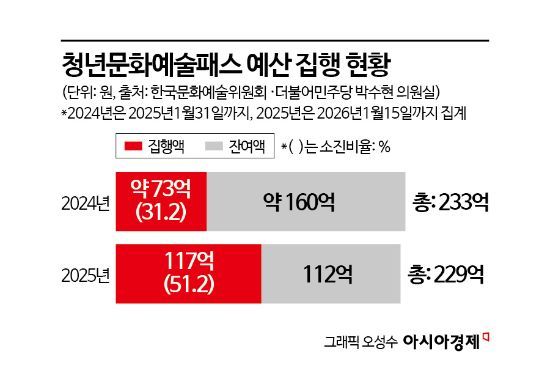
According to data submitted by the Ministry of Culture, Sports and Tourism to Assemblyman Park Soo-hyun of the Democratic Party of Korea on January 19, 2026, the national average usage rate of the Youth Culture and Arts Pass in 2025 was 86.1%, while the budget execution rate was 51.2%. Even though the usage rate climbed to the high 80% range, 11.2 billion won out of the total budget of 22.9 billion won remained unspent.
In the previous year, 2024, only 7.2 billion won of the 23.3 billion won budget was used, resulting in an execution rate of just 31.2%. More than half (52.8%) of those issued the pass at the time used it, but budget consumption was limited. This revealed the structural limitations of the execution system from the outset of the program.
Looking at the two-year trend, the gap between usage and execution rates has persisted. Although the usage rate in 2025 rose to 86.1%, improvements in execution lagged behind. This suggests that increased usage does not directly translate into budget consumption.
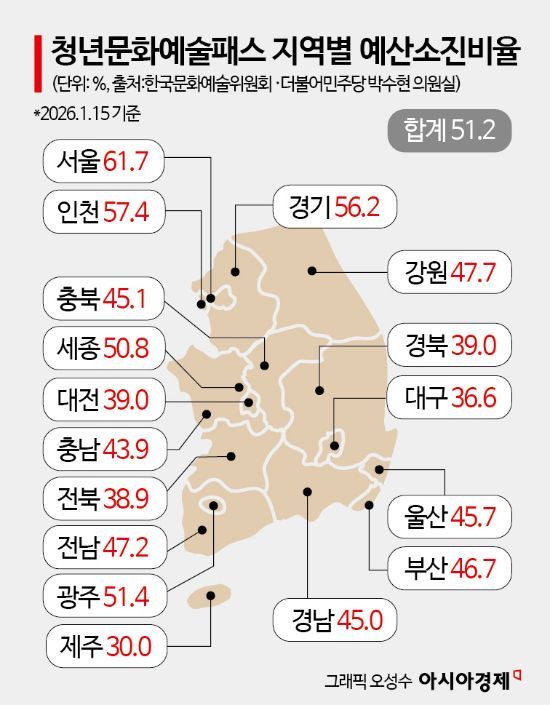
Regional figures show a similar pattern. In 2025, the usage rates were 88.9% in Seoul, 88.5% in Gyeonggi, 88.3% in Incheon, and 86.1% in Busan, with most regions reaching the high 80% range. Jeonbuk, Jeonnam, and Jeju were in the low 80% range. Nevertheless, the national average execution rate remained at 51.2%. This indicates that differences in regional usage rates alone cannot explain the unspent budget.
Experts point out the need to examine whether the pass is designed in alignment with actual usage patterns, as the situation of increased usage without proportional execution has persisted for two years.
It has also been confirmed that the unspent budget is not a temporary variable but a structural phenomenon. The fact that the execution rate remains around half signals a need to question whether the program is operating properly. Rather than judging the policy's effectiveness solely by rising usage rates, analyzing why the budget is not being executed beyond a certain level has emerged as a key task.
Jung Changsoo, Director of the Korea Institute of Public Finance, stated, "With unspent budget repeating for two years, we cannot rely solely on the program's good intentions. It is essential to fundamentally examine whether there are wasteful elements or if the eligibility, demand, and execution requirements are excessively stringent. Just because the program has a good purpose does not mean it should be maintained unconditionally; decisive action may be necessary."
An official from the Ministry of Culture, Sports and Tourism explained, "While increased promotion has raised the usage rate, the large amount of unused funds has resulted in the accumulation of unspent budget. We are currently exploring ways to expand cultural access, such as touring performances in regional areas."
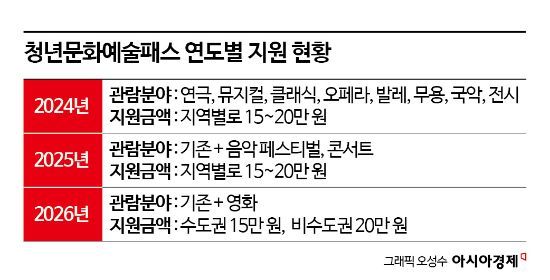
From this year, the Youth Culture and Arts Pass has undergone partial adjustments in support methods and usage scope as part of system improvements. The support amount has been differentiated between the Seoul metropolitan area (150,000 won) and non-metropolitan areas (200,000 won), and movie viewing has been added as an eligible use, in order to improve accessibility.
The policy's intent itself is positive. In the context of a stagnant performance and exhibition market, policy support aimed at generating demand among young people is meaningful. However, some point out that if the cycle of "budget expansion → repeated non-execution" continues, it will become increasingly difficult to justify the policy's cost-effectiveness.
Assemblyman Park emphasized, "It is an issue that a well-intentioned program to expand young people's access to culture has not made full use of its budget. In addition to promotion, efforts must be made to improve budget execution efficiency so that the program can make a tangible contribution to improving the quality of life for young people and become firmly established."
© The Asia Business Daily(www.asiae.co.kr). All rights reserved.