First CCTV Installation for Bird Monitoring at a Korean Airport
Corporation's Own Integrated Surveillance System
Establishing a Real-Time Monitoring Framework
Muan International Airport has decided to install closed-circuit television (CCTV) cameras specifically for bird monitoring, becoming the first airport in South Korea to do so, in order to prevent "bird strikes"-one of the causes identified in the December 29, 2024 passenger plane disaster.
According to industry sources on January 19, Korea Airports Corporation will install CCTV cameras at Muan Airport within this year to detect and analyze bird activity. This is the first time CCTV cameras will be introduced for the purpose of preventing bird strikes; previously, CCTV cameras were used for security, and flocks of birds were monitored visually.
The collected video data will be analyzed at the Bird Surveillance Integrated Information Center, which will be established within the international terminal at Gimpo Airport by the Aviation Safety Technology Institute. While each airport previously handled bird detection independently, Muan Airport will be the first in the country to implement an integrated monitoring system managed by the corporation.
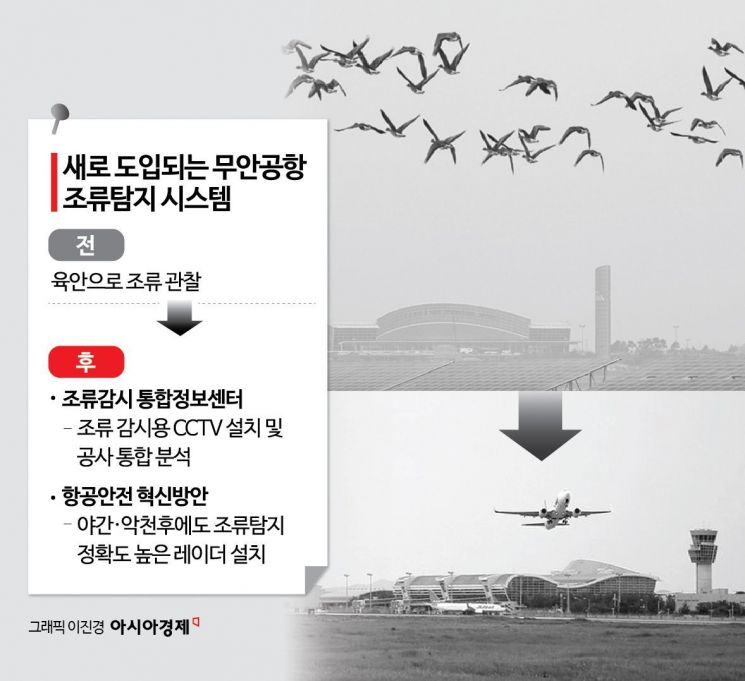
Korea Airports Corporation plans to select optimal installation points for the CCTV cameras in the first half of this year, considering factors such as height, placement, and angle, and to establish a monitoring system capable of real-time bird surveillance. In the second half of the year, the corporation will begin pilot operation of the Bird Surveillance Integrated Information Center to improve the accuracy of bird detection and analysis.
In addition, as part of the Ministry of Land, Infrastructure and Transport's "Aviation Safety Innovation Plan," a radar-based bird strike prevention system will also be introduced within the year. This radar system can accurately detect flocks of birds even at night or during severe weather conditions, effectively preventing bird strike accidents. Muan Airport is expected to become the first airport in South Korea equipped with bird detection radar.
Korea Airports Corporation's decision to introduce advanced systems such as bird monitoring CCTV and radar was prompted by the urgent need for systematic bird strike prevention measures following the December 29 disaster. Although the causes of the disaster were complex, it was analyzed that a collision between the aircraft and a flock of birds may have caused the landing gear to malfunction. Last year, the Aviation and Railway Accident Investigation Board (ARAIB), under the Ministry of Land, Infrastructure and Transport, released a preliminary report stating that feathers and bloodstains from Eurasian teal were found in both engines.
In particular, it has been confirmed that there have been 10 incidents of aircraft colliding with birds at Muan Airport over the past six years. The bird strike rate per number of flights at Muan Airport is reportedly the highest among the 14 regional airports nationwide. The bird strike rate at Muan Airport is 0.091% per flight.
A representative from Korea Airports Corporation stated, "With the changing climate environment, real-time monitoring and analysis have become just as important as preventive measures such as managing bird habitats, which is why we are pushing for the adoption of advanced systems. Depending on the results of the pilot operation of the new integrated monitoring system using CCTV cameras in the second half of this year, we plan to expand it to airports nationwide."
© The Asia Business Daily(www.asiae.co.kr). All rights reserved.

















