"Calls for Protecting Domestic Industries"
Last year, the number of trade remedy applications, including anti-dumping investigations, filed by domestic companies with the government reached an all-time high.
According to the "Trade Remedy Statistics" released by the Trade Commission of the Ministry of Trade, Industry and Energy on January 18, domestic companies filed a total of 13 anti-dumping investigation requests with the Trade Commission last year. This marks the highest number since 2002.
By country, 9 out of the 13 cases were anti-dumping investigations targeting Chinese companies, followed by 3 cases involving companies from the European Union (EU), and 1 case concerning a Japanese company.
Of these, the Trade Commission initiated 10 anti-dumping investigations last year. By product category, steel, non-ferrous metals, and other related products accounted for the largest share with 4 cases, followed by chemical products with 3 cases.
This trend reflects the challenges faced by the steel and chemical industries, which require structural business restructuring due to the maturity of domestic industries and are simultaneously suffering from global oversupply.
Among the 10 cases investigated by the Trade Commission, preliminary rulings were issued in 5 cases. The remaining 5 cases are still undergoing anti-dumping investigations.
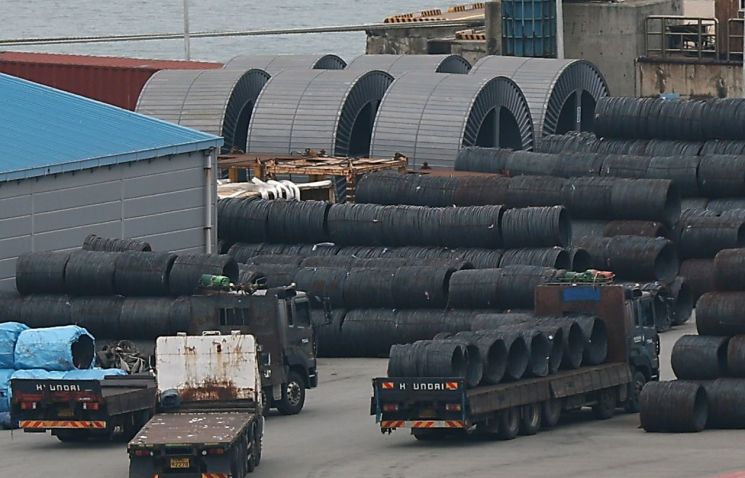
In cases related to steel and non-ferrous metal products, last year the Trade Commission issued a preliminary ruling to impose anti-dumping duties ranging from 28.16% to 33.57% on carbon steel and alloy steel hot-rolled products imported from Japan and China, following a petition from Hyundai Steel. The commission determined that these dumped imports had caused substantial injury to the domestic industry.
The domestic steel industry has continuously raised concerns that the influx of low-priced Chinese steel products, resulting from oversupply, has flooded the market with dumped products, disrupted market order, and undermined fair competition, causing significant damage.
Among chemical products, the Trade Commission issued a preliminary ruling to impose anti-dumping duties of up to 42.81% on imports of polyvinyl chloride (PVC) paste resin (PSR), used as building interior materials. This case was filed by Hanwha Solutions. The commission decided to impose a 42.81% anti-dumping duty on products from Germany’s Vinnolit and its affiliates, 37.68% on France’s Kem One and its affiliates, 25.79% on Norway’s Inovyn Europe and its affiliates, and 28.15% on Sweden’s Inovyn Trade and its affiliates.
It was also confirmed that domestic companies are taking measures to curb foreign competitors not only in traditional core industries but also in advanced technology sectors, which are emerging as future growth engines.
Last year, the Trade Commission, in response to a request from HD Hyundai Robotics, conducted anti-dumping investigations into two Japanese and three Chinese companies. The commission determined a causal relationship between dumped imports and injury to the domestic industry, and decided to impose provisional anti-dumping duties ranging from 21.17% to 43.60%.
The items subject to the anti-dumping investigation requested by HD Hyundai Robotics were advanced industrial robots with four or more axes and vertical articulated arms, used for automotive body assembly and welding, logistics packaging and automated sorting, metal cutting, and drilling operations.
The companies found to have engaged in dumping included two Japanese firms, Yaskawa and Fanuc, as well as three Chinese firms: ABB Engineering Shanghai, KUKA Robotics Guangdong, and Kawasaki Heavy Industries.
In addition, the Trade Commission determined that dumped imports of textile boards from Thailand had caused injury to the domestic industry and imposed provisional anti-dumping duties ranging from 11.92% to 19.43%, as part of its measures to protect domestic industries.
Previously, in March of last year, the government expanded and strengthened the Trade Commission's organization and functions to protect domestic industries from unfair trade practices such as dumping and to respond to the accelerated spread of protectionism following the start of the second Trump administration.
© The Asia Business Daily(www.asiae.co.kr). All rights reserved.
!["The Woman Who Threw Herself into the Water Clutching a Stolen Dior Bag"...A Grotesque Success Story That Shakes the Korean Psyche [Slate]](https://cwcontent.asiae.co.kr/asiaresize/183/2026021902243444107_1771435474.jpg)
















