New Conversion Subsidy of 1.3 Million Won, Increased Grants
Expanded Support for Medium and Large Electric Freight Vehicles and Small Electric Vans
Cumulative Supply Surpasses 123,000 Units... 220,000 Tons of Greenhouse Gas Reduction
Seoul City will supply a total of 22,526 electric vehicles in 2026. This year, the city plans to accelerate the transition to electric vehicles by introducing new subsidies for EV conversion and expanding support for medium and large freight vehicles as well as small passenger vans.
According to Seoul City on January 18, this year’s supply of electric vehicles to the private sector includes 15,019 passenger cars, 1,200 taxis, 202 vans, and 1,754 freight vehicles. Including 117 vehicles supplied to the public sector, the total reaches 22,526 units, which is about 3,500 more than last year’s supply of 19,081 vehicles.
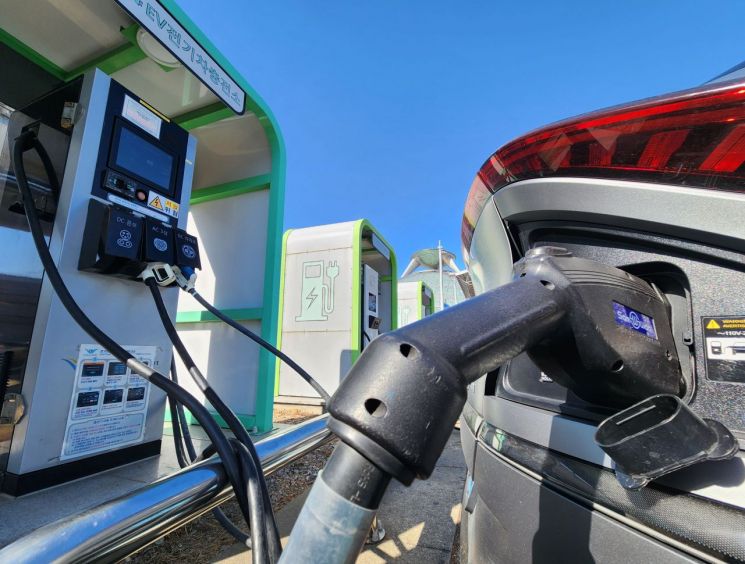 Seoul City is accelerating the transition to electric vehicles this year by introducing new subsidies for electric vehicle conversion and expanding support for medium and large freight vehicles as well as small passenger vans. The photo shows an electric vehicle charging station. Photo by Yonhap News Agency
This year, to promote the transition from internal combustion engine vehicles to electric vehicles, Seoul City will introduce a new conversion subsidy of up to 1.3 million won and implement customized additional support measures by vehicle type to reduce the purchase burden. The city also plans to provide preferential subsidies to electric vehicles with outstanding performance in charging speed, driving range, and battery efficiency, thereby encouraging technological innovation among manufacturers and voluntary price reductions.
The cumulative supply of electric vehicles in Seoul has surpassed 120,000 units. This accounts for 7.9% of new vehicle registrations last year and 3.4% of the total number of registered vehicles in Seoul. The reduction in greenhouse gas emissions resulting from the supply of electric vehicles is estimated at approximately 220,000 tons of CO2 equivalent, which is comparable to planting about 1.58 million pine trees annually.
Seoul City is also continuously expanding charging and safety infrastructure to ensure that citizens who purchase electric vehicles can use them more conveniently and safely. By last year, a total of about 80,000 charging stations had been installed. The city also promoted projects to support safety facilities for preventing electric vehicle fires, such as early fire detection systems using thermal imaging cameras and CCTV in apartment complexes and other locations.
For electric passenger cars, subsidies of up to 7.54 million won are provided depending on the vehicle price and eligibility. When combining the conversion subsidy and various additional subsidies, the benefits available to citizens increase further. For individuals who dispose of their existing internal combustion engine vehicle and purchase an electric passenger car or freight vehicle after January 1 of this year, an additional conversion subsidy of up to 1.3 million won is provided, which includes 1 million won from the national government and 300,000 won from the city government.
For low-income households and young first-time electric vehicle buyers, an additional 20% of the national subsidy amount is provided, and households with multiple children can receive up to 3 million won in additional support depending on the number of children. For taxis, an additional taxi-specific subsidy of 2.5 million won (1.92 million won from the national government and 580,000 won from the city government) is provided on top of the passenger car subsidy. Considering the long driving distances, if the battery warranty is at least five years or 350,000 kilometers, an additional 100,000 won from the city government is provided.
For electric freight vehicles, the support target has been expanded this year from mainly small vehicles (1 ton or less) to include medium and large freight vehicles. The subsidy amounts are up to 13.65 million won for small, 52 million won for medium, and 78 million won for large freight vehicles. For small electric freight vehicles used for delivery within residential areas, an additional 1 million won (10% of the national subsidy amount) is provided, and the requirements for scrapping existing diesel freight vehicles and operating for six months have been abolished. In addition, if the manufacturer or importer discounts the vehicle price by 500,000 won, the city government will provide an additional 500,000 won, resulting in a total support of 1 million won. For delivery vehicles, an additional 500,000 won is provided, for a maximum total subsidy of 1.5 million won.
Support for small passenger vans is also being expanded. For electric vans (buses), the maximum subsidies are 100 million won for large, 70 million won for medium, and 19.5 million won for small vans. For children's school buses, the maximum subsidies are 149.5 million won for large, 110.5 million won for medium, and 39 million won for small buses.
Kwon Min, Director of the Climate and Environment Headquarters of Seoul City, stated, "To accelerate the popularization of electric vehicles, we will expand subsidy benefits compared to last year and actively promote the transition in commercial vehicle sectors such as freight, taxis, and buses. Through these efforts, we will strive to simultaneously achieve carbon reduction and air quality improvement, providing citizens with a more pleasant and livable urban environment."
© The Asia Business Daily(www.asiae.co.kr). All rights reserved.
![Clutching a Stolen Dior Bag, Saying "I Hate Being Poor but Real"... The Grotesque Con of a "Human Knockoff" [Slate]](https://cwcontent.asiae.co.kr/asiaresize/183/2026021902243444107_1771435474.jpg)










