Emphasizing the Need for Korea-Japan Economic Cooperation
Presenting AI-Centered New Growth Strategies
Choi Tae-won, Chairman of the Korea Chamber of Commerce and Industry (and Chairman of SK Group), emphasized the urgent need for a shift toward growth-focused policies and the securing of new growth engines centered on artificial intelligence (AI) to overcome the structural low-growth phase of the Korean economy.
Appearing on KBS's "Sunday Diagnosis" broadcast on the 18th, Chairman Choi stated, "An economy that has stopped growing is like a bicycle that has lost its momentum and come to a halt, making it much harder to restart." He assessed, "Currently, the driving force behind Korea's economic growth has significantly weakened."
He reminded viewers that the nation’s potential growth rate has dropped to the 1.9% range, expressing concern that "the actual growth rate remains around 1%, which is even lower." In particular, regarding the gap between potential and actual performance, he analyzed, "This is evidence that the potential we possess is not being translated into real outcomes through policy support or implementation."
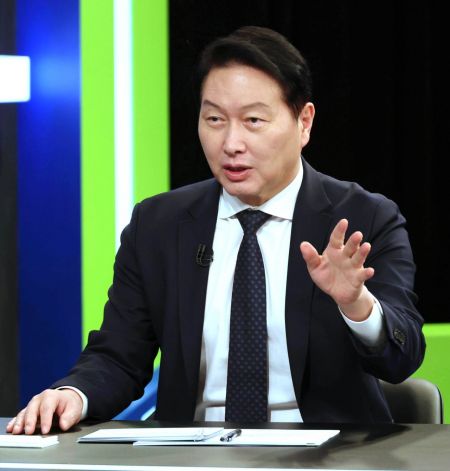 Choi Tae-won, Chairman of the Korea Chamber of Commerce and Industry. Korea Chamber of Commerce and Industry
He also offered sharp insights into the social problems that may result from slowing growth. Chairman Choi remarked, "Economic growth is directly linked to whether young people can dream of a future in this country," and predicted, "In a society where hope is not visible, the outflow and discontent of the younger generation will inevitably intensify."
Additionally, referring to Korea’s achievements in economic growth and democratization, he stressed, "If growth stagnates, the resources available for distribution become depleted, social conflict deepens, and ultimately, even the foundation of democracy can be shaken."
Regarding the corporate regulatory environment, he pointed to "institutional barriers that hinder growth" as a problem. Chairman Choi identified "stepwise regulations," where regulations increase as companies grow in size, and commented, "If the regulatory risks outweigh the benefits of growth, companies will give up on challenges and settle for the status quo."
Citing the example of Taiwan’s nurturing of TSMC through its sovereign wealth fund, he urged the creation of a business-friendly environment, stating, "National growth follows only when various large companies enter the market and compete fiercely."
On the issue of economic criminal penalties that constrain entrepreneurs, he reiterated the need for institutional reform, saying, "Investment is made based on thorough risk calculation, but criminal penalties exceed the scope that managers can predict or bear."
As a new growth solution, he suggested "Korea-Japan economic cooperation." Chairman Choi noted, "If the two countries move as a single economic community, such as by introducing a unified visa system, about 3 trillion won in new added value could be created," highlighting the potential for synergy between the two nations.
Regarding the AI industry, he described it as "a monumental civilizational transition akin to moving from the Stone Age to the Iron Age," and called for a nationwide response. He outlined concrete tasks to achieve this, including: expanding global AI infrastructure, revitalizing the startup ecosystem, and establishing support systems for product testing (PoC).
He particularly emphasized, "There are limits to growth with infrastructure designed only for the domestic market," adding, "A virtuous cycle of investment will occur only if we aim for global-standard infrastructure that can be used worldwide."
Finally, Chairman Choi stressed, "Korea has enough potential to write a new economic narrative by combining its cultural asset of K-culture with AI technological capabilities," and concluded, "If bold private-sector challenges are coupled with supportive policy measures, the future of the Korean economy remains hopeful."
© The Asia Business Daily(www.asiae.co.kr). All rights reserved.
!["The Woman Who Threw Herself into the Water Clutching a Stolen Dior Bag"...A Grotesque Success Story That Shakes the Korean Psyche [Slate]](https://cwcontent.asiae.co.kr/asiaresize/183/2026021902243444107_1771435474.jpg)
















