Kakao Bank Targets Thailand and Indonesia
K Bank Eyes Remittance and Payment in the UAE
Securing Mid- to Long-Term Growth Drivers Globally
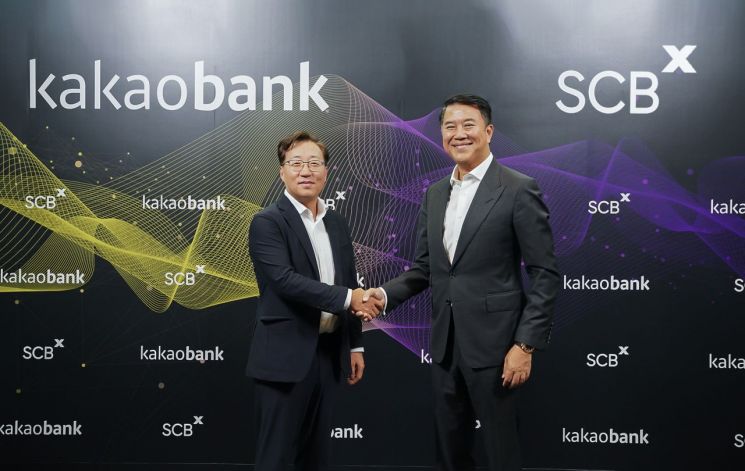 Yoon Ho-young, CEO of Kakao Bank (left), and Arthid Nanthawithaya, CEO of SCBX. Provided by Kakao Bank
Internet-only banks are accelerating their efforts to enter global markets. Due to the strict regulations characteristic of the domestic financial industry, there are limits to growth through internal competition alone. In addition, the recent tightening of household loan regulations by the authorities has made it difficult to expand existing operations. Internet banks, which have strengths in mobile services, are now transplanting their non-face-to-face financial models to expand their presence in overseas markets.
According to the financial industry on January 19, Kakao Bank is currently focusing on entering the Thai market. Kakao Bank is partnering with SCBX, the financial holding company that owns Siam Commercial Bank (SCB) in Thailand, to establish an internet-only bank (virtual bank) in Thailand.
The virtual bank they are preparing received its license in June of last year and is expected to begin operations as early as the second half of this year. The success or failure of Kakao Bank’s entry into Thailand is a major topic of interest in the domestic financial sector. Thailand has long been considered a "wasteland" for Korean financial companies. During the 1997 Asian financial crisis, Korean banks that had entered the Thai market withdrew en masse despite requests from the Thai government to remain, which cooled bilateral relations and raised the barriers to re-entry.
Kakao Bank is also accelerating its entry into Indonesia. "Superbank," a digital bank in which Kakao Bank made a strategic equity investment, recently surpassed 5 million users. Superbank, which launched in June 2024, turned a profit last year and was recently listed on the Indonesia Stock Exchange. Kakao Bank’s transfer of mobile technology through user interface (UI) and user experience (UX) consulting is cited as a key factor in its success.
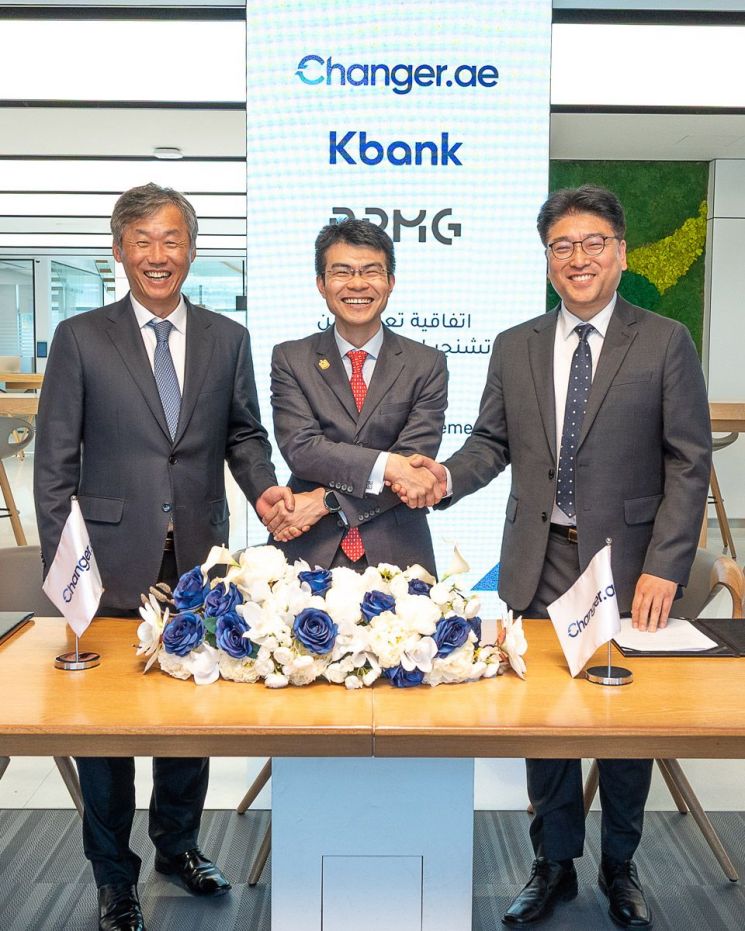 Choi Woohyung (left), CEO of K Bank, Wang Hao, Vice President of Changer, and Moon Bumyoung, Head of Development at BPMG, are posing for a commemorative photo at the business agreement ceremony held last month in Abu Dhabi, United Arab Emirates. Provided by K Bank
K Bank is also actively expanding its global footprint. On January 15, K Bank signed a business agreement with Changer, a digital asset company in the United Arab Emirates (UAE), and BPMG, a domestic blockchain company, to build a global remittance infrastructure based on digital assets and stablecoins. The plan is to jointly develop a next-generation remittance and payment network connecting Korea and the UAE, the financial hub of the Middle East, and to discover new business models based on blockchain technology.
The main targets are high-net-worth individuals and digital asset investors traveling between Korea and the UAE, as well as trade companies operating between the two countries. In particular, K Bank plans to use this collaboration as a starting point for global expansion. Choi Woohyung, CEO of K Bank, said, "Our partnership with Changer will serve as an important bridgehead for K Bank’s entry into the global market, especially the Middle Eastern financial market, which has abundant liquidity."
The latecomer Toss Bank has also made clear its intention for mid- to long-term overseas expansion. At a press conference last year, Lee Eunmi, CEO of Toss Bank, stated, "We plan to enter the global market within the next three to five years," adding, "Initially, this could take the form of equity investments, establishing joint ventures, or providing banking as a service, allowing third parties to use Toss Bank’s systems."
Toss Bank is considering not only Southeast Asia but also developed countries as potential markets. CEO Lee said, "Emerging markets have high growth potential, while developed countries have established financial systems but their customer experience is still not fully digitalized. Overseas banks struggling with digital transformation are already approaching us for collaboration," she added.
The active push by internet banks to expand globally is closely related to the domestic financial environment. The government’s tightening of household loans has increased the challenges faced by internet banks. With continued regulatory strengthening, it has become difficult to aggressively market mortgage loans, which were previously a strong point, and as a result, their performance has stagnated. For internet banks, household loans account for more than 90% of their total lending. If government regulations continue, it will inevitably disrupt their operations.
Now in their tenth year, internet banks are at a point where they need to prepare for the next phase of their business. When Kakao Bank first launched in 2017, it brought a fresh shock to the domestic banking sector with innovative products such as mobile banking, group accounts, and the 26-week savings plan, all of which improved accessibility. However, after ten years, critics say that internet banks now show growth patterns similar to traditional banks, and much of the initial novelty has faded. From the perspective of internet banks, finding new growth avenues is urgent. In fact, Kakao Bank plans to secure new growth engines through global expansion. Yoon Ho-young, CEO of Kakao Bank, previously emphasized at the time of Superbank’s listing, "We will build a global digital banking network to secure mid- to long-term growth drivers."
© The Asia Business Daily(www.asiae.co.kr). All rights reserved.
![Clutching a Stolen Dior Bag, Saying "I Hate Being Poor but Real"... The Grotesque Con of a "Human Knockoff" [Slate]](https://cwcontent.asiae.co.kr/asiaresize/183/2026021902243444107_1771435474.jpg)

















