"U.S. Export Controls Make Securing High-Performance Chips Difficult"
Chinese AI Developers Express Concerns
Zhipu Founder: "The Gap May Actually Be Widening"
No Chinese Companies Listed as Nvidia Chip Clients
Due to the United States' export controls on semiconductors to China, Chinese AI companies are increasingly concerned that they may fall behind in the competition with the U.S. as it becomes harder to obtain high-performance artificial intelligence (AI) chips.
The Wall Street Journal reported on January 16 (local time) that such pessimism is spreading among Chinese AI researchers. Tang Jie, founder of the Chinese AI startup Zhipu, said at a conference in Beijing last week, "China is making achievements in certain fields, but we must acknowledge the challenges we face," adding, "The gap may actually be widening."
This statement reflects the reality that, due to U.S. export restrictions targeting China, Chinese companies are struggling to secure advanced AI semiconductors compared to their American counterparts.
Recently, when Nvidia announced its next-generation chip 'Rubin,' it listed numerous American companies as clients, but not a single Chinese company was included. As a result, some Chinese companies are reportedly seeking alternative routes to secure Rubin chips, such as renting data centers in Southeast Asia and the Middle East. Tencent in China also previously utilized data centers in Japan to obtain Nvidia's 'Blackwell' chips in order to circumvent U.S. regulations.
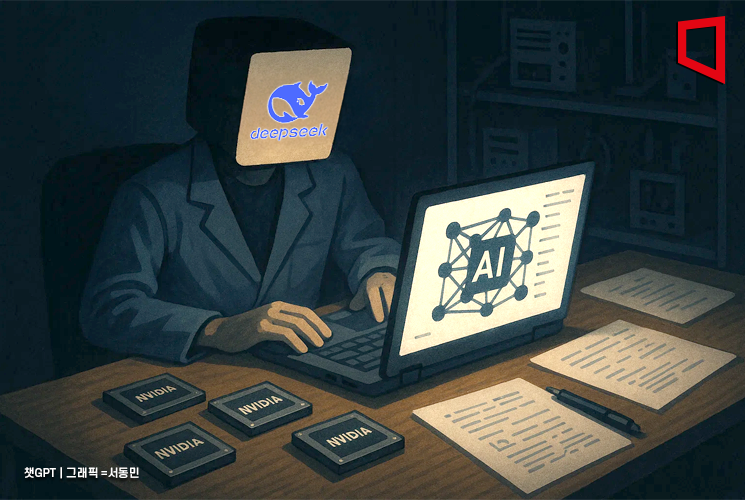
DeepSeek, which had symbolized China's "AI rise," reportedly tried to use Chinese-made chips such as those from Huawei during the development of its latest flagship model last year. However, after failing to achieve satisfactory results, it ultimately had to introduce Nvidia chips for certain tasks.
Although Chinese AI chips from companies like Huawei are making progress, the gap with Nvidia and others remains significant. Analysts note that Chinese companies, already struggling to secure chips, realistically find it difficult to gain an advantage over American companies, which also have abundant financial resources.
Justin Lin, who oversaw the development of Alibaba's AI model 'Qwen,' has stated that the likelihood of a Chinese company surpassing global leaders like OpenAI or Anthropic within the next three to five years is "20% or less."
However, despite concerns that China is facing an AI gap with the United States, there is still a significant perspective that China remains a major competitor to the U.S. when considering technological accumulation and the industrial ecosystem. Developers such as DeepSeek have demonstrated considerable development capabilities even with limited resources, narrowing the gap with American AI models. Now, they are even researching ways to build larger AI models with fewer chips.
© The Asia Business Daily(www.asiae.co.kr). All rights reserved.
![Clutching a Stolen Dior Bag, Saying "I Hate Being Poor but Real"... The Grotesque Con of a "Human Knockoff" [Slate]](https://cwcontent.asiae.co.kr/asiaresize/183/2026021902243444107_1771435474.jpg)
















