Han Myungseon, a 55-year-old housewife, held her father’s funeral last year without setting up a funeral hall. Instead of inviting relatives and acquaintances, her family conducted the funeral quietly in the mortuary, just among themselves. This decision was based on her father’s and the family’s belief in not wanting to impose on others. Han said, “Even if they are relatives, it can be a burden for them to travel from far away, and condolence money can also feel like an imposition. We were able to reduce the time spent managing condolence money and preparing food for visitors, and instead, our family could remember him without any unnecessary formalities.”
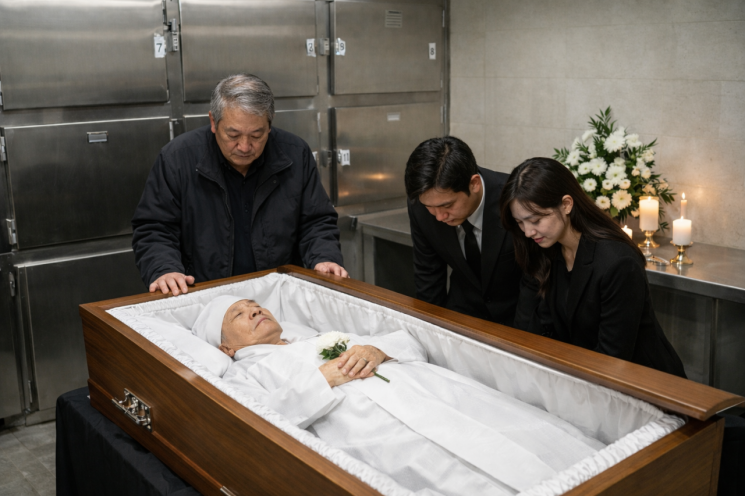
The culture of “funerals without a funeral hall,” where families skip the traditional visitation and hold a quiet ceremony among themselves, is spreading. Also referred to as “family funerals” or “two-day funerals,” this practice follows the basic steps of mortuary placement, encoffining, departure, and cremation after death, but omits the step of opening a funeral hall to receive visitors between encoffining and departure. The funeral is conducted in the mortuary, and the departure takes place from there, typically over two days.
The spread of this type of funeral is attributed to practical burdens. As family structures change and the culture of visitation declines, the number of visitors has decreased, while the costs for using a funeral hall and hosting guests remain high. This financial strain is cited as a key reason. Unlike traditional funerals, which typically cost over 10 million won (about 10,000 USD), funerals without a hall can be arranged for 2 to 3 million won (about 2,000 to 3,000 USD).
A funeral service provider explained, “Even for just one day, renting a funeral hall is expensive. You need at least 50 servings of food for the flower arrangements and guests, so the basic funeral costs alone can reach nearly 10 million won.” He added, “If there are not many family members or visitors, many people choose funerals without a hall, which can be done for about a quarter of the cost of a traditional funeral.”
For bereaved families, this approach reduces the burden of the funeral process and allows them to focus on saying goodbye to their loved one. Kim, a woman in her 40s who recently lost her mother after a long illness, said, “I was able to quietly gather my thoughts without worrying about others. Instead of elaborate formalities, I could truly focus on the act of saying farewell to my mother.”
Industry insiders also report that funerals without a hall are becoming increasingly common. Funeral director Lee Youngwoo stated, “The number of such funerals we handle each month has doubled. Unlike in the past, when there was a negative perception that these funerals were too modest or shabby, younger family members now prefer not to spend on unnecessary and superficial expenses.”
Kim Yuntae, a sociology professor at Korea University, analyzed, “As urbanization and individualization progress, social relationships are decreasing, leading to the emergence of this culture. Rather than exchanging condolence money and mutual aid, the culture of remembrance is shifting toward allowing families to focus on the deceased.”
© The Asia Business Daily(www.asiae.co.kr). All rights reserved.
![Clutching a Stolen Dior Bag, Saying "I Hate Being Poor but Real"... The Grotesque Con of a "Human Knockoff" [Slate]](https://cwcontent.asiae.co.kr/asiaresize/183/2026021902243444107_1771435474.jpg)











