Public Discovery, Venture Optimization, and Corporate Clinical Trials:
Tangible Outcomes of the 'Relay Research' Model Emerge
A new drug candidate originating from a public research institute has successfully advanced to the clinical stage through private sector development capabilities. The anti-cancer resistance-overcoming drug candidate ‘OCT-598,’ jointly developed by the Korea Research Institute of Chemical Technology, Cana Therapeutics, and Oscotec, has officially entered the development track with the initiation of first patient dosing in a domestic Phase 1 clinical trial.
This is regarded as a representative example of the so-called ‘relay research’ model in new drug development, where public-private collaboration progresses in stages.
OCT-598 is a compound jointly discovered and validated by the Korea Research Institute of Chemical Technology and Cana Therapeutics from the early stages of research. It was later transferred to Oscotec, where clinical development was accelerated.
With the successful commencement of first patient dosing in the recent domestic Phase 1 trial, the original developers-the Korea Research Institute of Chemical Technology and Cana Therapeutics-received milestone payments. This officially demonstrates that the research achievements have been translated into tangible business value.
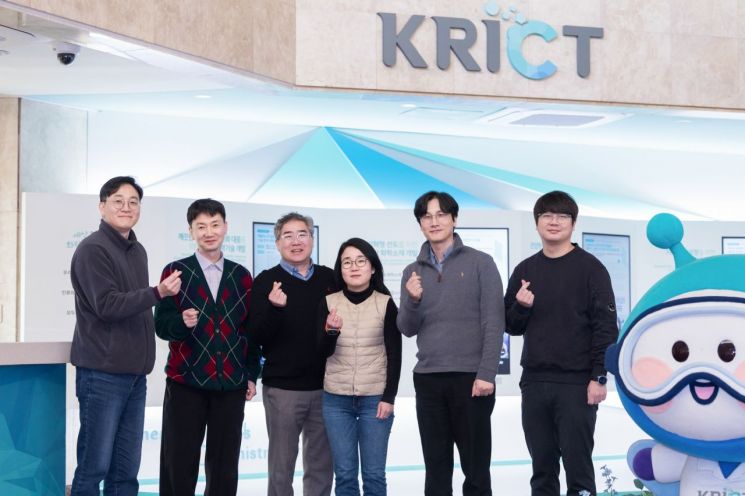 Research team led by Dr. Hansu Bong, Korea Research Institute of Chemical Technology (second from right). Courtesy of Korea Research Institute of Chemical Technology
Dual Inhibition Strategy Targeting Cancer Drug Resistance Pathways
The distinguishing feature of this candidate is its dual inhibition mechanism targeting both EP2 and EP4 receptors, which are key pathways in prostaglandin E2 (PGE2) signaling-long identified as central to the development of cancer cell resistance during treatment.
Whereas conventional anti-cancer drugs often fail to adequately control the tumor microenvironment that forms after cancer cell death, leading to diminished efficacy, OCT-598 employs a strategy that modulates the immunosuppressive environment itself to sustain anti-cancer effects.
In animal studies, complete remission (CR) was observed when the drug was used in combination with standard therapies, and the potential for forming anti-cancer immune memory to suppress recurrence and metastasis was also demonstrated. Based on these mechanisms, the company plans to continue developing the drug for patients with advanced solid tumors who have developed resistance to existing treatments.
Oscotec received Investigational New Drug (IND) approval from the U.S. FDA in May 2025 and from the Ministry of Food and Drug Safety in November of the same year, and is currently conducting clinical trials both domestically and internationally.
At present, major domestic medical institutions are evaluating the safety, optimal dosage, and initial efficacy of the drug in patients with advanced solid tumors. The company also plans to formally assess its resistance-overcoming effects through combination therapy with the standard anti-cancer drug docetaxel in the future.
"A Virtuous Cycle Model Linking Public Research Outcomes to Clinical Application"
Dr. Hansu Bong, the principal investigator at the Korea Research Institute of Chemical Technology, stated, “The clinical advancement of OCT-598 demonstrates that public research outcomes can reach the patient treatment stage when combined with the development capabilities of venture companies and pharmaceutical firms. The ‘relay research’ model, in which the public and private sectors divide roles and hand off the baton in stages, can serve as a practical solution to enhance national bio-competitiveness.”
This achievement is significant in that the division of labor-ranging from initial discovery (Korea Research Institute of Chemical Technology), to optimization and validation (Cana Therapeutics), to clinical development (Oscotec)-has functioned as intended, preventing research outcomes from being shelved and increasing the likelihood of commercialization.
Industry experts believe that the clinical results of OCT-598 will serve as a crucial test of the global competitiveness of domestically developed anti-cancer drugs in the field of cancer resistance treatment.
© The Asia Business Daily(www.asiae.co.kr). All rights reserved.

















