Suspicions Persist Over Possible Reappointment Maneuver
Party Leadership Dismisses Likelihood of Rejection
The Democratic Party of Korea has decided to reintroduce the amendment to the party constitution and regulations for the "one member, one vote" system for delegates and dues-paying members, which was rejected last month.
Jeong Cheongrae, leader of the Democratic Party of Korea, stated at the Supreme Council meeting held at the National Assembly on January 16, 2026, "We are once again pushing for the one member, one vote system for dues-paying members, which is essential for transitioning to an era of party member sovereignty that aligns with the era of popular sovereignty." Previously, the party leadership put the one member, one vote system to a vote last month, but it was rejected by the Central Committee due to a lack of quorum for amending the party constitution.
Jeong explained that the purpose of the one member, one vote system is to establish party member sovereignty and actively reflect the will of the members. He emphasized, "The basic principles of elections stipulated in our Constitution are universal, equal, direct, and secret ballot. Everyone has one vote. Since our party is called the Democratic Party, we must strictly adhere to the fundamental principles of democracy to move toward greater and broader democracy." He added, "By upholding the constitutional spirit of the one member, one vote system, we must transform into a true party of member sovereignty."
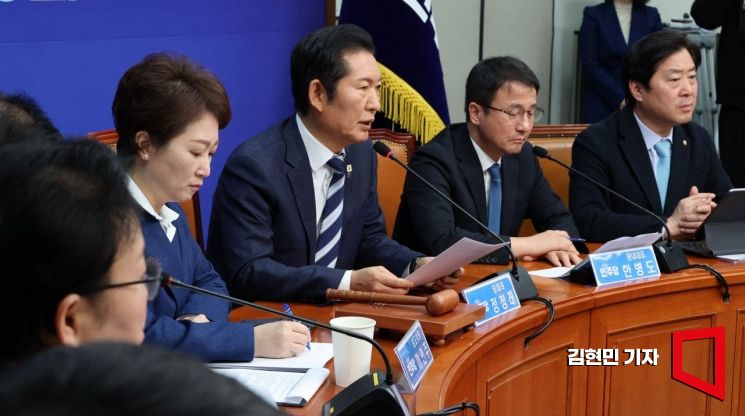 Jeong Cheongrae, leader of the Democratic Party of Korea, is speaking at the Supreme Council meeting held at the National Assembly on January 16, 2026. Photo by Kim Hyunmin
The Central Committee meeting to amend the party constitution will convene at 10 a.m. on February 2. The online vote by Central Committee members will take place from 10 a.m. on the same day until 6 p.m. on February 3. Prior to this, the Democratic Party plans to collect opinions from party members over three days, from January 22 to 24. In addition to the one member, one vote system, other proposals to be put to a vote include prioritizing one Supreme Council member appointed by the party leader for strategic regions (Yeongnam), and introducing mandatory all-member voting and party member participation requirements.
Within the party, some still suspect that Jeong is laying the groundwork for his own reappointment as party leader. One assemblyman told The Asia Business Daily, "Wasn't the low turnout last time due to suspicions about Jeong's intention to seek reappointment?" and added, "Since it failed once, there needs to be a more diverse process for gathering opinions."
An official from the ruling bloc also commented, "Pushing for the one member, one vote system means Jeong is increasing his chances of being reappointed," and added, "Whether or not this rule is applied in the next party convention will determine the level of internal conflict."
Another assemblyman said, "I don't think the possibility of rejection is as high as last time," but added, "Nevertheless, I plan to share various opinions among the assembly members. I will convey the message that Jeong should ensure the democratic nature, fairness, and procedural legitimacy of the process."
The party leadership is also wary of the possibility that the amendment could be rejected again due to a lack of quorum. Park Suhyeon, chief spokesperson of the Democratic Party, told reporters that day, "From the party leadership's perspective, last time's rejection was due to administrative shortcomings," and added, "If we prepare well, we expect it to pass with high participation and approval rates."
© The Asia Business Daily(www.asiae.co.kr). All rights reserved.
![Clutching a Stolen Dior Bag, Saying "I Hate Being Poor but Real"... The Grotesque Con of a "Human Knockoff" [Slate]](https://cwcontent.asiae.co.kr/asiaresize/183/2026021902243444107_1771435474.jpg)











