At a press tea meeting on the 16th: "Government responds just two weeks after integration declaration"
Mayor Kang: "A starting point for integration beyond finances, toward a unified living and economic zone"
Government: "Up to 5 trillion won in annual support and other incentives proposed"
Plans to expand relocation of public institutions and administrative authority
Gwangju Mayor Kang Gijeong stated regarding the government's announcement of financial support for the Integrated Metropolitan City, "This marks the starting point for Gwangju and Jeonnam to advance as a single living and economic zone." This statement comes in response to the government's official commitment to provide large-scale financial support and administrative and institutional incentives to regions pursuing administrative integration between metropolitan cities.
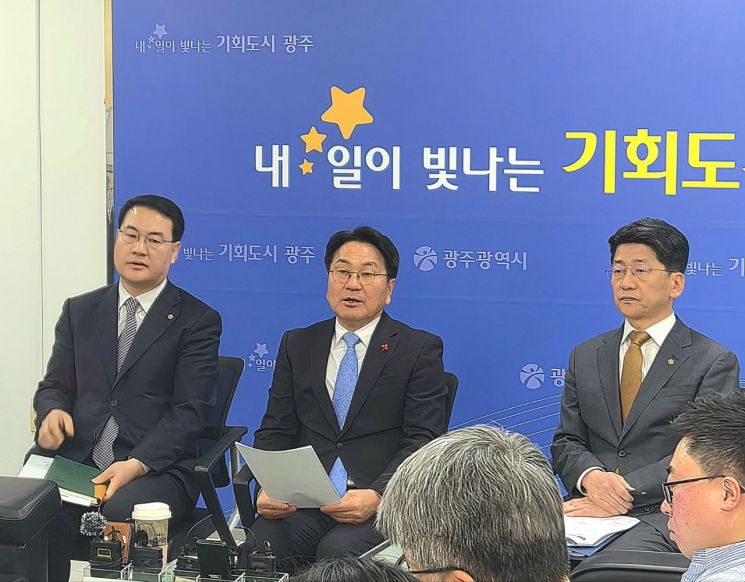
During a press tea meeting on the 16th, Mayor Kang said, "I am grateful that the Prime Minister personally and swiftly announced groundbreaking support measures for the Integrated Metropolitan City today. It is highly significant that the central government responded so quickly, just 14 days after the joint declaration to promote integration in front of the Democracy Gate in Mangwol-dong on the 2nd." He emphasized, "This support goes beyond a simple financial investment; it will serve as the starting point for Gwangju and Jeonnam to become a unified living and economic zone. We expect it to lead to population inflow, income growth, and the creation of quality jobs, thereby revitalizing the entire regional economy."
Mayor Kang highlighted the importance of gathering citizen opinions and swift legislative action by the National Assembly as future tasks. He stated, "Gwangju and Jeollanam-do will create a new growth axis for Korea by integrating through constant cooperation with the National Assembly and the central government." He added, "Today's government announcement of financial support signals the birth of the Gwangju-Jeonnam Metropolitan City with a budget of 25 trillion won. This comprises 7.7 trillion won for Gwangju, 11.7 trillion won for Jeonnam, and up to 5 trillion won in additional government support, making it the third-largest financial scale after Seoul and Gyeonggi Province." He further stated, "We will steadfastly pursue the creation of the Gwangju-Jeonnam Metropolitan City so that it can become a successful model for Korea's new era of regional development."
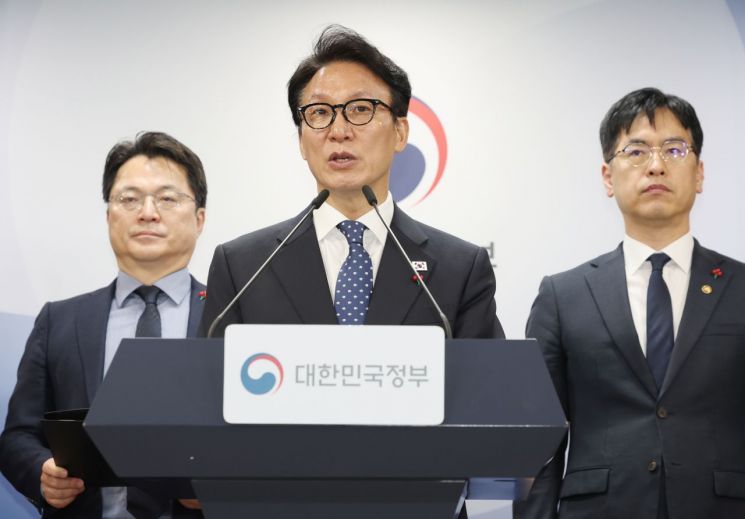 Prime Minister Kim Minseok is giving a briefing on administrative integration incentives at the Government Seoul Office in Jongno-gu, Seoul, on the 16th. Photo by Yonhap News
Earlier on the same day, Prime Minister Kim Minseok held a briefing at the Government Seoul Office and announced a package of incentives for the Integrated Metropolitan City, which will be launched through administrative integration between metropolitan cities. These incentives include financial support, enhanced status, preferential relocation of public institutions, and industrial revitalization. Prime Minister Kim stated, "The government has prepared bold incentives in four key areas that local residents can directly benefit from, to ensure the successful implementation of administrative integration and to connect integration with regional growth."
The incentives proposed by the government are: ▲financial support ▲enhancement of the status of the Integrated Metropolitan City ▲priority relocation of public institutions ▲industrial revitalization. Prime Minister Kim explained that the government plans to provide up to 5 trillion won per year and up to 20 trillion won over four years in financial support for the Integrated Metropolitan City. In addition, the government will consider redistributing national resources, including the establishment of new administrative integration grants and support funds. He also announced that the Integrated Metropolitan City would be granted a status equivalent to Seoul, the number of deputy mayors would be increased to four, and their positions would be elevated to vice-ministerial level.
Regarding the relocation of public institutions, the government plans to prioritize the Integrated Metropolitan City region during the second phase of public institution relocations, which is set to begin in earnest in 2027. However, the specific institutions to be relocated will be determined later, taking into account local preferences and industrial conditions. Additionally, the government will transfer the work of special local administrative agencies affiliated with the state to the Integrated Metropolitan City, and will support corporate attraction through measures such as employment subsidies, training support grants, reduced land lease fees, and local tax reductions for various development projects.
© The Asia Business Daily(www.asiae.co.kr). All rights reserved.


















