Promise of Treatment No Less Favorable Than That of Allied Countries
As the Trump administration in the United States has finalized a policy to exempt semiconductor tariffs for Taiwan-a major semiconductor-producing country-based on its investments in the U.S., the industry is closely watching the potential impact on South Korea.
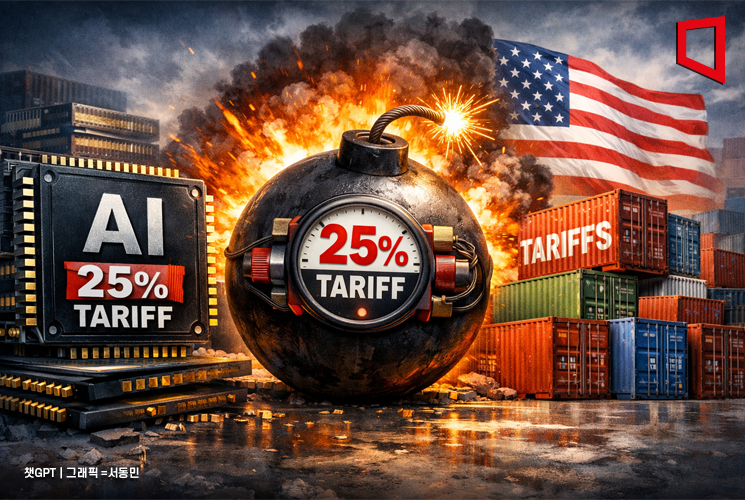
Given the previous tariff negotiations between South Korea and the United States, in which South Korea was promised treatment no less favorable than that of other competing countries such as Taiwan, analysts believe it is highly likely that the U.S. will propose a tariff plan for South Korea that is either identical or equivalent to the agreement reached with Taiwan. However, depending on the details, some companies may inevitably incur losses due to tariffs, making the future course of dialogue between the South Korean and U.S. governments a key issue.
On January 15 (local time), the U.S. Department of Commerce announced the details of its trade agreement with Taiwan, stating that only Taiwanese companies that establish and operate semiconductor manufacturing facilities in the United States will be partially exempt from tariffs.
Accordingly, Taiwanese companies building new semiconductor manufacturing facilities will be exempt from tariffs for imports up to 2.5 times their production capacity during the construction period. Imports exceeding 2.5 times the capacity will be subject to a preferential tariff rate. In addition, Taiwanese companies that complete new semiconductor manufacturing facilities in the U.S. will be able to import up to 1.5 times their new production capacity without paying tariffs.
Analysts say that the United States has effectively set a guideline for semiconductor tariffs by making Taiwan the first case. Prior to the trade agreement with Taiwan, the Trump administration had also announced the previous day that it could impose itemized tariffs on semiconductors in general under Section 232 of the Trade Expansion Act.
The focus of future negotiations is now shifting to South Korea. An industry insider said, "It is highly likely that the U.S. will apply the same approach as with Taiwan-linking tariff exemptions to U.S. investments-without specifying concrete figures for South Korean semiconductor tariffs." However, the insider also noted, "Since the proportion of semiconductors we manufacture and export to the United States is not as large compared to China or Taiwan, the impact of tariffs on us may not be that significant."
There is also analysis that the effects will differ among companies. Samsung Electronics, which has built foundry (semiconductor contract manufacturing) plants in Austin and Taylor, Texas, thereby meeting the requirement of 'constructing or owning local production facilities,' is likely to be exempt from a portion of the tariffs. In contrast, SK Hynix, which is only building a new 'advanced packaging' plant in West Lafayette, Indiana, may not clearly qualify for tariff exemptions given the scale and nature of its facility. The industry views it as uncertain whether this facility, which does not produce finished products, will be recognized by the U.S. government as a manufacturing facility eligible for tariff exemptions.
For now, companies are reportedly viewing this as a matter for the government and are closely monitoring the situation. In November last year, the South Korean government, as a result of the South Korea-U.S. summit, produced a joint fact sheet but did not reach a clear agreement on semiconductor tariffs. The United States only promised South Korea conditions no less favorable than those given to countries with a larger scale of semiconductor trade than South Korea.
© The Asia Business Daily(www.asiae.co.kr). All rights reserved.

















