Report: Regime Change Unlikely Even with Military Intervention
More Military Force Needed to Counter Possible Iranian Retaliation
Trump Delays Decision, Requests Redeployment of U.S. Troops
Carrier Strike Group Including USS Abraham Lincoln Moves
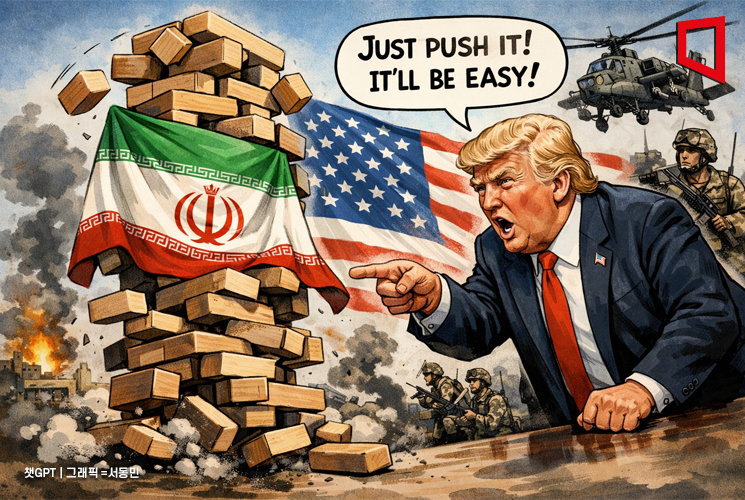
As the Iranian government continues its harsh crackdown on anti-government protesters, the Trump administration has repeatedly issued warnings to Iran. Analysts have noted that even if the United States were to launch a military operation against Iran, it would be difficult to topple the current regime. As a result, it is believed that the U.S. has redeployed its military forces in the Middle East and is closely monitoring the situation.
The Wall Street Journal (WSJ) reported on the 15th (local time) that President Donald Trump recently received a briefing stating that large-scale attacks, such as bombing operations against Iran, are unlikely to bring down the Iranian regime and could instead trigger a larger conflict. The report also indicated that while smaller-scale attacks might boost the morale of anti-government protesters in Iran, it would ultimately be difficult to halt the regime's repression of dissidents.
In particular, White House aides reportedly advised that more military power would be needed to protect U.S. troops and allies (such as Israel) in the Middle East in the event of Iranian retaliation. Accordingly, WSJ stated that President Trump has not made a final decision regarding the situation in Iran, and has requested the redeployment of U.S. forces as a precaution in case a large-scale attack order is issued.
Lindsey Graham, a Republican senator close to President Trump, told reporters that "the scale of operations against Iran is still uncertain," adding, "I believe the scale should be larger."
The Trump administration appears to have refrained from making a final decision on military operations out of concern for possible Iranian retaliation. According to WSJ, Iranian government officials have recently warned the governments of Turkey, Qatar, the United Arab Emirates (UAE), and Oman that "if Iran is attacked, it will strike U.S. military bases in the region."
The area most at risk of Iranian retaliation is the Al Udeid Air Base in Qatar. As the largest U.S. military base in the Middle East, Iran previously attacked this base in June of last year in retaliation for a U.S. strike on its nuclear facilities. In response, the United States withdrew some troops from the base this week as a preventive measure. As tensions between the U.S. and Iran have escalated, Turkey, Qatar, and Saudi Arabia have recently urged President Trump not to attack Iran. The New York Times (NYT) also reported that Israeli officials have raised concerns about potential military action, with Prime Minister Netanyahu asking President Trump to postpone plans for a military strike against Iran.
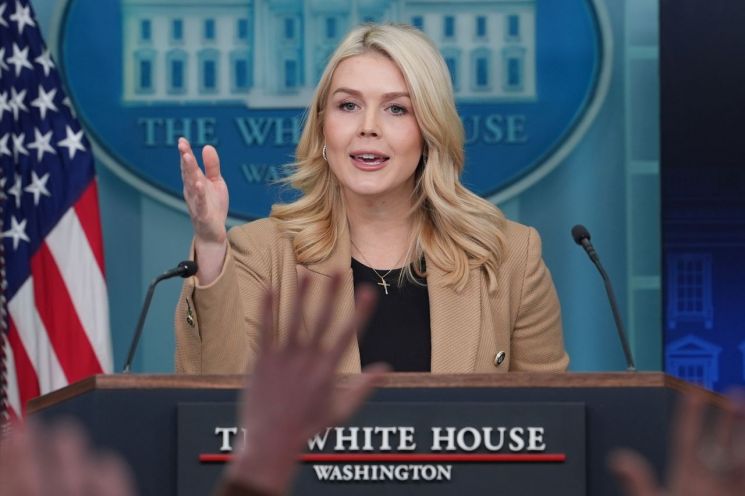
Nevertheless, the Trump administration continues to issue warnings to Iran. During a briefing, White House Spokesperson Caroline Rabbit stated, "President Donald Trump understands that the 800 executions scheduled for yesterday in Iran have been halted," adding, "The President and his team are closely monitoring the situation."
Spokesperson Rabbit also said, "The President and his team have communicated to the Iranian regime that 'if the killings continue, there will be serious consequences,'" emphasizing that "all options remain on the table." These remarks suggest that the possibility of military action against Iran, previously warned about, has not been ruled out.
According to NewsNation, the U.S. Department of Defense has begun moving a carrier strike group, previously deployed in the South China Sea, to the U.S. Central Command Area of Responsibility (AOR). The Central Command AOR covers 21 countries, including Iran, as well as the Middle East, Central Asia, South Asia, and Northeast Africa.
The carrier strike group, centered around the nuclear-powered aircraft carrier USS Abraham Lincoln, is expected to take five to seven days to reach its new location. Some analysts believe that President Trump is continuing to issue warnings to Iran in order to buy time until the carrier strike group is fully redeployed.
© The Asia Business Daily(www.asiae.co.kr). All rights reserved.
![User Who Sold Erroneously Deposited Bitcoins to Repay Debt and Fund Entertainment... What Did the Supreme Court Decide in 2021? [Legal Issue Check]](https://cwcontent.asiae.co.kr/asiaresize/183/2026020910431234020_1770601391.png)

















