Chairman Jung Gi-seok: "Respect for the Court's Decision, but Disappointed"
No Complete Denial of Causality Between Smoking and Lung Cancer
"The State Must Protect Citizens from Tobacco"
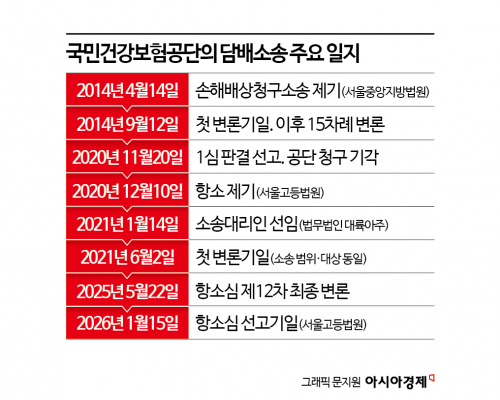
The National Health Insurance Service has announced plans to file a further appeal after losing an appellate court case in a damages claim lawsuit worth approximately 50 billion won against tobacco manufacturers.
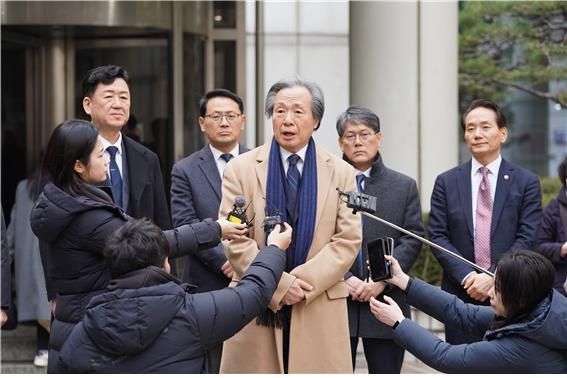 Jung Gi-seok, Chairman of the National Health Insurance Service, is speaking on the 15th at the Seoul High Court in Seocho-gu, Seoul, regarding the second trial loss in a large-scale damages claim lawsuit filed against major tobacco companies. National Health Insurance Service
On January 15, the Civil Division 6-1 of the Seoul High Court ruled against the National Health Insurance Service in its damages claim lawsuit against KT&G, Korea Philip Morris, and BAT Korea, upholding the lower court’s decision in favor of the defendants.
While the Service stated that it respects the judiciary’s decision, it also assessed, "This ruling demonstrates that there are still limitations to resolving the issue of responsibility for diseases and social costs caused by smoking through judicial means."
According to the National Health Insurance Service, this lawsuit was a public interest litigation aimed at holding the parties responsible for causing harm accountable for the structure in which the costs of treating serious illnesses such as lung cancer caused by smoking have long been shifted onto the public through the health insurance system.
The Service focused its case on the causal relationship between smoking and disease, the addictive and harmful nature of tobacco, and the duty of tobacco companies to provide information. However, the court did not accept these arguments in the appellate trial.
The court found in its ruling that the individuals involved in the case were already aware of the harmful and addictive nature of smoking at the time they began smoking in the past. However, the National Health Insurance Service pointed out that this assessment does not align with the medical and social realities of that era.
The Service explained, "Even the U.S. Surgeon General Report, which sets the standard for health issues related to smoking, only officially recognized in 1988 that cigarette smoking is caused by nicotine addiction. Considering that public health campaigns, anti-smoking policies, stricter advertising restrictions, and the expansion of non-smoking areas became more active only after that, it is unrealistic to assume that the general public in the 1960s and 1970s fully understood the dangers of smoking and made their choices based on that awareness."
Although this appellate ruling did not ultimately recognize the causal relationship between smoking and disease, some have evaluated it as a step forward compared to the first trial, which had completely denied such a relationship.
In its decision, the court explicitly acknowledged that the individuals involved were long-term heavy smokers and that developing lung cancer and laryngeal cancer-diseases closely linked to smoking-were important factors in determining causality. This marks a step beyond the first trial, which categorically denied the causal relationship between smoking and disease, and suggests the possibility of future changes in judicial decisions regarding smoking-related harm.
However, considering that major countries overseas recognize the direct responsibility of tobacco companies for smoking-related harm, and that there is a national consensus in Korea with 1.5 million people signing a petition supporting tobacco company accountability, the judiciary’s stance is also being criticized as overly passive in protecting the public’s right to health.
The Service stated, "Internationally, smoking-related harm is viewed not as an issue of individual choice but as a structural problem that society as a whole must address, with judicial rulings and policy responses working in tandem. This lawsuit process shows that our society can no longer postpone discussions on how to address responsibility for smoking-related harm institutionally."
The National Health Insurance Service plans to closely analyze the intent and reasoning behind the ruling, address any legal shortcomings, and actively consider filing an appeal to the Supreme Court.
Jung Gi-seok, Chairman of the National Health Insurance Service, met with reporters immediately after the verdict and said, "While I respect the court’s decision, it is a very disappointing and regrettable ruling. Tobacco companies make enormous profits from selling cigarettes, while the public suffers and dies from smoking-related illnesses. It is like a driver fleeing the scene after causing a traffic accident that left people injured or dead. Tobacco companies are hit-and-run offenders," he criticized.
Chairman Jung also stated, "Tobacco companies have persistently misled the court by relying only on the incorrect claims of a small segment of the medical community. If the state does not protect its citizens from tobacco, the fundamental rights enshrined in the Constitution will inevitably be undermined. We will prepare a diverse range of strategies and respond thoroughly, as if facing a new trial," he added.
© The Asia Business Daily(www.asiae.co.kr). All rights reserved.


















