On January 15, National Education Commission Eases Criteria for High School Credit System
Teacher Organizations Proposed Using Only "Attendance Rate" for Both Core and Elective Subjects
"Academic Achievement Rate" Still Included for Core Subjects... Relative Grading Remains
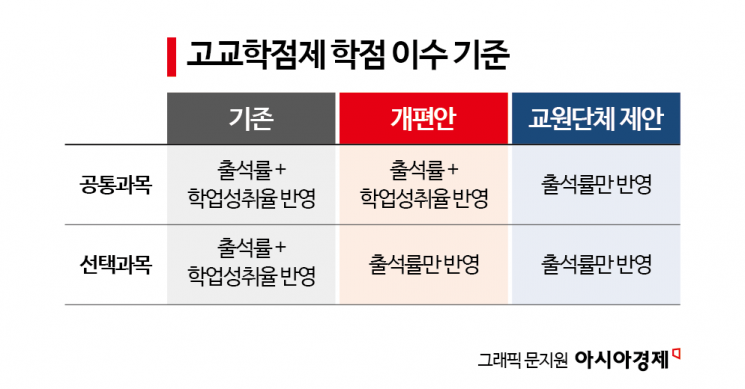
The final criteria for earning credits under the high school credit system, which was introduced last year, were decided on January 15. Starting in March, in order to earn credits in high school, students will need to meet requirements for both 'attendance rate' and 'academic achievement rate' in core subjects, while only 'attendance rate' will be managed for elective subjects. Teachers had suggested that only 'attendance rate' be included as the credit criterion for both core and elective subjects, but this was not reflected in the final decision.
On this day, the National Education Commission held its 64th meeting at the Government Complex Seoul, where it deliberated and approved the establishment and revision of the national curriculum related to the high school credit system.
The revised plan stipulates in the general guidelines for elementary and secondary education curriculum, specifically for the organization and operation of the high school curriculum, that "at least one of attendance rate or academic achievement rate must be reflected, with the criteria set in consideration of educational activities and learner characteristics." This is a relaxation compared to the previous guideline, which stated that "attendance rate and academic achievement rate must be reflected." Of the 21 commissioners, 19 attended the meeting and all present voted in favor of this plan.
However, there was disagreement regarding the recommendation to include 'academic achievement rate' as a criterion for core subjects. Teacher organizations insisted that only 'attendance rate' should be reflected as the credit criterion, but the Commission decided to recommend to the Ministry of Education that both 'attendance rate' and 'academic achievement rate' be reflected for core subjects, while only 'attendance rate' may be applied for elective subjects. The earning of credits for creative experiential activities will also be based on attendance rate.
Choi Eunok, Vice Minister of Education, stated during the meeting, "Regarding the recommendations, the Ministry of Education will prepare its plan and announce it within this month."
The high school credit system allows students to graduate if they earn 192 credits over three years of high school. The system was designed to help students set their career paths by allowing them to choose subjects they are interested in. However, since even elective subjects are graded on a relative scale, students tend to prioritize grades over interest when choosing subjects. Teacher organizations have expressed concerns that this, along with the increased burden on teachers due to the Minimum Achievement Level Guarantee Instruction (Choi Seongbo), is problematic. Under the high school credit system, students must attend at least two-thirds of class sessions and achieve an academic achievement rate of at least 40% to receive credit. If students do not meet the minimum achievement level, they must receive supplementary instruction to make up for learning deficits. However, critics point out that this leads to an excessive focus on simply processing credit completion, which is a negative side effect. As a result, opposition from teachers is expected to continue.
On January 13, the Korean Federation of Teachers' Associations, the Teachers' Union Federation, and the Korean Teachers and Education Workers Union-the three major teachers' organizations-issued a statement regarding the Commission's administrative notice on the high school credit system. They argued, "The proposal does not sufficiently reflect the actual situation in schools or the reality of students' learning, and it ignores the repeated demands from the field and the educational expertise of teachers," and urged that "the criteria for earning credits under the high school credit system should be set based on attendance rate across all grades."
© The Asia Business Daily(www.asiae.co.kr). All rights reserved.

















