A Star Product That Accounted for 20% of Annual Sales from the Start
Exported to 22 Countries Including the US and Europe... Growing in Overseas Markets
"It's hot, so you blow on it~ It's delicious, so you blow on it~"
The red round steamer placed in front of neighborhood stores during winter was a symbol of steamed buns (Hoppang). Now 55 years old, Hoppang has remained a staple winter snack for over half a century, even as countless other snacks have come and gone.
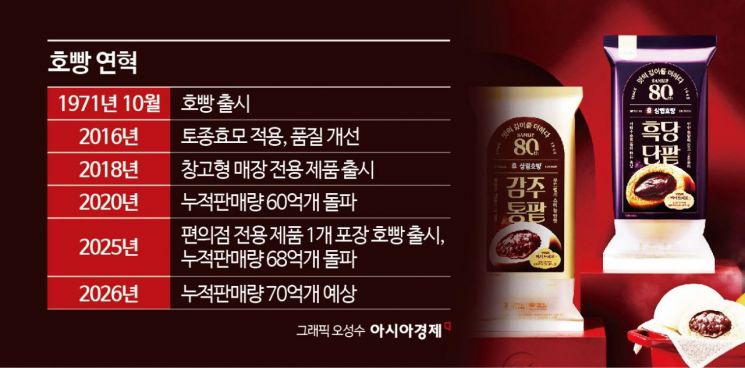
According to the food industry on January 18, Samlip's "Samlip Hoppang," which was first introduced in October 1971, surpassed a cumulative sales volume of 6.8 billion units as of the end of December last year. If you line up Hoppang, each with a diameter of 10 cm and a height of 5 cm, end to end, they would circle the Earth about 16 times. Stacked vertically, they would be enough to go back and forth between the ground and Mount Everest more than 18,000 times.
Based on the domestic population, this translates to every person in Korea eating an average of 2 to 3 Hoppang each winter. This year, cumulative sales are expected to exceed 7 billion units. It is rare even in the food and beverage industry for a single product to record such sales over more than 50 years.
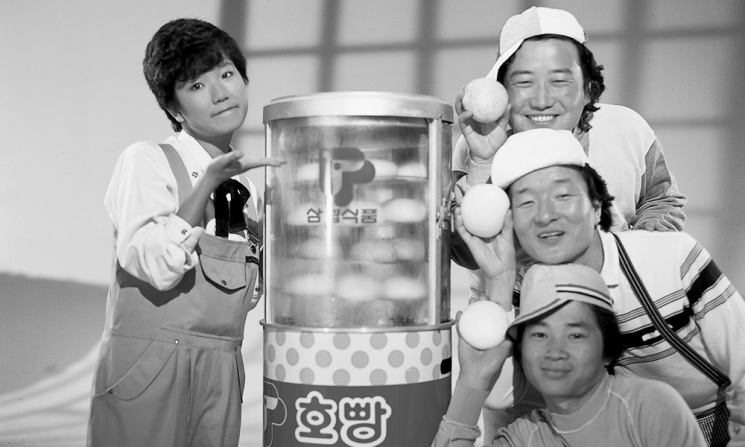
Hoppang was developed by Samlip to fill the sales gap caused by a sharp decline in bread consumption during the winter. In the winter of 1970, researchers and franchise owners at Samlip Foods were anxious that the bread displayed on shelves would freeze in the severe cold. The late Changseong Heo, founder and Honorary Chairman of Sangmidang Holdings, worked day and night with researchers to come up with "bread that could be sold even in winter." After about a year of experimentation, Hoppang was born.
With a diameter of 10 cm and weighing 90 grams, Hoppang was priced at 20 won, which was more expensive than existing bread at the time, but it spread quickly after its launch. Franchise owners were able to secure stable income even during the off-season for bread, and this is regarded as a symbol of founder Changseong Heo's commitment to shared growth. True to its name, "bread you blow on because it's hot," Hoppang established itself as the quintessential winter snack. Even though it was sold only for a limited time from mid-October to February in the early 1970s, Hoppang accounted for more than 20% of Samlip Foods' annual sales at the time.
The secret to its longevity lies in continuous product innovation. Samlip Hoppang has maintained its core lineup of red bean, vegetable, and pizza flavors, while introducing about 20 new products each season. The lineup has expanded to include unique flavors targeting younger consumers, such as mint chocolate, mala, and soda, as well as meal replacements like meat and chive or charcoal-grilled rib. Recently, Samlip has applied its proprietary "Fermented Rice Starter Alpha" to all products to improve texture and flavor. Last year alone, 14 new products and single-packaged items were launched. In particular, the convenience store-exclusive "single-packaged Hoppang" surpassed cumulative sales of 2 million packs within just 50 days of its release.
The cooking method has also evolved. Consumption, once limited to steaming, has expanded through social media to include air fryers and waffle pans. This strategy has extended the brand's value not only through the product itself but also through new consumption methods.
Results are also emerging in overseas markets. Samlip Hoppang is currently exported to 22 countries, including the United States, Australia, Hong Kong, and Europe. Samlip Red Bean Hoppang was the only Korean product to receive the highest rating of three stars in the ready-meal category at the 2024 International Taste Institute in Belgium last June. This product accounts for 52% of sales among Samlip's exports to the United States. Samlip has also introduced package products combining the mini steamer "Hojimi" and Hoppang, mainly through Asian food distribution channels such as H Mart in the United States. Sales in the U.S. market increased by 126% year-on-year in the first half of last year.
A Samlip representative said, "As Korean food culture becomes more familiar to overseas consumers through Korean dramas, movies, and other popular culture content, products with strong Korean characteristics like Hoppang are also being naturally embraced abroad."
© The Asia Business Daily(www.asiae.co.kr). All rights reserved.


















