Maintaining the Goal of February Passage Amid Adjusted Pace
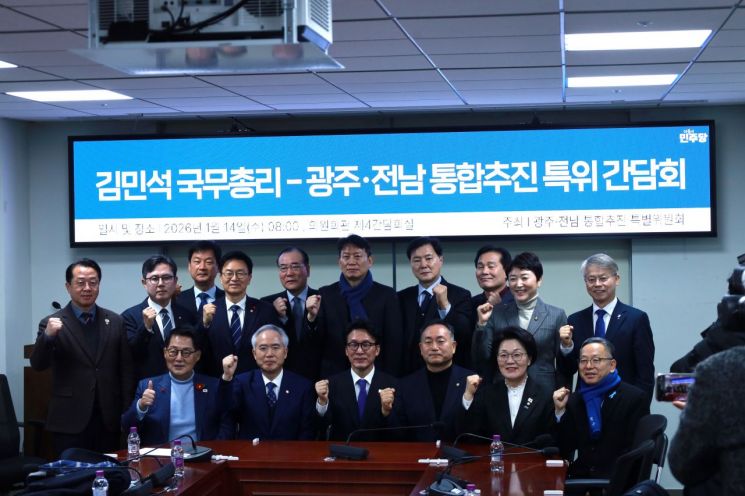 The Special Committee for the Integration Promotion of Gwangju and Jeonnam (Co-Chairmen Kim Woni and Yang Bunam, Members of the National Assembly) held a meeting on the 14th at the National Assembly with Prime Minister Kim Minseok and members of the National Assembly from Jeonnam and Gwangju. Photo by Kim Woni's Office
The introduction of the “Special Act on the Establishment of Gwangju-Jeonnam Special City,” which will serve as the legal foundation for the administrative integration of Gwangju and Jeonnam, is expected to be delayed until the end of this month, later than originally scheduled.
According to the Gwangju-Jeonnam Administrative Integration Promotion Council and other sources on January 15, the special administrative integration bill, which was initially expected to be introduced on January 16, has been rescheduled to the end of the month due to insufficient physical preparation and other reasons.
This postponement was concretized after Yang Bunam, co-chairman of the Democratic Party’s Gwangju-Jeonnam Integration Promotion Committee, mentioned the possibility of adjusting the pace following a meeting with Prime Minister Kim Minseok and local members of the National Assembly at the National Assembly on January 14, stating, “It is realistically difficult to introduce the bill by the 16th.”
This move is seen as both a partial response to local public opinion that the integration process is proceeding too quickly, and as a strategic decision to further refine the incentives and special provisions related to administrative integration.
However, local political and administrative leaders, including Gwangju Mayor Kang Gijung and Jeonnam Governor Kim Youngrok, believe that there will be no major obstacles to the special act passing the National Assembly in February.
Both Gwangju City and Jeonnam Province are accelerating their efforts to ensure the bill’s passage. On this day, the two local governments are holding a legislative public hearing to explain the background and necessity of the special administrative integration bill, raise public awareness, and persuade the government and the National Assembly.
On January 16, a joint city-province administrative integration promotion council meeting will be held to discuss promotional strategies and ways to build consensus on the need for integration. In addition, regional public hearings will be held from January 19 to 31, and, separately, procedures to gather opinions from the city and provincial councils and residents will continue through next month.
The final draft of the Gwangju-Jeonnam administrative integration special act, which is currently being finalized, consists of 8 parts, 23 chapters, 312 articles, and over 300 special provisions. It includes administrative and financial incentives and various authority transfer measures linked to strategic industries such as artificial intelligence (AI), energy, and semiconductors.
However, some assess that, at this stage, the bill only addresses long-standing local issues to a limited extent. If unforeseen variables such as fairness issues with other regions arise, there is a possibility of large-scale revisions to the bill as a whole.
Ultimately, local political figures say that the key issue is how well public opinion in the region can be unified and how effectively the government and National Assembly can be persuaded.
One local political figure stated, “The success or failure of this administrative integration depends on how unified Gwangju and Jeonnam can be in their stance. Since the introduction of the bill has been somewhat delayed, it is necessary to use this time to further refine the special act.”
© The Asia Business Daily(www.asiae.co.kr). All rights reserved.

















