Minister Kim Jeong-Kag Holds Luncheon with Battery Industry Executives on January 8
Remarks Interpreted as Suggesting Possible Restructuring
Ministry of Trade, Industry and Energy Clarifies: "Purpose Was to Seek Diverse Solutions"
Battery Industr
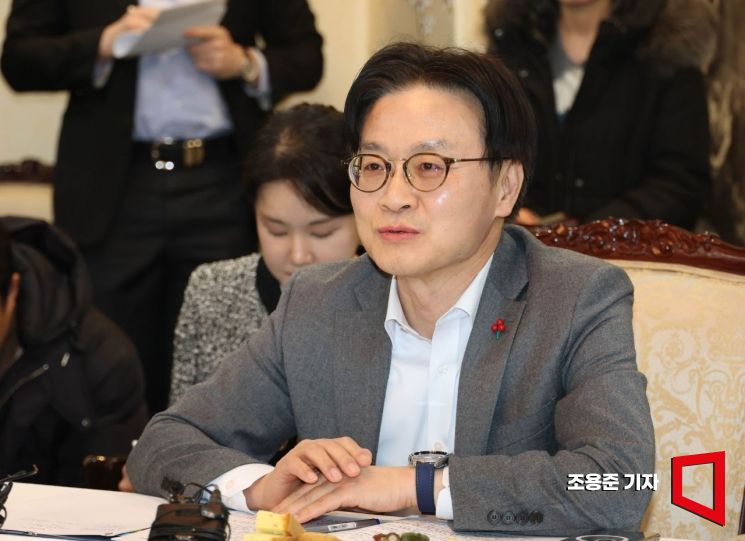 Kim Jeong-Kag, Minister of Trade, Industry and Energy, is speaking at a meeting hosted by the American Chamber of Commerce in Korea (AMCHAM) held at the Government Complex Seoul in Jongno-gu, Seoul on January 9, 2026. Photo by Jo Yongjun
Kim Jeong-Kag, Minister of Trade, Industry and Energy, recently summoned executives from domestic battery companies to discuss the crisis facing the battery industry. Minister Kim emphasized the need to devise various solutions to prevent the battery industry from following the same path as the petrochemical sector.
According to the Ministry of Trade, Industry and Energy and the battery industry on January 15, Minister Kim held a closed-door breakfast meeting on January 8 at an undisclosed location in Seoul with Kim Wooseop, Head of Communications at LG Energy Solution, Shin Changho, Chief Operating Officer of SK On, and Cho Han-je, Vice President and Head of Marketing at Samsung SDI. Key executives from major battery materials companies, including Song Hojun, CEO of Ecopro, and Heo Jehong, CEO of L&F, were also present.
This meeting was convened amid heightened concerns, as domestic battery companies have recently announced a series of contract cancellations.
The Dong-A Ilbo reported that during the meeting, Minister Kim made remarks questioning whether the current three-company structure in the battery industry is sustainable, given the current market environment and production volumes. Depending on interpretation, this could be seen as the government signaling that restructuring may be necessary for the battery industry, just as it was for the petrochemical sector.
In response to the controversy, the Ministry issued a separate statement clarifying that, "Given the current difficulties in the battery market, the government and the industry must work together to find solutions. While the government will actively provide support, the industry should also explore various ways to prevent the situation from developing as it did in the petrochemical sector."
The Ministry further stressed, "The intention was not to suggest that the government would support the industry only if companies voluntarily restructure, as was the case in the petrochemical sector, nor to imply that the number of battery companies should be reduced. The Ministry will continue to closely monitor industry trends, maintain close communication with the sector, and do its utmost to strengthen the competitiveness of the secondary battery industry."
A Ministry official also explained, "The purpose of the meeting was to discuss the challenges facing the battery industry and possible solutions; there was absolutely no mention of restructuring."
Despite the government’s clarification, the battery industry remains visibly uneasy.
While Korean battery companies are struggling to compete with Chinese firms in the global market, the Korean government, in practice, has offered little direct support beyond research and development (R&D) subsidies. In contrast, the Chinese government is reported to have provided hundreds of trillions of won in support to its secondary battery industry to date.
The battery industry has long requested various forms of support from the government, including direct reimbursements, investment tax credits, production tax credits, and special electricity rates, but none have materialized so far. In this context, the minister in charge summoning company executives and making remarks that could be interpreted as advocating restructuring has dampened industry morale.
An industry representative emphasized, "Although battery companies are currently facing difficulties, batteries are a national security asset that will be essential not only for electric vehicles but also for future industries such as robots, drones, data centers, and ships." In reality, only Korea and Japan are capable of competing with China in the global market.
In the United States, the largest market for Korean battery companies, electric vehicle policies have been scaled back since the launch of the second Trump administration, but in the long term, the market is expected to return to a normal growth trajectory.
© The Asia Business Daily(www.asiae.co.kr). All rights reserved.
![Clutching a Stolen Dior Bag, Saying "I Hate Being Poor but Real"... The Grotesque Con of a "Human Knockoff" [Slate]](https://cwcontent.asiae.co.kr/asiaresize/183/2026021902243444107_1771435474.jpg)
















