Design Changes Unavoidable... Underpass Abolition Plan Under Review
Residents Protest Amid Concerns Over Delays and Safety
The construction of Section 13, Phase 2 of Gwangju Urban Railway Line 2 has been completely suspended due to design modification issues, simultaneously raising concerns about delays in the opening and safety controversies.
According to Gwangju City and other sources on January 15, the Gwangju Urban Railway Construction Headquarters held a community briefing session the previous day in Suwan-dong, Gwangsan-gu, explaining the background of the construction suspension near the Suwan Underpass in Section 13 and outlining future alternatives. Section 13 stretches from the Nonghyup Distribution Center intersection to the Unnam intersection. In particular, in the approximately 700-meter section around the Suwan Underpass, the presence of densely clustered underground Korea Electric Power Corporation cables and heat transmission pipes between the underpass and high-rise buildings has made it impossible to proceed with the original shallow-depth construction method.
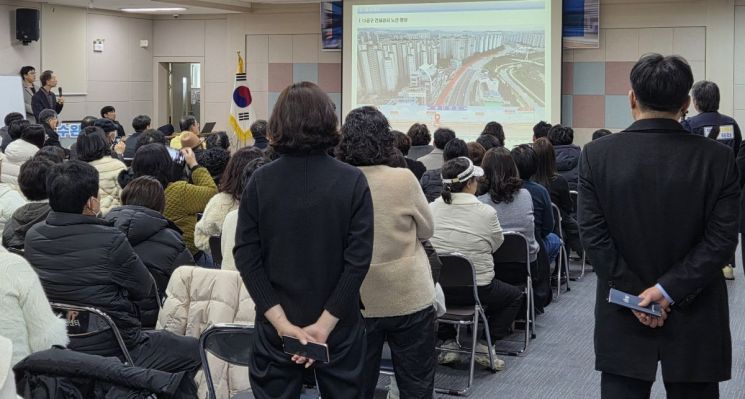 The Gwangju Urban Railway Construction Headquarters held a community briefing session on the afternoon of the 14th in Suwan-dong, Gwangsan-gu, explaining the background of the 'construction suspension' of Section 13, Phase 2 of Urban Railway Line 2. Photo by Assemblyman Park Sugi
Although construction had been underway for over a year in the remaining areas of Section 13, all work was halted last month following the conclusion that design changes were unavoidable. As a result, the Construction Headquarters is currently reviewing several alternatives: maintaining the existing route but switching to a deeper mid- or large-depth tunnel construction method; abolishing the Suwan Underpass and relocating the line to that space; or rerouting the line toward the side road in the Pungyeongjeongcheon direction.
At present, the most likely option is considered to be 'route modification after abolishing the Suwan Underpass,' as this would involve a relatively shorter construction period and lower difficulty. However, this plan is expected to be controversial, as it would require the removal of the underpass, which has served as a key transportation facility connecting the east and west of the Suwan District for nearly 20 years since its opening in 2007. The Suwan Underpass is 750 meters long and has six lanes in both directions, connecting Hanam Industrial Complex and the Second Ring Road. On weekends and holidays, it has frequently experienced congestion due to vehicles accessing commercial facilities in the Suwan District.
On the other hand, there have been ongoing criticisms that the underpass does not provide significant traffic benefits due to difficulties in responding to accidents and bottlenecks at entry and exit intersections. The Construction Headquarters stated, "The underpass was built in conjunction with the introduction of the central bus lane system in the past, but since the abolition of the central bus lane, many believe its function and significance have diminished. We will consult with experts and decide within this month whether modifying the route using the underpass is the most realistic alternative."
Residents have criticized the suspension as a result of poor planning at the design stage. At the briefing session, residents argued that issues related to utility interference and safety, which had been pointed out even before construction began, were not adequately addressed. They also raised concerns about infringement on their living environment and reduced station accessibility due to route changes. There were repeated calls for the public release of objective verification data regarding potential ground subsidence and the safety of nearby high-rise buildings if the construction method is switched to mid- or large-depth tunnels.
Park Sugi, a member of the Gwangju City Council (Gwangsan 5), stated, "This is not simply an issue of construction schedule adjustment, but a case that reveals structural limitations at the design stage. A transparent review is necessary, with the highest priority placed on citizen safety."
This suspension of Section 13 construction is expected to affect the overall opening schedule of Gwangju Urban Railway Line 2. At present, there is even the possibility that the opening could be delayed until after 2032.
© The Asia Business Daily(www.asiae.co.kr). All rights reserved.

















