People Power Party: "Second Special Prosecutor Bill Is Endless Political Retaliation"
Democratic Party: "Will Pass the Bill After Termination Vote on the 16th Despite Opposition Filibuster"
It appears that the filibuster-a tactic involving unlimited debate to obstruct legislative proceedings-will be repeated during the first extraordinary plenary session of the National Assembly in 2026. Ahead of the plenary session scheduled for January 15, the ruling and opposition parties continued to clash over the "Second Comprehensive Special Prosecutor Act." The Democratic Party of Korea, seeking to push through the bill to establish a second special prosecutor following the three major special prosecutor acts (related to insurrection, Kim Keonhee, and Private Chae), faced a warning from the People Power Party, which announced plans to launch a filibuster in response.
The floor leadership of both parties continued to negotiate the legislative agenda that day, but struggled to reconcile their differences regarding the second special prosecutor bill. Song Eon-seok, Floor Leader of the People Power Party, stated at the Supreme Council meeting, "Pushing forward with the second special prosecutor is an unfair 'ruling party acquitted, opposition party guilty' approach," adding, "It is nothing more than the endless repetition of politically motivated investigations and retaliation against the opposition."
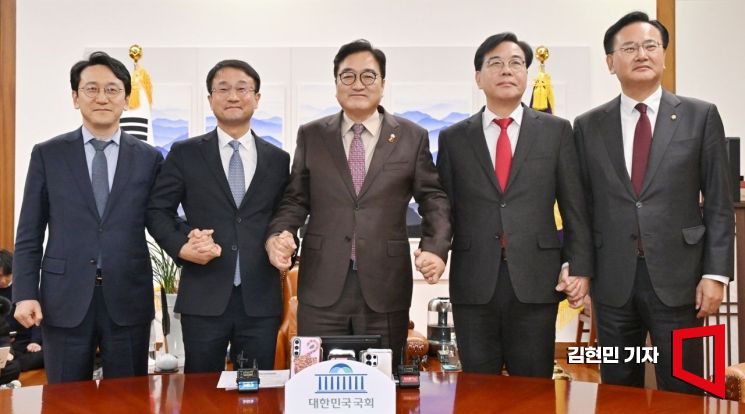 Woo Wonsik (center), Speaker of the National Assembly, and floor leaders from both ruling and opposition parties met at the Speaker's office on the 14th, joining hands for a commemorative photo. From the left: Cheon Junho, Deputy Floor Leader for Operations of the Democratic Party of Korea; Han Byungdo, Floor Leader; Speaker Woo; Song Eonseok, Floor Leader of the People Power Party; and Yoo Sangbeom, Deputy Floor Leader for Operations. January 14, 2026. Photo by Kim Hyunmin
The People Power Party insisted that issues surrounding the "Unification Church Special Prosecutor Act" must be resolved before addressing the second special prosecutor bill. Their strategy appears to be that, unless the Unification Church special prosecutor is accepted, they will block other livelihood-related bills through a filibuster. After the meeting, Floor Leader Song stated, "The Democratic Party is trying to dilute the issue by insisting that suspicions about the Shincheonji Church be included in the Unification Church special prosecutor bill," and added, "We made it clear that we want these to be handled as separate special prosecutor cases."
The Democratic Party is expected to push ahead with the 35 livelihood-related bills and the second special prosecutor bill, which have been selected by Speaker Woo Wonsik, leveraging the majority held by the broader pro-government bloc, even if no agreement is reached. Han Byungdo, Floor Leader of the Democratic Party, said at the Supreme Council meeting, "The Democratic Party will put an end to the stalling tactics by passing the second special prosecutor bill through a filibuster termination vote on January 16." A filibuster can be forcibly ended with the approval of at least three-fifths of all sitting lawmakers, 24 hours after it begins.
© The Asia Business Daily(www.asiae.co.kr). All rights reserved.
![Clutching a Stolen Dior Bag, Saying "I Hate Being Poor but Real"... The Grotesque Con of a "Human Knockoff" [Slate]](https://cwcontent.asiae.co.kr/asiaresize/183/2026021902243444107_1771435474.jpg)
















