Trump Signs Successive Proclamations on Semiconductors and Critical Minerals
"Ministry and Industry Conduct Joint Analysis to Assess Impact on Korean Companies"
Meetings with U.S. Congress, USTR, and OMB During U.S. Visit
Managing Tariff Follow-Up and IEEPA Risks Simultaneously
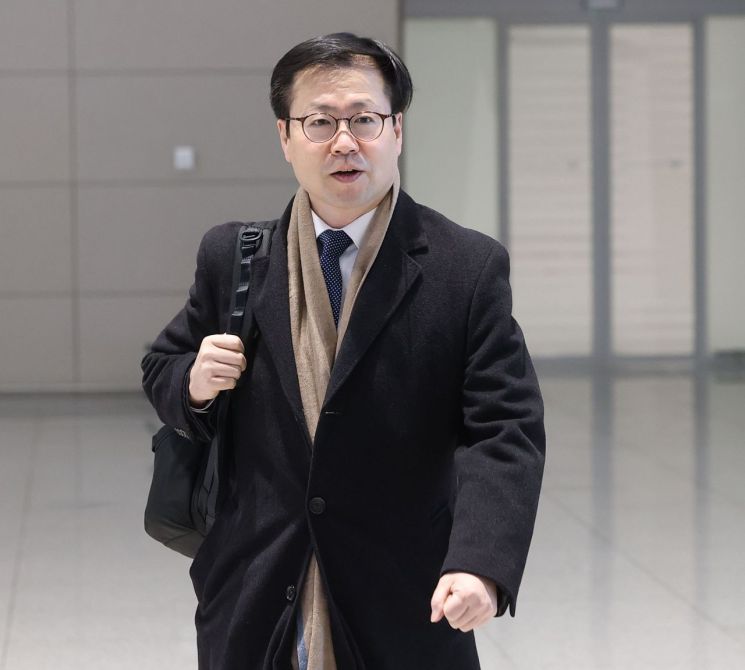
Yeo Han-koo, Trade Minister for Trade Negotiations at the Ministry of Trade, Industry and Energy, who is currently visiting the United States, has postponed his return by one day in order to assess the potential impact of a series of proclamations signed by U.S. President Donald Trump regarding semiconductors and critical minerals.
On January 14 (local time), Yeo met with reporters at Union Station in Washington, D.C., stating, "New executive orders related to semiconductors and critical minerals have been announced," and added, "I plan to stay in Washington for an extra day to get a clearer understanding of the situation." Initially, he was scheduled to travel to New York that day and return to Korea on a night flight, but he changed his plans.
Regarding the impact of the semiconductor tariff proclamation signed by President Trump on Korean companies, he said, "We are closely monitoring the situation, so it is difficult to comment prematurely," and explained, "The ministry and the industry are jointly analyzing the issue." He further stated, "I intend to stay an additional day to see if there are more local contacts to meet or information to gather in the United States."
Previously, President Trump signed a proclamation imposing a 25% tariff on semiconductor chips imported into the United States and subsequently re-exported to third countries. According to the White House, this measure primarily targets AI accelerator semiconductors such as Nvidia's 'H200,' and is based on the findings of the U.S. Department of Commerce's investigation into the impact of semiconductor imports on national security under Section 232 of the Trade Expansion Act.
The White House stated in a fact sheet, "President Trump may soon impose broader import tariffs to encourage domestic manufacturing of semiconductors and derivative products, and may introduce corresponding tariff offset programs."
In a separate proclamation, President Trump also directed negotiations with trading partners to adjust the structure of critical mineral imports to align with U.S. national security interests. The proclamation also included the possibility of measures such as setting minimum import prices for certain critical minerals, depending on the outcome of the negotiations.
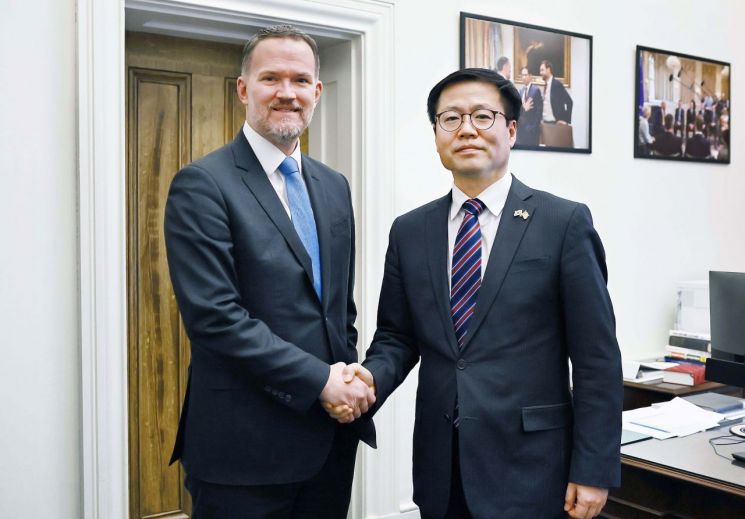
Meanwhile, during his visit to the United States, Minister Yeo conducted extensive outreach to the U.S. Congress, government, and industry, explaining Korea's digital legislation and the follow-up implementation of the Korea-U.S. tariff negotiations.
While in Washington, D.C., he met with members of the U.S. Senate and House of Representatives (Andy Kim, Bill Hagerty, Dave McCormick, Todd Young, Adrian Smith, Darrell Issa, Rudy Yakym), as well as representatives from the service and ICT industries and associations, think tanks such as CSIS and PIIE, Jamieson Greer, U.S. Trade Representative (USTR), and Russell Vought, Director of the White House Office of Management and Budget (OMB), to coordinate key issues.
Given ongoing concerns from the U.S. side that Korea's online platform regulations and digital service legislation could result in discrimination against American companies, Minister Yeo reportedly focused on explaining the background and procedures of the legislative process and Korea's willingness to consult with U.S. firms.
The U.S. Congress and industry representatives expressed their appreciation for the Korean government's explanations but emphasized that the principle of "avoiding unnecessary barriers to U.S. companies," as specified in the joint statement from the Korea-U.S. summit in November last year, must be upheld. They also called for stakeholder input and transparent legislative procedures, indicating that they would closely monitor future developments.
It was also reported that U.S. lawmakers inquired about the recent large-scale personal data breach in Korea. The Korean government clarified that relevant agencies are conducting investigations in accordance with the law and made it clear that it is inappropriate to interpret this incident as a trade or diplomatic issue between Korea and the United States.
Minister Yeo also reviewed the follow-up implementation of the Korea-U.S. tariff negotiations during his meeting with Greer. Both sides shared updates on the implementation of non-tariff agreements, and Minister Yeo particularly emphasized that Korea should not be treated less favorably than other countries, especially ahead of the U.S. Supreme Court's upcoming decision on the International Emergency Economic Powers Act (IEEPA).
In his meeting with Director Vought, discussions focused on expanding investment cooperation between Korea and the United States in strategic industries such as shipbuilding. As U.S. industrial policy and the trend of increased local investment by Korean companies converge, there are expectations that future cooperation will be further strengthened across trade, industry, and security sectors.
© The Asia Business Daily(www.asiae.co.kr). All rights reserved.
![User Who Sold Erroneously Deposited Bitcoins to Repay Debt and Fund Entertainment... What Did the Supreme Court Decide in 2021? [Legal Issue Check]](https://cwcontent.asiae.co.kr/asiaresize/183/2026020910431234020_1770601391.png)
















