KITA to Hold Second Briefing Tomorrow
Experts: "Settlement Date Must Be Checked"
The U.S. Supreme Court has not yet issued a legal ruling on the so-called "reciprocal tariffs" imposed during the Trump administration, but as speculation grows that a final decision is imminent, Korean companies are accelerating their preparations for tariff refunds.
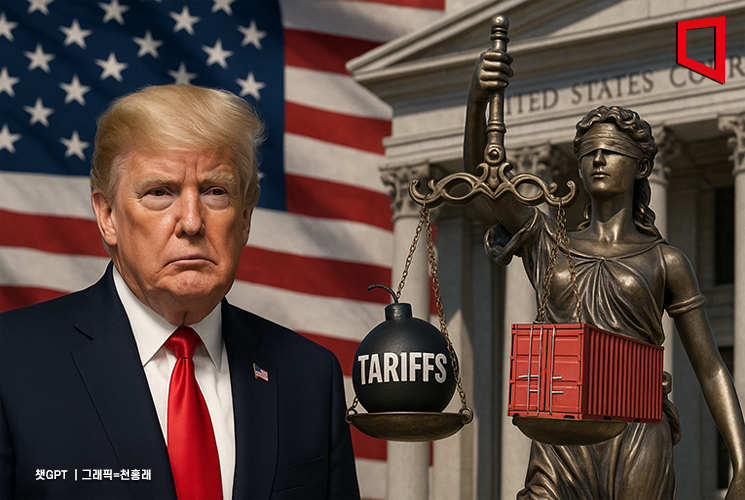
According to the business community on January 15, export and import support organizations such as the Korea International Trade Association (KITA) have recently been inundated with inquiries from companies regarding the possibility and procedures for tariff refunds related to the reciprocal tariffs. If the U.S. Supreme Court ultimately rules these tariffs unlawful, all tariffs collected so far would be rendered null and void, opening the door for companies to reclaim significant amounts of money.
To meet the strong demand from companies seeking to resolve this issue, KITA has decided to hold a second briefing session on U.S. tariff litigation and refund responses at the Trade Tower in Samseong-dong, Seoul, on the morning of January 16. The first session was held on December 19 last year at COEX in Samseong-dong, Seoul, after the appellate court decision, and was attended by more than 100 representatives from export companies, industry organizations, and associations, reflecting high interest. The business community expects that attendance at the second session will far exceed that of the first.
Experts advise companies to carefully check the settlement date in preparation for tariff refunds, and this point is expected to be emphasized again at the upcoming briefing. At the first KITA session, lawyer Yoon Youngwon of the law firm SEJONG stressed, "The strategy for tariff refund procedures depends on the settlement date," explaining, "Before settlement, refunds can be obtained simply by correcting the import declaration, but after the tax amount is finalized, a formal 'protest' must be filed with U.S. Customs and Border Protection (CBP) within 180 days from the date of settlement to receive a refund." John Leonard, an advisor at Kim & Chang and former Deputy Executive Director of the CBP Office of Trade, pointed out, "In principle, the applicant for tariff refunds is the U.S. importer," and added, "Korean companies must clearly identify in contracts who is responsible for the tariff burden and who is entitled to the refund." He continued, "Recently, there has been an increase in Delivered Duty Paid (DDP) transactions, where the tariff burden is shifted to the exporter. In such cases, the exporter may apply for the refund directly, so prior verification is necessary."
A KITA official stated, "In most cases, there is no explicit contractual clause specifying how to return the reduced unit price if the local importer receives a tariff refund," and analyzed, "Depending on the outcome of the ruling, there is a high possibility of large-scale settlement disputes or lawsuits between U.S. importers and Korean exporters."
© The Asia Business Daily(www.asiae.co.kr). All rights reserved.

















