Bosch Plans to Cut 13,000 Jobs by 2030
Continental, Valeo, and Other Parts Suppliers Also Announcing Layoffs
"China Poses a Major Threat...An Unprecedented Crisis"
Over the past two years, it has been estimated that around 100,000 jobs have been cut in the European automotive parts industry. On January 13 (local time), Yonhap News quoted the Financial Times (FT) of the United Kingdom, reporting that, according to the European Association of Automotive Suppliers (CLEPA), the number of layoffs announced by European Union (EU) automotive parts companies was 54,000 in 2024 and 50,000 in 2025. This figure is nearly double the total of 53,700 layoffs announced during the COVID-19 pandemic in 2020 and 2021.
 In September last year, Bosch, the world's largest automotive parts manufacturer, announced plans to cut an additional 13,000 jobs by 2030. Photo by Reuters Yonhap News
Previously, in September of last year, Bosch, the world's largest supplier, announced plans to cut an additional 13,000 jobs by 2030. It was also reported that Continental, Valeo, Forvia, Schaeffler, and Mahle each announced plans to cut more than 1,000 jobs between 2024 and 2025.
This trend is largely attributed to the aggressive entry of Chinese companies into the European market. Benjamin Krieger, Secretary General of CLEPA, described the situation as "unprecedented," noting, "China poses a significant threat. They are bringing technically well-made cars to the market at very low prices."
Additionally, as the European market gradually moves away from gasoline and diesel vehicles, suppliers focused on internal combustion engine vehicles are facing increasing pressure. In particular, since the Volkswagen emissions scandal in 2015, the market share of diesel vehicles has been declining.
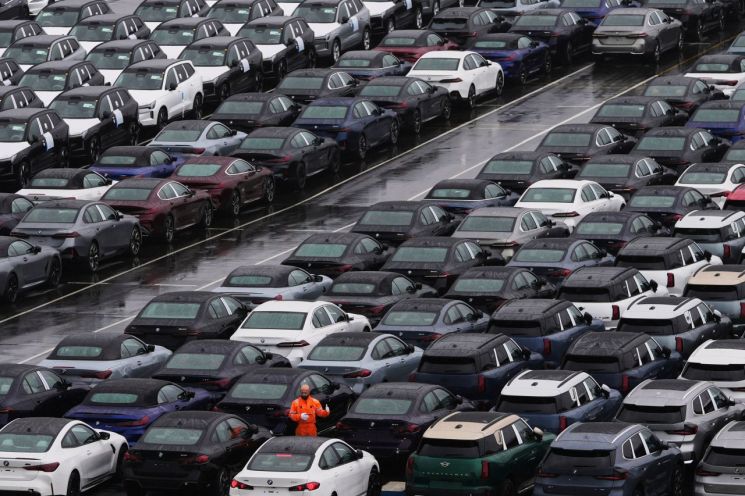 Photo of the international automobile terminal at the Port of Zeebrugge, Belgium, to aid in understanding the article. Photo by AP Yonhap News Agency
According to the European Automobile Manufacturers’ Association (ACEA), as of October last year, the market share in Europe by engine type was 34.7% for hybrids, 26.9% for gasoline vehicles, 18.3% for electric vehicles (EVs), 9.4% for plug-in hybrids (PHEVs), and 8% for diesel vehicles.
Tariffs imposed by the Donald Trump administration in the United States have also had an impact. In August of last year, President Trump set tariffs on European cars and automotive parts at 15%. While this is significantly lower than the originally proposed 27.5%, it is still a substantial increase compared to the previous rate of 2.5%.
The European Commission is preparing measures to increase the proportion of European-made products in key sectors to protect European industry. Automotive parts suppliers are demanding that the standards for the proportion of European-made parts be set high, but automakers are reportedly opposed, citing concerns over price competitiveness.
© The Asia Business Daily(www.asiae.co.kr). All rights reserved.


















