Preemptive Inspections of Large-Scale Operators such as Portals and Telecom Companies
Crackdown on Dark Patterns, Biometric Data Collectors Also Targeted
AI, Blockchain Sectors and Public Institution Vulnerabilities Under Review
As a series of large-scale personal information leaks have occurred, the government has decided to select six high-risk sectors for intensive inspection.
 Song Kyunghee, Chairperson of the Personal Information Protection Commission, is striking the gavel at the 1st plenary meeting of the Personal Information Protection Commission held at the Government Seoul Office in Jongno-gu on January 14, 2026. Photo by Jo Yongjun
On January 14, the Personal Information Protection Commission finalized the "2026 Direction for Personal Information Investigation Work" at its plenary meeting. The commission will shift from a post-incident sanction-focused response to a risk-based investigation approach, including preemptive status checks.
First, the commission will prioritize proactive inspections of major industries and businesses that handle large volumes of personal information and are closely linked to daily life. Priority inspection targets will be selected based on a comprehensive evaluation of the amount of personal information held, frequency of incidents, nature of services, and whether sensitive information is processed. Large-scale portals, telecommunications companies, and financial institutions-where leaks could have significant repercussions-are expected to be among the main targets. Based on recent cases involving administrative fines, the commission plans to examine internal control systems by reviewing key vulnerabilities such as hacking.
Businesses that utilize biometric information such as facial and voice data, as well as video information, will also be subject to intensive inspection. In response to recent IP camera hacking incidents, the commission will inspect the handling of personal information by service providers that use biometric recognition data, such as facial and voice information, in multi-use facilities and identity verification processes.
"Dark patterns," which are used to excessively collect or unreasonably process personal information, have also been identified as one of the six high-risk areas. The commission plans to encourage improvements by monitoring major web and application services to ensure that the rights of data subjects are not infringed. Additionally, as cases of excessive collection of personal information from children and adolescents at venues such as performance halls have come to light, the entertainment industry will also be subject to inspection.
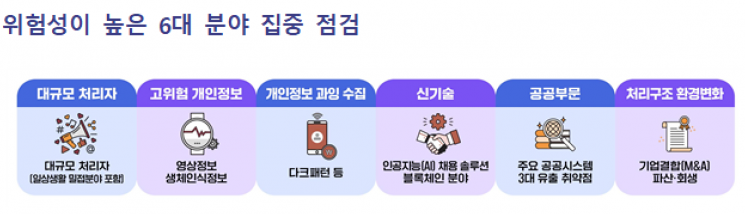
The commission has determined that new risks of infringement are also increasing due to emerging technologies such as artificial intelligence (AI) and blockchain. For companies developing AI-based recruitment solutions and the organizations using them, the commission will check efforts to ensure transparency, such as whether decisions are automated, whether there is an obligation to provide explanations, and whether key evaluation criteria are disclosed.
In the blockchain sector, the commission will focus on controlling the identifiability of individuals in applications such as virtual assets and decentralized identity (DID) services, the structure for distributing responsibility among blockchain participants, and the legality of cross-border data transfers.
For the public sector, the commission will strengthen vulnerability inspections, including simulated hacking, targeting major public systems. Special emphasis will be placed on improving the three main recurring leak vulnerabilities: human error, web vulnerabilities, and management blind spots.
Finally, the commission will also inspect the legality and safety of large-scale personal information transfers and destruction that occur during corporate structural changes such as mergers and acquisitions (M&A), bankruptcy, and rehabilitation.
Meanwhile, the commission will enhance the functions of the "Personal Information Infringement Reporting Center," which provides public consultation and helps resolve grievances. It will offer guidance on remedies and establish a real-time monitoring system to detect personal information infringement factors early.
Additionally, the commission plans to strengthen the authority of investigations and enable faster responses by introducing enforcement fines for non-compliance with data submission requests, establishing evidence preservation orders to compel data retention, and creating a legal basis for regular preemptive status inspections.
© The Asia Business Daily(www.asiae.co.kr). All rights reserved.


















