Solving the Silicon Anode Performance Degradation Problem
with the Development of a New Binder Material
SK On has proposed a solution to the performance degradation problem, which has been considered a major obstacle to the commercialization of silicon anode all-solid-state batteries, through the development of a new material.
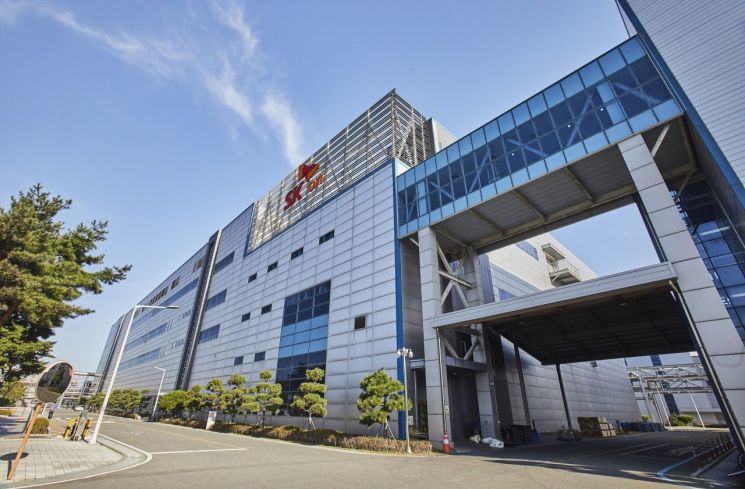
On January 15, SK On announced that, in collaboration with Professors Jung Yoonseok and Kim Junghoon of Yonsei University, it has developed a new binder material optimized for silicon anodes called "electron-conductive polymer (PPMA)." PPMA is a new binder material that simultaneously secures both conductivity and adhesive strength, resolving the structural safety issues that have plagued conventional silicon anode all-solid-state batteries.
The results of this research were published on December 5 in the international journal "Nature Communications." The study has drawn attention for stably implementing a conductive polymer binder-which had previously seen limited use in liquid electrolyte-based batteries-within all-solid-state battery environments, thereby expanding its range of applications.
SK On succeeded in operating a silicon anode all-solid-state battery with the new binder material under pressure conditions close to those required for commercialization. This achievement is significant in that it verified the performance of a high-energy-density pouch-type battery under actual electric vehicle application conditions, going beyond laboratory-level test batteries. Notably, even after hundreds of charge-discharge cycles, the battery stably maintained its initial performance without any capacity loss.
Silicon anodes are theoretically capable of storing about 10 times more than graphite, making them a key material for next-generation high-energy-density batteries. However, the issue of volume expansion-over 300% during charge and discharge cycles-remains a challenge for commercialization. All-solid-state batteries conduct electricity only through contact between solid particles in the electrodes. If this contact is lost, it is difficult to restore, so increasing the use of binder materials or applying high pressure has been the common approach. However, polyvinylidene fluoride (PVDF), which has been widely used as a binder, is highly insulating, making it difficult to improve electrode performance as its usage increases.
SK On and the Yonsei University research team identified that the cause of performance degradation under low-pressure conditions lies in electron movement within the electrode, rather than lithium-ion transfer. The newly developed PPMA material is designed to stably form electron pathways throughout the electrode while strengthening the bonding between silicon particles. Additionally, this new binder material stands out for simplifying the manufacturing process and improving production efficiency. Whereas the conventional method required special solvents and high pressure, PPMA enables a water-based process, reducing environmental impact and manufacturing costs. The required pressure was also reduced by more than 80%.
Park Kisoo, Head of the Future Technology Institute at SK On, said, "Through industry-academia cooperation, we have made meaningful progress in the field of next-generation all-solid-state batteries," adding, "We will continue to accelerate innovation in next-generation battery technologies together with academia."
© The Asia Business Daily(www.asiae.co.kr). All rights reserved.
![Clutching a Stolen Dior Bag, Saying "I Hate Being Poor but Real"... The Grotesque Con of a "Human Knockoff" [Slate]](https://cwcontent.asiae.co.kr/asiaresize/183/2026021902243444107_1771435474.jpg)
















