Last year, the number of railway passengers approached 150 million, setting an all-time record.
According to Korea Railroad Corporation (KORAIL) on January 15, the cumulative number of KTX and general train passengers last year reached 146.24 million, an increase of 1.44 million compared to the previous year (144.8 million). By train type, KTX accounted for 92.71 million passengers, while general trains such as Mugunghwa and Saemaeul carried 53.53 million passengers.
The day with the highest number of railway users during the year was Saturday, November 15, the first weekend after the college entrance exam, with a total of 550,000 passengers using the trains that day.
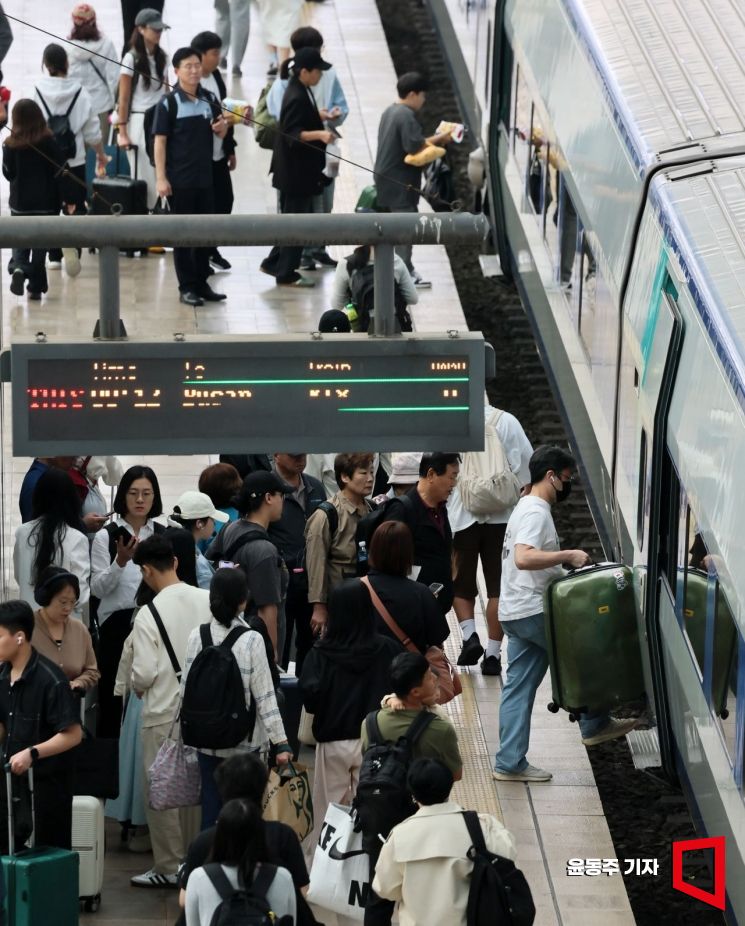
Seoul Station was the busiest station of the year, with a total of 120,000 passengers annually. It was followed by Dongdaegu Station with 52,000, Daejeon Station with 51,000, Busan Station with 49,000, and Yongsan Station with 41,000 passengers. The most popular route was Seoul↔Busan, with a total of 7.76 million passengers. This was followed by Seoul↔Daejeon with 5.74 million, and Seoul↔Dongdaegu with 4.98 million passengers.
KORAIL analyzed that the expansion of new lines such as the Donghae Line, Gyoe Line, and Mokpo-Boseong Line last year drove the increase in railway passengers. The company explained that improved connectivity between regions led to a tangible rise in passenger numbers. Last year, the number of passengers by new line was 1.86 million on the Donghae Line (including general trains), 210,000 on the Gyoe Line, and 160,000 on the Mokpo-Boseong Line.
The increase in KTX service on the Jungang Line (Cheongnyangni~Bujeon) and the Gangneung Line (Cheongnyangni~Gangneung) also contributed to the rise in passenger numbers. Last year, KORAIL tripled the number of Jungang Line services from six (three round-trips) per day to eighteen (nine round-trips) per day, and increased KTX-Eum services on the Gangneung Line, which has high tourism demand, by four trips (two round-trips) per day, adding 1,524 seats daily.
It is also notable that the number of foreign railway passengers exceeded 6 million annually. Previously, KORAIL introduced 310 new ticket vending machines at 148 stations nationwide, including Seoul and Daejeon, equipped with overseas card payment functions to make it easier for foreigners to purchase tickets.
Additionally, KORAIL enhanced its multilingual services by adding Thai, Vietnamese, and Indonesian support to the mobile app 'KORAIL Talk,' making the service available in a total of seven languages, and by operating a travel center at Seoul Station to assist foreign tourists.
Cha Seongryeol, Head of KORAIL's Passenger Business Division, stated, "Last year, the cumulative annual number of train passengers surpassed the previous all-time record," adding, "KORAIL will continue to expand train operations nationwide to improve mobility rights for the public."
© The Asia Business Daily(www.asiae.co.kr). All rights reserved.
![A Woman Who Jumps Holding a Stolen Dior Bag... The Mind-Shaking, Bizarre Con of a "Human Knockoff" [Slate]](https://cwcontent.asiae.co.kr/asiaresize/183/2026021902243444107_1771435474.jpg)
















