This Year’s Average Auction Price for Roses Up 66%
Economic Downturn Spurs Search for Alternatives to Fresh Flowers
Floral Industry: "Government Support Is Urgently Needed"
Yang, who has been running a flower shop in Seongbuk-gu, Seoul for 30 years, feels anxious even as the busy season of entrance and graduation ceremonies approaches. As the economic downturn becomes entrenched and flower prices soar, customers have stopped visiting flower shops altogether. To make matters worse, more consumers are now seeking alternatives to fresh flowers that wilt quickly, preferring items that can be kept for longer periods. Yang said, "Every customer who comes in asks why flowers are so expensive, but the wholesale prices at the auction market have risen so much that there is nothing we can do. This is my 30th year running the shop, but these days I am seriously considering whether I should just close down."
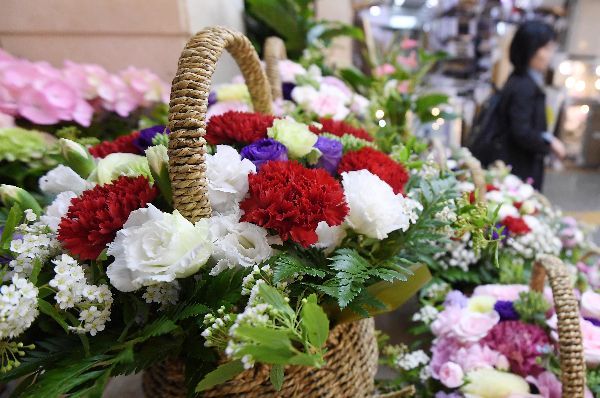 Flower baskets including carnations are displayed at a flower shop in Banpo Underground Shopping Center, Seocho-gu, Seoul. Photo by Hyunmin Kim kimhyun81@
Floriculture small business owners are growing increasingly concerned as the traditional peak season of entrance and graduation approaches. Raw material prices have skyrocketed, and consumer sentiment has weakened. On top of that, there is a growing trend of people celebrating special occasions in their own ways or choosing a variety of alternatives instead of flowers.
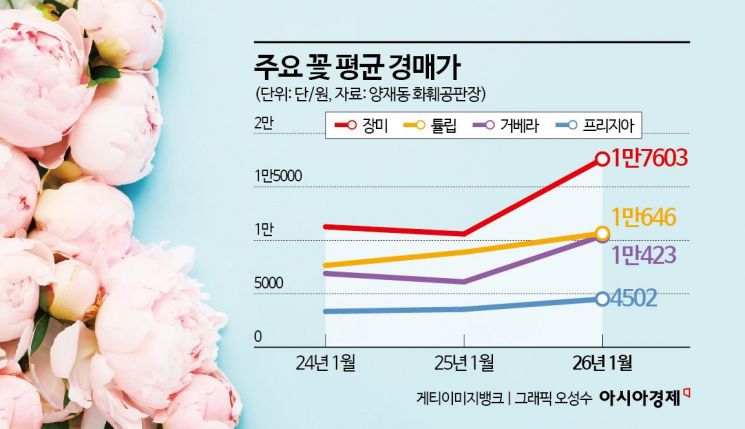
According to the Korea Agro-Fisheries & Food Trade Corporation (aT) on January 15, auction prices for major items commonly used in bouquets have continued to rise this year. The average January auction price for a bundle of roses at the Yangjae Flower Wholesale Market, a popular choice for entrance and graduation gifts, was 17,603 won, up 66.3% from the previous year. During the same period, gerberas rose to 10,423 won, a 70.7% increase, and tulips climbed to 10,646 won, up 19.9%. The average auction price for freesias, often used for their variety of colors, also rose 27.1% year-on-year to 4,502 won.
The main reason for this year’s surge in flower prices is a decrease in production volume. Since last year, electricity rates have risen significantly, prompting some small-scale growers to reduce their cultivation area and output to cut heating costs. According to the Floriculture Distribution Information System, the total volume of cut flowers in January this year dropped by 12.5% compared to last year. Furthermore, since June of last year, imports of Ethiopian roses have been completely banned due to concerns over the False Codling Moth (FCM). Ethiopian roses were especially popular because they were relatively inexpensive compared to imports from Colombia and other countries.
An aT official explained, "As labor and electricity costs have risen, farms have reduced their production volume, and last year’s unfavorable climate conditions in production areas had the greatest impact on the decrease in output. We expect prices to fall again after the peak season from January to March, as demand will decrease."
The social atmosphere of seeking cheaper alternatives is also adding to the worries of small business owners. More people are trying to save money by buying used flowers or replacing short-lived fresh flowers with items like stuffed animals, balloons, or soap flowers. Recently, controversy arose in the floral industry when a broadcasting awards ceremony featured a congratulatory bouquet made of toy 'Lego flowers' instead of real flowers, prompting an official statement from the industry.
The floral industry believes that government policy support is needed to promote flower consumption and establish it as part of the culture. Bae Jeonggu, President of the Korea Florist Association, said, "The floriculture industry is the livelihood base for more than 20,000 small business owners and numerous flower farms. In addition to rising labor, oil, and raw material costs, there is now a growing trend of avoiding fresh flowers altogether. Floriculture small business owners are struggling more than ever, so it is crucial for the government to show interest and make efforts to encourage flower consumption in daily life and support flower farms."
© The Asia Business Daily(www.asiae.co.kr). All rights reserved.













