Metropolitan Areas Lead in Startups and Infrastructure
Provincial Regions Attract Companies by Easing Regulations
KCCI: "Nationwide Improvement Needed for a Better Business Environment"
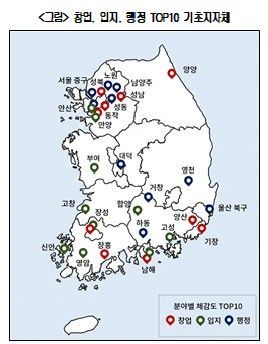
The Korea Chamber of Commerce and Industry recently conducted a "Business Environment Perception Survey" targeting 6,850 companies located in 228 basic local governments, selecting the top 10 in the fields of startup, location, and administration. The regions recognized for excellence in startups included Seongnam and Anyang (Gyeonggi Province), Dongjak and Seongbuk (Seoul), as well as Yangyang (Gangwon Province), Namhae and Yangsan (South Gyeongsang Province), Gijang (Busan), and Jangseong and Jangheung (South Jeolla Province), which were all highlighted as startup-friendly local governments.
According to the Korea Chamber of Commerce and Industry on January 15, the top 10 in the location category included many local governments from the Yeongnam and Honam regions, such as Goseong, Namhae, and Hamyang (South Gyeongsang Province), Shinan, Yeongam, and Jangseong (South Jeolla Province), and Gochang (North Jeolla Province). In addition, Anyang and Ansan (Gyeonggi Province) and Buyeo (South Chungcheong Province) were also selected as outstanding regions. In the administrative convenience category, Namyangju and Ansan (Gyeonggi Province), Geochang and Hadong (South Gyeongsang Province), Yeongcheon (North Gyeongsang Province), Daedeok (Daejeon), Buk-gu in Ulsan, Nowon and Seongdong (Seoul), and Jung-gu in Seoul were named to the top 10.
This survey selected the top 10 basic local governments in each field by measuring the subjective satisfaction of companies that have experienced local government administration during their business activities.
 Korea Chamber of Commerce and Industry
Regarding the results, Lee Minchang, President of the Korea Association for Regulatory Studies, explained, "The high concentration of new industry companies in the Seoul metropolitan area allows for networking effects due to geographical proximity, which seems to have led to higher satisfaction among local governments in this region." He added, "In terms of location, local governments in the provinces, where regulations have been relaxed and there is ample land available, have been preferred for factory establishment."
Anyang (Gyeonggi Province), Namhae (South Gyeongsang Province), and Jangseong (South Jeolla Province) were included in the top 10 for both location and startup categories. The analysis suggests that creating a business-friendly environment and providing tailored support for startups were effective in attracting companies.
Anyang (Gyeonggi Province) established a large-scale venture company promotion district to attract venture companies and provided legal and financial consulting to ensure companies did not face regulatory obstacles. Jangseong (South Jeolla Province) attracted corporate investment by establishing a nano industrial complex and amended its urban planning ordinance to expand the types of businesses allowed, enabling convergence startups to move in. Namhae (South Gyeongsang Province) supports companies building new factories in industrial complexes with up to 5 billion won in facility costs and provides administrative consulting from the early stages of startups.
Ansan (Gyeonggi Province) was recognized as an outstanding region in both location and administration. The city supports the establishment of smart factories for manufacturing companies with up to 50 million won and increases convenience by having public officials visit factories directly to provide consulting.
Local governments in the Seoul metropolitan area recognized for startup excellence actively supported demonstration projects to foster startups. Seongnam (Gyeonggi Province) was selected as a drone demonstration city for five consecutive years and actively introduced related new technologies, while Dongjak (Seoul) provides testbeds for autonomous driving and Internet of Things (IoT) industries.
Outside the metropolitan area, local governments that differentiated themselves by supporting startup items tailored to regional characteristics were selected as outstanding regions. Yangyang (Gangwon Province) and Gijang (Busan), for example, offer new tourism business ideas targeting increasing numbers of tourists through local acceleration programs. In Yangsan (South Gyeongsang Province), a startup academy provides mentoring opportunities with local entrepreneurs, and Jangheung (South Jeolla Province) is actively attracting entrepreneurs from the metropolitan area through a memorandum of understanding (MOU) with Seoul City.
Local governments that scored highly in the location category are attracting companies through bold support for new tenants and regulatory relief. Hamyang and Goseong (South Gyeongsang Province) provide up to 20 billion won in subsidies to large investment companies and are working hard to attract manufacturing companies of a certain scale. Gochang (North Jeolla Province) supports youth companies with up to 30 billion won in subsidies, promising support regardless of company size. In addition, Buyeo (South Chungcheong Province) has relaxed location regulations such as building coverage ratio and floor area ratio to the legal limit, enabling more efficient land use.
In the administrative category, local governments that proactively identified and resolved inconveniences for companies received high marks. Jung-gu in Seoul introduced a pre-booking system for civil complaints, where officials visit sites or prepare necessary documents in advance to review legal requirements before a company files a complaint, increasing convenience. Seongdong (Seoul) and Namyangju (Gyeonggi Province) have implemented AI-based civil complaint platforms, allowing companies to find all necessary licensing information at once by entering simple keywords.
In Daedeok (Daejeon), a culture where officials seek proactive solutions instead of rejecting permits due to passive interpretation has taken root, resulting in high satisfaction. The area's characteristics, with a concentration of industrial complexes and many R&D and new technology companies, often lead to regulatory gaps. In Hadong (South Gyeongsang Province), officials visit factory sites to provide advance consulting on potential regulatory violations, and in Geochang (South Gyeongsang Province), the government relieves the burden on companies by offering free major accident prevention training within the jurisdiction after collecting company concerns.
Lee Jongmyung, Head of the Industrial Innovation Headquarters at the Korea Chamber of Commerce and Industry, commented, "Compared to similar surveys conducted more than a decade ago, companies now highly value the regulatory innovation efforts of local governments overall," adding, "I hope that through healthy competition among local governments, the entire country will be raised to a higher standard as a business-friendly environment."
© The Asia Business Daily(www.asiae.co.kr). All rights reserved.











