Administrative Integration Town Hall Meeting Held on the 13th
Political, Administrative, and Civil Society Stakeholders Gather
Political Circles and Local Governments Agree on the Inevitability
Calls for “Deliberation and Guarantees of Authority Must Come First”
A public forum was held on the morning of January 13 in the first-floor lobby of the Gwangju Metropolitan Council to examine the direction and implementation tasks of the Gwangju-Jeonnam administrative integration from the perspective of citizens. The political sector emphasized the need for swift decision-making, citing national strategy and a “golden time,” while local governments asserted that integration is inevitable to address issues related to industry, energy, and population. In contrast, civil society raised concerns about the rapid pace, stressing that procedural legitimacy, resident consent, and guarantees of authority must come first.
The event was a town hall meeting hosted by the New Gwangju Forum and moderated by Representative Hong Inhwa, under the theme, “Gwangju-Jeonnam Administrative Integration: Seeking the Path Together with Citizens!”
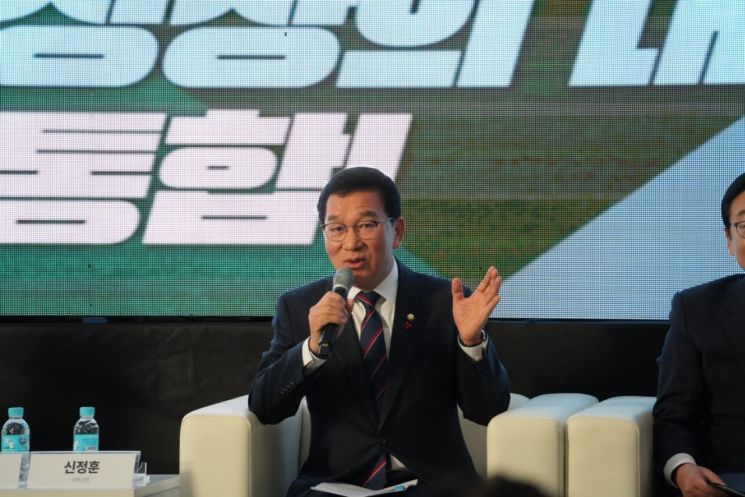 Shin Jeonghoon, Member of the National Assembly of the Democratic Party of Korea. Photo by Song Bohyun
Keynote speeches were delivered by Assemblyman Shin Jeonghoon and Munin, Mayor of Buk-gu, Gwangju, who presented the policy significance of administrative integration and outlined the future direction for its implementation.
Assemblyman Shin Jeonghoon of the Democratic Party of Korea began by addressing the political sector’s responsibility for the lack of sufficient groundwork in discussions on Gwangju-Jeonnam administrative integration. He pointed out that since the separation of the city and province, there have been repeated conflicts and wasteful competition over the allocation of national medical schools, industrial placements, and social infrastructure (SOC). In addition, the dualization of education, transportation, culture, and consumption activities has led to growing inconvenience due to the mismatch between living zones and administrative jurisdictions. He emphasized that this integration should serve as a turning point to deepen local autonomy and decentralization, and that institutional measures are needed to prevent disadvantages for rural areas.
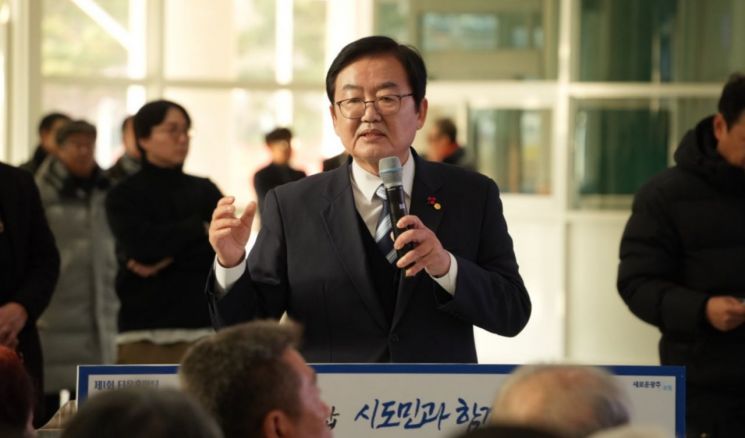
Munin, Mayor of Buk-gu, Gwangju, cited industry and energy issues as core reasons for integration. He explained that attracting strategic industries such as semiconductors and defense requires a solid foundation of electricity and energy, but under the current separation between city and province, there are structural limitations in responding to distributed energy policies and electricity trading. Despite Gwangju and Jeonnam sharing the same living and economic sphere, excessive competition has persisted in attracting industries and public institutions, and he argued that integration should transform this into a mutually beneficial structure. He added that regional issues such as population decline and the relocation of military airports also require an integrated approach.
The discussion continued with Shin Sujung, Chairperson of the Gwangju City Council, Choi Hyungsik, former Mayor of Damyang County, and Park Jaeman, Co-Representative of Participation Autonomy 21, joining the open debate.
The debate focused on major issues after integration, including: the timeline and phased tasks for administrative integration; directions for improving administrative efficiency and restructuring fiscal systems; expected changes in education, welfare, and industry; and ways to secure procedural legitimacy through citizen participation.
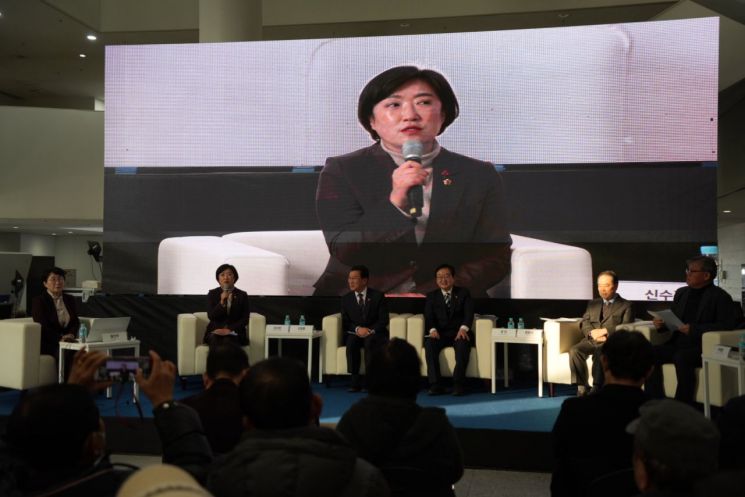
Shin Sujung, Chairperson of the Gwangju City Council, highlighted the symbolism of holding the administrative integration discussion at the city council, stating that integration is not a matter of choice but of survival given the population decline and risk of extinction facing Gwangju and Jeonnam. However, she stressed that, given the very rapid timeline, there must be sufficient collection of citizen opinions and deliberation throughout the process, including the proposal of special legislation, passage through the National Assembly, and resolutions by city and provincial councils. She argued that while speed is inevitable, transparent information disclosure and procedural legitimacy must go hand in hand.
Choi Hyungsik, former Mayor of Damyang County, defined the Gwangju-Jeonnam administrative integration as the starting point for transforming the national governance system. He stated that the central government-centered approach to national administration has reached its limits, and that integration should serve as a driving force for moving toward a decentralized state. He asserted that the special law must include the transfer of authority at the level of a federal system and a practical model for autonomous government, ensuring legislative and fiscal powers so that the integrated local government can make decisions and take responsibility independently. He also said that the special law should specify a legal body to continuously implement a mid- to long-term vision for the post-integration period.
Civil society called for a slowdown in the pace of integration discussions. Park Jaeman, Co-Representative of Participation Autonomy 21, pointed out that although administrative integration is a significant issue affecting all aspects of citizens’ daily lives, it is proceeding rapidly without sufficient explanation and deliberation. He noted that concerns are already emerging that the opinions of stakeholders in fields such as education and welfare are not being adequately reflected. While expressing support for administrative integration itself, he emphasized that it is the duty of the administration to thoroughly explain and discuss the integration process with citizens, highlighting the need for a resident consent procedure. He added that, to minimize conflicts after integration, legislation guaranteeing strong local fiscal authority and legislative power must be enacted in parallel.
© The Asia Business Daily(www.asiae.co.kr). All rights reserved.