Gemini Chosen as the Foundation Model for Apple Intelligence
Gemini to Be Deployed on Apple Devices Within the Year
Google Expected to Virtually Dominate Smartphone AI Market
Google, which has emerged as a new powerhouse in the global artificial intelligence (AI) market, has joined forces with Apple, its main rival in the Android phone segment. Apple, the largest competitor in the smartphone market with a highly loyal customer base, has adopted Google's AI model, Gemini. With Google AI, which possesses its own AI semiconductors and a wealth of training data based on its search engine, gaining Apple as a new partner, a major upheaval in the AI market is anticipated. On this day, Alphabet, Google's parent company, saw its stock price surge, pushing its market capitalization above $4 trillion (approximately 5,800 trillion won).
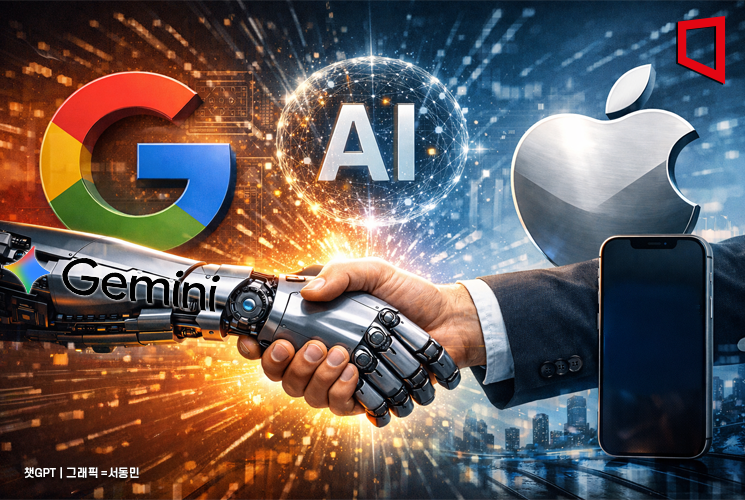
On January 12 (local time), Apple and Google issued a joint statement announcing, "We have signed an agreement to build the next-generation Apple AI foundation model based on Google's Gemini model and cloud technology." As a result, Apple AI services such as 'Apple Intelligence' and the personal assistant 'Siri' are expected to operate based on Gemini sometime this year.
The specific terms of the agreement have not been disclosed. However, foreign media previously reported in November of last year that the two companies were negotiating a deal estimated to be worth $1 billion (about 1.4 trillion won) annually. This means that users of Apple devices-including iPhones, iPads, and Macs, which are estimated to number over 2 billion-will likely be able to utilize Gemini.
The decision by Apple to adopt Google's AI model is attributed to the lack of competitiveness of 'Apple Intelligence.' Apple has been criticized for lagging behind its competitors in both AI model development and services, earning the label of a "latecomer" in AI. This stands in stark contrast to Android smartphones, such as Samsung's Galaxy, which have been rapidly introducing new AI features powered by Gemini. Even the agentic AI feature 'Personalized Siri,' which Apple promoted when unveiling Apple Intelligence in 2024, was initially scheduled for release last year but is now expected to launch sometime this year due to development delays.
The Gemini model that Apple has decided to use is known to have about 1.2 trillion parameters. This is ten times more than Apple's proprietary model, which currently powers Apple Intelligence with 150 billion parameters. The greater the number of parameters in an AI model, the better it performs complex computations and reasoning tasks. At present, Apple uses not only its own model for Apple Intelligence but also OpenAI's ChatGPT, routing user requests through ChatGPT when the queries are complex. While Apple utilizes both Google's and OpenAI's models, industry observers expect Gemini to become the primary model.
However, even if Apple devices use the Gemini model, it appears that users' data will not be used for model training. The Gemini model employed by Apple operates either as an 'on-device' model running solely within smartphones like the iPhone, or through Apple's proprietary servers called 'Private Cloud Compute,' which are isolated from external networks.
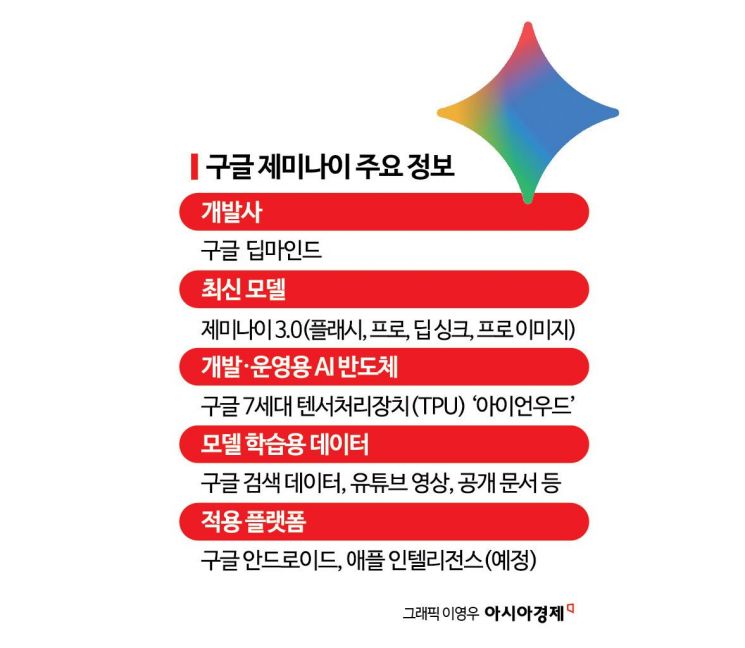
With Gemini being integrated into Apple Intelligence, Google's influence in the AI market is expected to grow even further. Google, through its subsidiary DeepMind, was an early entrant in the AI field, introducing the Go-playing AI 'AlphaGo.' However, Gemini's predecessor, Bard, performed significantly worse than ChatGPT, leading to the perception that Google was trailing OpenAI. With the subsequent release of Gemini, whose performance has now reached maturity, Google has become a competitive rival, and the Gemini 3.0 Pro released in November 2023 has surpassed the latest version of ChatGPT in performance. As Google is now poised to challenge OpenAI, the industry expects competition to intensify further.
As a result of this partnership, Google is expected to virtually dominate the smartphone AI market. Considering that the global smartphone operating system market is divided between Google Android and Apple iOS, Gemini will effectively be present on nearly every smartphone worldwide capable of running AI. An industry insider commented, "With Apple adopting Google's Gemini as the brain of its AI services, it is essentially seen as declaring the abandonment of its own AI development," adding, "As Apple, which was lagging in AI, reached out to Google, Google's AI territory has expanded even further."
Google is recognized for having a 'full AI stack,' with its own chips for AI model development and abundant data for training. It uses its self-developed AI accelerator, the Tensor Processing Unit (TPU), for both developing and running Gemini. The seventh-generation TPU, 'Ironwood,' unveiled by Google in November 2023, is considered a strong challenger to Nvidia, which dominates the AI semiconductor market. Google also has the advantage of leveraging the vast amounts of data collected through its global search engine and video platform YouTube for AI training and personalization.
Samsung Electronics is also considering using a new model in addition to its proprietary 'Gauss' and Google's Gemini for its Galaxy smartphones. According to major foreign media, Samsung plans to integrate Perplexity's model into its AI assistant service, Bixby, on Galaxy smartphones. Bixby powered by Perplexity is expected to be implemented starting with the Galaxy S26 series, which is scheduled to be unveiled at the end of next month.
© The Asia Business Daily(www.asiae.co.kr). All rights reserved.



















