"The administrative integration of Gyeongnam and Busan is a task of our time, but we must first gather the opinions of residents through a referendum, and proceed cautiously only after the status and authority following integration have been clearly secured."
The Gyeongnam Provincial Council announced this position regarding the ongoing discussions on administrative integration with Busan, lending support to Governor Park Wansu's perspective.
Previously, on January 6, Governor Park stated at a New Year's press conference that the legitimacy of administrative integration should be secured by collecting the opinions of city and provincial residents through a referendum, and that integration would be meaningless unless the authority and status of the integrated local government are guaranteed first.
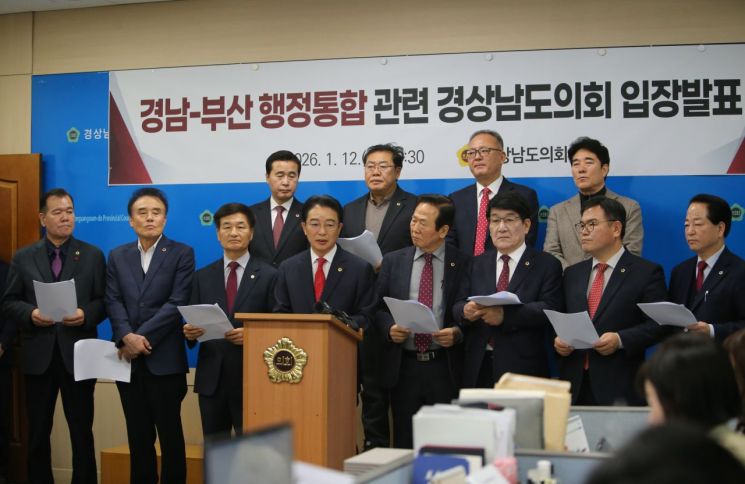 Chairman Choi Hakbeom and the leadership of the Gyeongnam Provincial Council are announcing their position on the promotion of administrative integration between Busan and Gyeongnam. Photo by Lee Seryeong
On January 12, Chairman Choi Hakbeom and 10 members of the council's leadership held a press conference in the council's briefing room, stating, "Administrative integration is an inevitable choice for the sustainable future and survival of our region, and it is the direction we must pursue in the long term. However, what is more important than the speed of progress is that the process must be meticulously prepared based on the trust of the residents."
They emphasized, "It must be completed based on the consent of residents, not through hasty political agreements," highlighting the need to pursue a referendum.
They further stated, "Administrative integration is not merely an adjustment of administrative boundaries; it is a decision that will have a significant impact on the identity, living environment, and fiscal structure of the region, affecting all aspects of the lives of city and provincial residents." They cited Article 18 of the current Local Autonomy Act, which stipulates that 'major decisions of local governments that impose excessive burdens or have significant impacts on residents may be put to a referendum.'
They continued, "According to the results of regional forums involving the Gyeongnam-Busan Administrative Integration Special Committee, public opinion among residents was far from unified," expressing concern that "pushing ahead with administrative integration without a process to unify these diverse voices is like building a castle on sand."
They stressed, "Along with the expected benefits of integration, concerns such as the concentration of infrastructure and reduced administrative accessibility must also be transparently presented and undergo a thorough process of public discussion."
They also asserted, "Simply merging administrative districts is meaningless. If the status and actual autonomy commensurate with a metropolitan integrated local government are not guaranteed, integration will only result in further inefficiency."
They called for "development privileges tailored to local conditions based on expanded finances, and institutional status appropriate for an integrated metropolitan local government," urging the central government to "carefully consider and clearly present the direction and authority that the integrated local government should pursue."
They pointed out, "There are significant differences between the administrative structures of Gyeongnam Province and Busan City, as well as their relationships with basic local governments," and set as prerequisites the review of the distribution of responsibilities and adjustment of authority, and the establishment in advance of legal and institutional measures to ensure the quality of administrative services after integration.
They reiterated, "Administrative integration is a major task that will determine the course of our region for the next century," emphasizing that "integration must be by the residents and for the residents of the city and province."
Additionally, they stated, "Rushing the process could lead to conflict, but thoroughly prepared integration could become a new opportunity for growth," and urged the central government to "transfer authority from central ministries, grant special privileges and incentives appropriate for the status of the integrated local government, and for Gyeongnam and Busan to engage in more communication with local residents regarding administrative integration."
Chairman Choi and others remarked, "With less than 150 days remaining before the June local elections, pushing ahead rapidly with administrative integration could cause inconvenience to residents," adding, "What matters more than speed is the right direction, and what is more important than political achievements is the lives and happiness of the residents."
© The Asia Business Daily(www.asiae.co.kr). All rights reserved.

















